


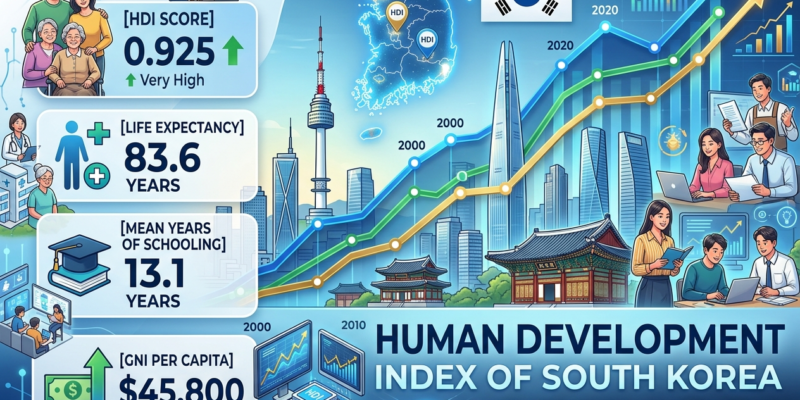
South Korea ranks among the world’s top nations on the Human Development Index (HDI), reflecting decades of rapid economic transformation, world-class education investment, and healthcare system development. For Indian students, professionals, and travelers considering South Korea, understanding the Human Development Index of South Korea offers critical insight into why this East Asian nation consistently attracts global talent and academic migration.
This blog covers everything you need to know about South Korea HDI ranking, its components, historical growth, and what it means for people planning to study in South Korea after 12th or pursue jobs in Korea for Indians.
What Is the Human Development Index (HDI)
The Human Development Index is a composite statistical measure developed by the United Nations Development Programme (UNDP) to assess the overall development of a country beyond simple economic metrics. Rather than measuring national wealth alone, the HDI evaluates three fundamental dimensions of human life.
The first dimension is a long and healthy life, measured through life expectancy at birth. The second dimension is access to knowledge, measured through mean years of schooling for adults aged 25 years and over and expected years of schooling for children entering school age. The third dimension is a decent standard of living, measured through Gross National Income (GNI) per capita adjusted for purchasing power parity.
Each dimension is scored between 0 and 1. The final HDI score is the geometric mean of these three normalized indices. A score above 0.800 classifies a country in the Very High Human Development category, which is where South Korea firmly sits.
South Korea HDI Score and Global Ranking in 2026
South Korea HDI score in the most recent UNDP Human Development Report stands at approximately 0.929, placing the country among the top 20 nations globally. South Korea is classified in the Very High Human Development tier, sharing rankings with nations such as Norway, Switzerland, Germany, and Australia.
South Korea HDI ranking has consistently improved over the past three decades, moving from a mid-range developing nation in the 1980s to one of the most developed countries in the world today. This dramatic improvement in South Korea human development index is a direct result of government policy prioritizing education, universal healthcare, and export-driven economic growth.
For anyone considering universities in South Korea for international students, this high HDI score translates directly into access to world-class academic infrastructure, research funding, and quality of campus life.
Three Core Pillars of South Korea Human Development Index
Life Expectancy at Birth
South Korea life expectancy at birth currently stands at approximately 83.7 years, one of the highest in Asia and among the top globally. Korean women have an average life expectancy of around 86.6 years, while Korean men live an average of approximately 80.5 years.
This exceptionally high life expectancy in South Korea reflects the strength of its universal healthcare system, called the National Health Insurance Service (NHIS), which covers nearly all citizens and legal residents. South Korea healthcare spending as a percentage of GDP has steadily increased, and the country has made massive investments in medical research, hospital infrastructure, and preventive health programs.
Education Index South Korea
The education component of South Korea HDI is perhaps its most impressive pillar. South Korea mean years of schooling stands at approximately 12.2 years, among the highest in the world. Expected years of schooling for children entering school in South Korea today is approximately 16.5 years, which again places South Korea in the global top tier.
South Korea literacy rate is effectively 99 percent across all adult age groups. The country invests heavily in public education, with private educational expenditure also being among the highest globally. The Korean education system, though often discussed for its intensity and competitive nature, produces graduates who consistently outperform peers from most nations in mathematics, science, and reading according to PISA assessments.
For Indian students interested in K-courses and academic programs, this educational excellence creates a highly stimulating academic environment with rigorous but rewarding curricula.
Gross National Income Per Capita South Korea
South Korea GNI per capita adjusted for purchasing power parity is approximately 44,500 USD, reflecting a high-income economy with robust domestic consumption, global export strength, and technological innovation. South Korea is home to globally recognized conglomerates such as Samsung, Hyundai, LG, and SK Group, which contribute significantly to its per capita income.
The country transitioned from one of the poorest nations in the world after the Korean War of the 1950s to a high-income OECD member within a single generation. This economic miracle underpins the income dimension of South Korea HDI and creates substantial opportunities for skilled international workers.
South Korea HDI Historical Growth from 1990 to 2026
The trajectory of South Korea human development index score tells the story of one of the most remarkable national transformations in modern history.
In 1990, South Korea HDI score was approximately 0.730, placing it in the high development category. By 2000, the score had risen to approximately 0.820 as the country recovered from the 1997 Asian financial crisis and continued expanding its education and health systems. The decade from 2000 to 2010 saw the score climb to approximately 0.880 as South Korea’s economy diversified into high-value manufacturing, technology, and services.
From 2010 to 2020, South Korea HDI reached the 0.910 to 0.925 range, driven by further improvements in life expectancy and rising GNI per capita. By 2026, South Korea HDI score of approximately 0.929 reflects a mature, highly developed society with ongoing improvements in health technology, digital infrastructure, and educational attainment.
This consistent upward trend in South Korea human development demonstrates that the country’s development gains have been sustained, broad-based, and structurally embedded in institutional systems rather than dependent on temporary resource booms.
Education Index of South Korea: Why Korean Schools Lead the World
South Korea education index is a subject of global fascination and significant academic study. The country’s near-obsessive investment in education is culturally rooted in Confucian values that prize academic achievement, discipline, and merit-based advancement.
South Korea school enrollment rates are extremely high across all levels. Primary school enrollment is essentially universal. Secondary school enrollment rates exceed 95 percent. Tertiary education enrollment in South Korea is among the highest in the OECD, with approximately 70 percent of high school graduates going on to university or post-secondary education.
The Korean government invests approximately 4.5 to 5 percent of GDP in education annually. Private households also spend an extraordinary share of income on private tutoring, called Hagwon, which is a supplementary private education sector generating billions of dollars annually.
South Korea university rankings reflect this investment. Seoul National University, Korea University, and Yonsei University are consistently ranked among Asia’s top institutions. KAIST and POSTECH are globally recognized for science and technology research. These institutions attract thousands of international students each year, many of whom come from India through structured scholarship programs.
Indian students exploring student life in South Korea will find a campus culture that emphasizes both academic rigor and community engagement, with strong support networks for international students across major universities.
South Korea Life Expectancy and Health Index Explained
South Korea health system is a cornerstone of its high HDI score. The country achieved universal health coverage in 1989, making it one of the first Asian nations to do so. The National Health Insurance system operates on a compulsory enrollment basis, meaning virtually every resident in South Korea is covered for essential medical services.
South Korea life expectancy improvements over the past 50 years have been dramatic. In 1970, South Korean life expectancy at birth was approximately 62 years. By 2000, it had risen to 76 years. Today, South Korea life expectancy of approximately 83.7 years represents a gain of over 20 years within a single lifetime.
Key factors driving South Korea’s exceptional health outcomes include universal access to preventive care, high rates of cancer screening, low obesity rates compared to Western nations, a diet rich in fermented and vegetable-based foods, strong public health infrastructure, and a culture that encourages regular health check-ups.
South Korea infant mortality rate stands at approximately 2.5 per 1,000 live births, one of the lowest in the world. South Korea maternal mortality ratio is also extremely low, reflecting the quality of obstetric care available across the country.
South Korea’s investment in medical research and biotechnology has produced globally competitive pharmaceutical and medical device industries, further reinforcing the health infrastructure that supports strong life expectancy outcomes.
South Korea GNI Per Capita and Income Index
South Korea income index within the HDI framework reflects the country’s transformation into a high-income knowledge economy. With a GNI per capita of approximately 44,500 USD (PPP), South Korea’s standard of living far exceeds global averages and is comparable to many Western European nations.
The Korean economy is characterized by a highly educated workforce, dominant export sectors in semiconductors, automobiles, shipbuilding, and consumer electronics, and a rapidly growing digital services sector. South Korea is a founding member of the G20 and a member of the OECD, the club of wealthy developed nations.
For Indian professionals exploring jobs in Korea for Indians, this high income environment means competitive salaries relative to Indian pay scales, particularly in technology, engineering, manufacturing, and teaching sectors. The 1 Indian Rupee to South Korean Won exchange rate further illustrates the economic gap and the financial benefit of working in South Korea.
South Korea minimum wage has been increasing annually. In 2026, the minimum wage in South Korea is set at approximately 10,030 Korean Won per hour. For skilled professionals, average monthly salaries in technology and engineering sectors range from 3 million to 7 million Korean Won, representing a substantial premium over comparable roles in India.
How South Korea HDI Compares with India, Japan, and the United States
Comparing South Korea HDI with peer nations provides important context for understanding its developmental achievement.
India HDI score in 2026 is approximately 0.644, placing India in the medium human development category. This reflects India’s strong performance in some dimensions such as economic growth but ongoing challenges in health outcomes, educational attainment, and income distribution. The gap between South Korea HDI of 0.929 and India HDI of 0.644 illustrates why South Korea is such an attractive destination for Indian students and workers.
Japan HDI score is approximately 0.925, which is very close to South Korea. Both nations demonstrate the effectiveness of the East Asian development model combining state investment in education and health with export-oriented industrial policy. Japan’s higher life expectancy is partially offset by South Korea’s stronger performance in education and recent income growth.
United States HDI score is approximately 0.927, placing it very close to South Korea as well. The similarity in scores despite the enormous difference in GDP per capita reflects the fact that HDI adjusts for diminishing returns at very high income levels and penalizes inequality in health and education outcomes.
Norway HDI score, consistently the highest in the world, is approximately 0.966. The Nordic social welfare model, with universal services and low inequality, explains the gap between Norway and South Korea.
South Korea HDI and Opportunities for International Students
For international students, particularly those from India, South Korea’s high HDI has concrete practical implications. It means excellent university infrastructure, well-funded research laboratories, healthy and safe living conditions, accessible public transportation, and a dynamic urban environment.
South Korea government scholarship programs such as the Global Korea Scholarship (GKS) actively recruit international students from developing nations including India. These scholarships cover tuition, living expenses, and language training, making South Korea one of the most financially accessible high-HDI destinations for graduate students from India.
Universities in South Korea for international students offer programs across engineering, medicine, business, humanities, and arts. Many courses are available in English, particularly at the graduate level, removing the language barrier that might otherwise limit access.
The K-culture environment adds a layer of cultural richness to the study experience. South Korea’s global influence through K-pop, Korean cinema, Korean drama, and Korean food has made it one of the most culturally dynamic destinations in the world.
Understanding South Korean K-manners and social customs is equally important for international students seeking to integrate effectively into campus and community life.
Gender Development Index in South Korea
South Korea Gender Development Index (GDI) presents a more complex picture than the overall HDI. While South Korea performs extremely well on overall human development, gender gaps persist in labor market participation and political representation.
South Korea female labor force participation rate is approximately 54 percent, lower than the OECD average of approximately 64 percent. South Korea gender pay gap remains one of the largest in the OECD, with women earning on average approximately 31 percent less than men in equivalent positions.
However, South Korea gender gaps in education have been effectively eliminated at the primary and secondary levels. Women in South Korea are now more likely than men to complete tertiary education. The gap between male and female educational attainment has closed almost entirely in younger generations.
South Korea government has implemented various policies to address gender inequality in the labor market, including expanded parental leave entitlements, public childcare subsidies, and anti-discrimination enforcement in hiring. Progress has been measurable but slower than many other high-HDI nations.
South Korea female life expectancy significantly exceeds male life expectancy, at approximately 86.6 years versus 80.5 years for men. This female longevity advantage is consistent with global patterns but is particularly pronounced in South Korea.
South Korea Inequality-Adjusted Human Development Index
The Inequality-Adjusted Human Development Index (IHDI) accounts for inequality in the distribution of health, education, and income outcomes across a population. South Korea IHDI score is approximately 0.821, reflecting a moderate level of inequality-related loss compared to the overall HDI score.
South Korea Gini coefficient, a measure of income inequality, stands at approximately 0.355. This places South Korea in the middle range among OECD nations, more equal than the United States but less equal than the Nordic countries. Income inequality in South Korea is driven partly by the gap between large conglomerate employees and workers in small and medium enterprises, and partly by regional income differences between Seoul and rural areas.
Educational inequality in South Korea is relatively low compared to its income inequality. The public school system provides a broadly similar quality of education across regions, though private tutoring creates supplementary advantages for wealthier families.
Health inequality in South Korea is also relatively contained due to the universal health insurance system, which prevents significant gaps in access to basic medical care based on income level.
What South Korea HDI Means for Indian Students and Workers
For Indian nationals considering South Korea as a destination for study, work, or long-term migration, the country’s high Human Development Index is more than an abstract statistic. It reflects a concrete reality of safe streets, functional public services, reliable infrastructure, accessible healthcare, and high-quality educational institutions.
10 differences between North and South Korea that first-time visitors often notice are partly explained by the HDI gap between the two nations, where South Korea’s development trajectory has diverged dramatically from the North.
South Korea’s famous cultural landmarks, food, and places are also products of a high-development society where citizens have disposable income, leisure time, and cultural investment to sustain vibrant arts, cuisine, and tourism ecosystems.
For those planning a visit before committing to long-term study or work, a 7-day South Korea itinerary provides a ground-level experience of the development outcomes that HDI statistics describe in aggregate.
Practical financial preparation, including understanding the Indian Rupee to Korean Won exchange rate, is an essential step for anyone moving from India to South Korea whether for study or employment.
Key Takeaways on the Human Development Index of South Korea
South Korea HDI score of approximately 0.929 places it firmly among the world’s most developed nations. This score is the product of a long and healthy life expectancy exceeding 83 years, a highly educated population with nearly universal literacy and high tertiary enrollment, and a per capita income exceeding 44,000 USD in purchasing power parity terms.
South Korea’s development journey from post-war poverty to global high-HDI status within 60 years is one of the most studied cases in development economics. The lessons of this journey, prioritizing human capital investment, maintaining universal health access, and building export-competitive industries, continue to shape South Korean policy and society.
For Indian students and professionals, South Korea represents one of the most accessible and rewarding high-HDI destinations globally, offering world-class education, competitive employment opportunities, cultural richness, and a standard of living that consistently ranks among the highest in Asia and the world.
Frequently Asked Questions About South Korea Human Development Index
What is South Korea HDI rank in the world?
South Korea ranks approximately 19th to 23rd globally on the Human Development Index, varying slightly by the edition of the UNDP report. The country is firmly in the Very High Human Development tier with a score near 0.929.
How does South Korea HDI compare to India?
South Korea HDI of approximately 0.929 significantly exceeds India HDI of approximately 0.644. This 0.285-point gap reflects differences in life expectancy, educational attainment, and income levels between the two countries.
Why is South Korea HDI so high?
South Korea HDI is high due to universal healthcare coverage since 1989, one of the world’s most educated workforces, consistent economic growth driven by technology and manufacturing exports, and strong public investment in education and research.
Is South Korea a good country for Indian students based on HDI?
Yes. South Korea’s high HDI directly translates into quality university infrastructure, safe living conditions, accessible healthcare for registered students, and strong labor market outcomes after graduation. Combined with government scholarship programs, it is one of the best high-development destinations for Indian students.
What is South Korea life expectancy in 2026?
South Korea average life expectancy is approximately 83.7 years, with women averaging approximately 86.6 years and men approximately 80.5 years.