

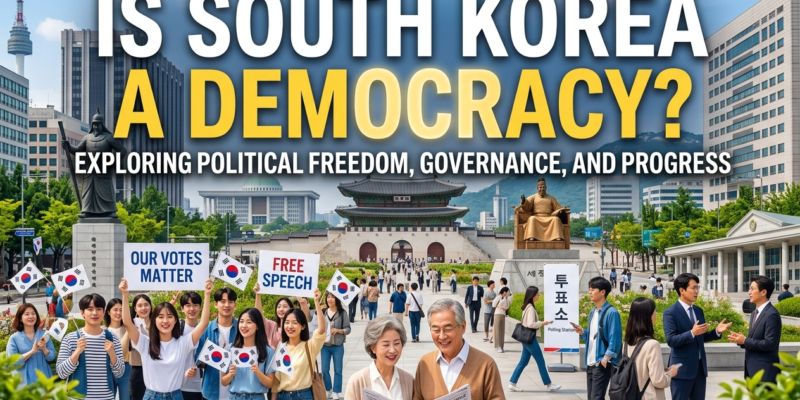
South Korea operates as a presidential representative democratic republic with regular elections and power transitions. Understanding if South Korea is a democracy helps international students and travelers assess political stability for study in South Korea after 12th. This guide examines its democratic framework, history, and current status.
Is South Korea a Democracy: Core Political Structure
Presidential Republic System in South Korea Democracy
South Korea functions as a unitary presidential republic where the president serves as head of state and government. The National Assembly holds legislative power through multi-party elections every four years. Presidents serve single five-year terms, preventing long-term power concentration.
This structure aligns with democratic principles of separation of powers and checks and balances. Citizens over 18 vote in direct presidential elections, ensuring broad participation.
Multi-Party System in South Korea Democracy
South Korea maintains a competitive multi-party system with major parties like the Democratic Party and People Power Party. Independent candidates and smaller parties also participate in elections. The system allows opposition voices in parliament, a key feature of whether South Korea is a democracy.
Election oversight by the National Election Commission ensures transparency and prevents fraud. Voter turnout consistently exceeds 70 percent in national elections.
Historical Journey: When Did South Korea Become a Democracy
Transition from Military Rule to South Korea Democracy
South Korea established its democratic foundation in 1948 after liberation from Japanese rule. Military dictatorships dominated from 1961 to 1987 under Park Chung-hee and Chun Doo-hwan. The June Democratic Struggle of 1987 forced constitutional reforms, creating the Sixth Republic.
Direct presidential elections began in 1987 with Roh Tae-woo’s victory. Since then, South Korea has seen seven peaceful power transitions, confirming its status as a democracy.
Key Milestones in South Korea Democracy Timeline
| Year | Event | Impact on South Korea Democracy |
|---|---|---|
| 1948 | First Republic established | Formal democratic constitution |
| 1987 | Sixth Republic Constitution | Direct presidential elections |
| 1997 | Kim Dae-jung elected | First opposition president |
| 2017 | Park Geun-hye impeached | First female president removed democratically |
These milestones demonstrate South Korea’s evolution into a consolidated democracy.
South Korea Democracy Rankings and Global Assessment
International Democracy Indices for South Korea
The Economist Intelligence Unit classifies South Korea as a full democracy. V-Dem Institute ranks it among Asia’s top electoral and liberal democracies. Freedom House scores South Korea 83/100 for political rights and civil liberties.
Despite high rankings, challenges persist in judicial independence and media freedom. These metrics confirm South Korea qualifies as a democracy with room for improvement.
Comparison: South Korea vs Regional Democracies
| Country | Democracy Index Score | Electoral Process | Civil Liberties |
|---|---|---|---|
| South Korea | Full Democracy | Very High | High |
| Japan | Full Democracy | High | High |
| Taiwan | Full Democracy | Very High | High |
| North Korea | Authoritarian | None | None |
This comparison highlights South Korea democracy strengths relative to 10 differences between North and South Korea.
Current Challenges Facing South Korea Democracy 2026
Political Polarization in South Korea Democracy
South Korea experiences elite polarization between conservative and progressive factions. Recent impeachments of Presidents Park Geun-hye (2017) and Yoon Suk-yeol (2025) reflect institutional resilience but also political tension. The 2025 snap election demonstrated democratic mechanisms functioning under crisis.
Public trust in institutions rebounded in 2026 polls, with 23 percent improvement in government confidence. These events test but ultimately strengthen South Korea’s democratic framework.
Rule of Law and Institutional Strength
South Korea maintains mid-to-high range performance in rule of law according to global indices. The Constitutional Court independently rules on impeachment cases. Military remains subordinate to civilian control post-2024 martial law attempt.
Judicial reforms continue to address prosecutorial power concentration. These developments affirm South Korea democracy institutional maturity.
Democratic Institutions Powering South Korea Democracy
National Assembly Role in South Korea Democracy
The 300-seat unicameral National Assembly legislates, approves budgets, and checks executive power. Proportional representation ensures diverse voices. Committee system provides legislative oversight of government ministries.
Assembly approval required for key appointments maintains democratic accountability. Regular sessions broadcast publicly enhance transparency.
Independent Institutions Supporting South Korea Democracy
- Constitutional Court: Reviews laws and presidential impeachments
- Board of Audit and Inspection: Monitors government spending
- National Election Commission: Oversees fair elections
- Anti-Corruption Commission: Prevents public sector graft
These bodies collectively sustain South Korea’s democratic governance.
Civil Liberties and Rights in South Korea Democracy
Freedom of Expression in South Korea Democracy
South Korea guarantees press freedom with over 400 daily newspapers and numerous broadcasters. Internet penetration exceeds 96 percent with minimal censorship. Public demonstrations occur regularly without state interference.
Constitutional protections ensure freedom of assembly and association. These rights form the foundation of whether South Korea is a democracy.
Political Participation Rights
Universal suffrage applies to citizens over 18. Women hold 19 percent of National Assembly seats. Youth quotas encourage political engagement. Referendum mechanisms exist for constitutional changes.
Inclusive participation confirms South Korea democracy vibrancy.
Economic Development and South Korea Democracy Relationship
Democracy Enabling Economic Miracle
South Korea transformed from war-torn poverty to global economic power under democratic consolidation. Democratic accountability drove anti-corruption reforms essential for investment. Rule of law protected property rights fueling growth.
For Indians exploring jobs in Korea for Indians, stable democracy ensures employment security.
Stable Governance Attracting Investment
Democratic institutions provide policy predictability crucial for foreign direct investment. Transparent legal systems protect business interests. Regular elections maintain government accountability to economic stakeholders.
Implications for International Students: South Korea Democracy Benefits
Campus Political Freedom
Universities in South Korea for international students operate with academic freedom. Student governments elect representatives democratically. Campus protests address policy concerns peacefully.
Democratic environment fosters critical thinking essential for global education.
Visa and Residency Security
Democratic governance ensures consistent immigration policy application. Rule of law protects international student rights. Transparent visa processes benefit Indian applicants aware of 1 Indian Rupee in South Korea currency.
South Korea Democracy vs Authoritarian Neighbors
Clear Distinctions from North Korea
Unlike North Korea’s hereditary dictatorship, South Korea holds competitive elections. Free media contrasts with state propaganda. Individual rights replace collective control. These factors answer definitively if South Korea is a democracy.
Travelers planning South Korea itinerary 7 days experience democratic openness immediately.
Regional Democratic Leadership
South Korea models democratic consolidation for Asia. Peaceful power transitions set regional standard. Institutional resilience withstands crises. Global recognition affirms democratic maturity.
Practical Implications: Why South Korea Democracy Matters
For Indian Students and Professionals
Democratic stability ensures education quality consistency. Rule of law protects international contracts. Free expression facilitates cultural adaptation. Political predictability aids long-term planning.
Explore student life in South Korea within this secure democratic framework.
Travel and Business Confidence
Democratic governance guarantees personal safety. Transparent regulations simplify business operations. Independent judiciary resolves disputes fairly. Political stability attracts tourism and investment.
Conclusion: Affirmative Answer to Is South Korea a Democracy
South Korea unequivocally qualifies as a full democracy with robust institutions and active citizen participation. Despite challenges, democratic resilience demonstrated through crisis management confirms system strength. International students benefit from stable governance supporting K-courses.
For personalized guidance on studying or working in South Korea’s democratic environment, visit our services or contact our team. Learn about K-culture and K-manners thriving under democratic freedoms.