

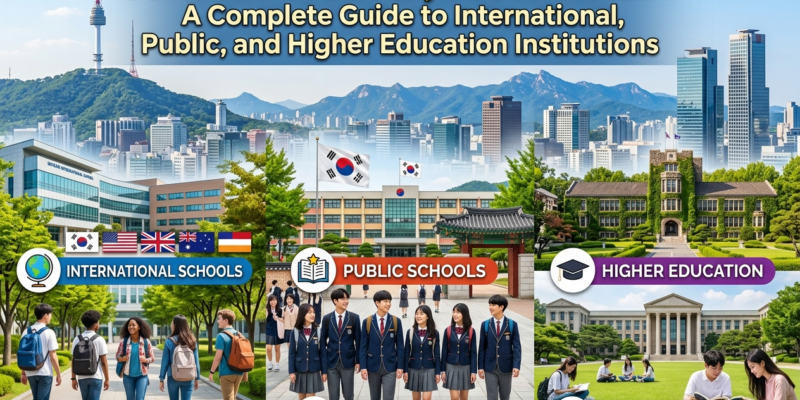
Seoul, the capital of South Korea, is home to one of the most advanced and competitive education systems in the world. Whether you are an Indian family planning to relocate, a student seeking higher education, or a parent researching schooling options for children accompanying you on a study or work visa, understanding the school landscape in Seoul is essential. This guide covers international schools, public education, prestigious universities, and what the Seoul academic environment means for students coming from abroad.
Overview of the Education System in Seoul South Korea
South Korea’s education system is globally recognized for its rigor, discipline, and outcomes. Seoul, as the country’s capital and most populated city, concentrates the highest density of educational institutions ranging from kindergartens and elementary schools to some of the most competitive universities in Asia.
The Korean national education structure follows a 6-3-3-4 system: six years of elementary school, three years of middle school, three years of high school, and four years of undergraduate study. Education is compulsory through middle school, and attendance rates at all levels are among the highest in the world.
Public schools in Seoul operate in the Korean language, making them less accessible to newly arrived international students or those without Korean language proficiency. This is why international schools play a critical role for expatriate families and students from countries including India, the United States, China, Japan, and various European nations.
Top International Schools in Seoul South Korea
Seoul International School
Seoul International School, located in Seongnam near the Seoul metropolitan area, is one of the most established international institutions in Korea. It follows the American curriculum and offers programs from pre-kindergarten through Grade 12. The school is accredited by the Western Association of Schools and Colleges and the Council of International Schools. It is highly regarded for its college placement record, with graduates gaining admission to universities across the United States, Canada, and the United Kingdom.
Korea International School
Korea International School operates multiple campuses in Seoul and Pangyo, offering an American-style curriculum. It is known for its strong extracurricular programs, diverse student body, and dedicated faculty drawn from international teaching backgrounds. The school prepares students for SAT, AP examinations, and university applications to English-medium institutions worldwide.
Seoul Foreign School
Seoul Foreign School is one of the oldest international schools in Korea, founded in 1912. It offers both the British national curriculum and the International Baccalaureate program. The school serves students from numerous nationalities and maintains strong academic standards across primary and secondary levels.
Yongsan International School of Seoul
Yongsan International School serves the Christian expatriate community and follows a US-accredited curriculum. It offers education from kindergarten through high school in English and is known for its community-focused approach and pastoral care for students adjusting to life in Korea.
Dwight School Seoul
Dwight School Seoul is part of the global Dwight Schools network and offers the International Baccalaureate curriculum at all three levels: Primary Years Programme, Middle Years Programme, and Diploma Programme. It attracts students seeking a globally recognized qualification with a strong emphasis on inquiry-based learning.
Public Schools in Seoul for Korean-Speaking Students
For students who are fluent in Korean or committed to learning the language, public schools in Seoul offer high-quality education at no tuition cost for legal residents. Public elementary and middle schools are assigned based on residential district. High school admissions in Seoul involve a lottery or examination-based system depending on the school type.
Special-purpose high schools in Seoul are highly competitive institutions designed for students with exceptional aptitude in specific areas such as science, foreign languages, arts, and physical education. These include:
Foreign language high schools such as Seoul Foreign Language High School and Daewon Foreign Language High School, which produce many of South Korea’s diplomats, translators, and internationally oriented professionals.
Science high schools including Hansung Science High School, designed to nurture students with demonstrated talent in mathematics and natural sciences, feeding directly into elite university science and engineering programs.
Arts high schools such as Seoul Arts High School, which train students in music, visual arts, dance, and theatrical performance from an early age.
Universities and Higher Education Institutions in Seoul
Seoul is home to the most prestigious universities in South Korea and among the top-ranked institutions in Asia. For Indian students considering higher education in South Korea, these universities represent exceptional academic and career launch opportunities.
Seoul National University
Seoul National University is consistently ranked as South Korea’s top university and among the leading universities in Asia. It offers undergraduate, graduate, and doctoral programs across all major academic disciplines. Programs in engineering, medicine, law, business, and social sciences attract students from across the world. Government scholarships such as the Global Korea Scholarship frequently place international students at Seoul National University.
Yonsei University
Yonsei University is one of the three SKY universities, a colloquial term in Korean academic culture referring to Seoul National University, Korea University, and Yonsei University. It has a strong international reputation, a dedicated Underwood International College offering English-medium programs, and active exchange partnerships with universities globally.
Korea University
Korea University is the third institution in the SKY grouping. Known for its strong alumni network in Korean business and government, it offers English-medium graduate programs and has a particularly strong reputation in law, business, and political science.
Sungkyunkwan University
Sungkyunkwan University, one of the oldest educational institutions in Korea with roots dating to the Joseon dynasty, has emerged as a leading research university with strong programs in engineering, business, and natural sciences. It maintains significant corporate partnerships, particularly with Samsung, which contributes to research funding and graduate employment pathways.
Hanyang University
Hanyang University is known particularly for its engineering and industrial science programs. It has campuses in Seoul and Ansan and a growing reputation for applied research in robotics, automotive technology, and information engineering.
For detailed information about courses available for international students at Korean universities, including application processes and scholarship options, visiting a dedicated resource for Indian students can provide targeted guidance.
Admission Process for International Students at Seoul Schools
For international schools in Seoul, admission processes vary by institution but generally include:
Submission of academic transcripts from previous schools, which should ideally be in English or accompanied by certified translations. Many international schools in Seoul accept transcripts in other languages with notarized translations.
Proof of English language proficiency, especially for American and British curriculum schools. Some institutions administer their own placement assessments to determine appropriate grade or course level.
Letters of recommendation from previous teachers or school administrators are commonly required for high school admissions.
Student interviews, either in person or online, are increasingly common as schools assess fit and readiness for their academic programs.
For university admissions at Korean institutions, international students typically apply through the dedicated foreign student admissions track, which differs from the domestic admissions process. Requirements include academic transcripts, language proficiency certificates in either Korean or English depending on the program, a personal statement, and letters of recommendation.
Life as a Student in Seoul Schools
Students attending schools in Seoul, whether at international schools or Korean public institutions, benefit from one of the most technologically equipped and academically stimulating environments in the world. Seoul schools are well-resourced, with modern facilities, extensive library collections, sports complexes, and extracurricular programs spanning robotics, debate, music, athletics, and community service.
The competitive academic culture of Seoul is well-documented globally. Korean students attend private tutoring academies known as hagwons after regular school hours, reflecting the high premium Korean families place on academic achievement. For international students, this environment can be motivating as well as intense, requiring thoughtful time management and access to adequate support structures.
Understanding Korean cultural norms and manners is important for students integrating into Seoul school communities. Respect for teachers, group-oriented learning styles, and awareness of hierarchical social dynamics within student groups are all aspects of the school culture that international students benefit from learning in advance.
Cost of Schooling in Seoul for International Students
International school tuition in Seoul is comparable to similar institutions in other major global cities. Annual tuition at established international schools typically ranges from approximately 15 million Korean Won to 30 million Korean Won per year depending on grade level and institution. Additional costs include enrollment fees, facilities charges, textbooks, uniforms, and extracurricular activity fees.
Public school education for children of legal residents in South Korea is provided at no tuition cost through middle school, though incidental costs including supplies, meal programs, and optional activities apply.
University tuition varies considerably by institution and program. National universities such as Seoul National University have relatively lower tuition compared to private institutions. For international students, tuition at Korean universities ranges from approximately 3 million to 8 million Korean Won per semester for undergraduate programs.
Scholarship Opportunities for International Students at Seoul Schools
The Korean government, through the National Institute for International Education, administers the Global Korea Scholarship program, which covers tuition, accommodation, a monthly stipend, airfare, and Korean language training for selected international students. This scholarship covers both undergraduate and graduate level study at designated Korean universities.
Many universities including Yonsei, Korea University, and Sungkyunkwan offer their own merit-based scholarship programs for international applicants, covering partial or full tuition. For Indian students specifically, exploring scholarship pathways before applying can significantly reduce the financial burden of studying in Seoul.
Conclusion
Schools in Seoul South Korea represent a diverse and high-quality educational ecosystem spanning international institutions following Western curricula, competitive Korean public schools, specialized high schools for gifted students, and world-class universities. For Indian families and students planning to build a future in South Korea, understanding this landscape is the first step toward making informed decisions about education pathways.
To explore more about living and studying in Seoul, including accommodation, cultural adjustment, and academic programs designed for international students, visit studyinsouthkorea.in for comprehensive guidance tailored to Indian students and families.