


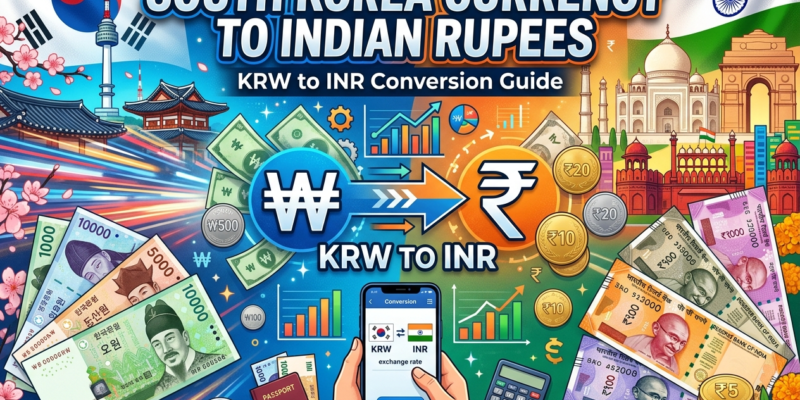
Understanding the difference between South Korea currency and Indian currency is one of the first practical steps every Indian student, tourist, or professional must take before planning a trip or study abroad journey to South Korea. The Korean Won (KRW) and the Indian Rupee (INR) have a significant exchange rate gap, and knowing how to handle this difference can save you thousands of rupees and a great deal of confusion.
This detailed guide covers everything from the current KRW to INR exchange rate to money transfer tips, daily budgeting, and cost comparisons between both countries.
What Is the Official Currency of South Korea
The official currency of South Korea is the Korean Won, commonly written as KRW or represented by the symbol ₩. The Korean Won is issued and regulated by the Bank of Korea, which is the central bank of the country. The Won has been in circulation since 1962 and replaced the old Hwan currency system.
Korean Won coins come in denominations of 10, 50, 100, and 500 Won, while banknotes are available in 1,000, 5,000, 10,000, and 50,000 Won notes. The 50,000 Won note is the highest denomination and features the portrait of Shin Saimdang, a famous artist and mother of the Joseon dynasty scholar Yulgok.
For Indian students and travelers, understanding the face value of Korean Won is critical because prices in South Korea appear large in numerical terms but are actually moderate when converted to Indian Rupees.
Current South Korea Currency to Indian Rupee Exchange Rate in 2026
As of mid-2026, the approximate exchange rate between South Korean Won and Indian Rupee is as follows:
1 KRW = approximately 0.062 to 0.065 INR
1 INR = approximately 15.5 to 16.2 KRW
This means that if you convert 10,000 Indian Rupees, you will receive approximately 155,000 to 162,000 Korean Won. While this might seem like a large amount in Korean Won, it is important to remember that everyday items in South Korea are priced in thousands of Won.
Exchange rates fluctuate daily based on global currency markets, US dollar performance, Reserve Bank of India policies, and Bank of Korea interventions. Always check a reliable financial platform such as Google Finance, XE.com, or your bank’s official rate before making any conversion.
For Indian students who are planning to study in South Korea for international students, keeping track of this exchange rate is essential for budgeting tuition fees, accommodation, and daily living costs.
Historical Overview of KRW vs INR Exchange Rate
The Korean Won and Indian Rupee have historically maintained a relatively stable relationship with minor fluctuations. A decade ago, 1 KRW was worth roughly 0.054 to 0.058 INR. Over the years, as both economies have grown, the exchange rate has seen gradual movement.
South Korea has consistently maintained a strong economy driven by technology exports, semiconductor manufacturing, and global brands like Samsung, LG, and Hyundai. India, on the other hand, has seen rapid GDP growth but also experienced inflationary pressures on the Rupee. These macroeconomic factors together shape the KRW to INR exchange rate on a long-term basis.
For anyone considering long-term commitments such as a degree program or employment in South Korea, understanding historical trends helps in financial planning and choosing the right time to transfer funds.
How to Convert Indian Rupees to Korean Won: Best Methods for Indians
There are several ways to convert INR to KRW. Each method comes with its own cost structure, convenience level, and exchange rate margin.
Bank Wire Transfer
The most reliable and widely used method for sending large amounts is a bank wire transfer. Indian banks such as SBI, HDFC, and ICICI offer international wire transfer services. However, the exchange rate offered by banks often includes a margin of 2 to 4 percent above the mid-market rate, plus a fixed transaction fee.
Forex Cards Loaded with KRW
Multi-currency forex cards offered by banks and fintech companies like BookMyForex and ExTravelMoney allow you to load Korean Won before departure. These cards are widely accepted at ATMs and merchant terminals in South Korea.
Online Money Transfer Platforms
Platforms like Wise (formerly TransferWise), Remitly, and InstaReM offer better exchange rates than traditional banks and charge lower fees. These platforms are particularly useful for Indian students working in Korea who need to send money home or receive funds from family.
Currency Exchange at Airports and Moneychangers
Exchanging cash at Indian or Korean airports is the most convenient but typically the most expensive option. Airport forex counters charge a premium, and the exchange rate is often 3 to 6 percent worse than the mid-market rate. Authorized money changers in major cities like Seoul offer better rates and should be the preferred option when exchanging cash.
ATM Withdrawals in South Korea
Most ATMs in South Korea, especially those at global banks, convenience stores like CU and GS25, and major post offices, accept international cards. However, foreign transaction fees and ATM withdrawal charges can add up. Always choose to withdraw in local currency (KRW) and decline dynamic currency conversion when prompted.
Cost of Living Comparison: South Korea vs India
One of the most common questions asked by Indian students and travelers is how the cost of living in South Korea compares with that in India. The short answer is that South Korea is significantly more expensive than India, but the quality of infrastructure, safety, healthcare, and public services is also considerably higher.
Monthly Expenses for an Indian Student in South Korea
Accommodation in a university dormitory ranges from 150,000 to 400,000 KRW per month, which translates to approximately 9,750 to 26,000 INR. Off-campus shared apartments cost between 300,000 and 600,000 KRW per month.
Food expenses in South Korea are manageable if you eat at local Korean restaurants or convenience stores. A meal at a local restaurant costs between 7,000 and 12,000 KRW, equivalent to roughly 455 to 780 INR. Cooking at home significantly reduces this cost.
Public transportation in cities like Seoul and Busan is extensive, affordable, and efficient. A single subway or bus ride costs around 1,400 KRW, which is approximately 90 INR. Monthly transit passes are available at lower rates.
Mobile phone plans in South Korea start from around 20,000 to 50,000 KRW per month, depending on data allowance and carrier.
Overall, an Indian student in South Korea should budget between 600,000 and 900,000 KRW per month for basic living expenses excluding tuition, which is approximately 39,000 to 58,500 INR.
Comparison with India
The same standard of living in a metropolitan Indian city like Mumbai or Delhi would cost considerably less in Rupee terms. However, the income potential in South Korea through part-time work and scholarships often compensates for the higher cost. Indian students who plan their finances carefully often find South Korea to be a manageable and rewarding destination.
Price Comparison of Common Items: South Korea vs India
Understanding how specific everyday items are priced in South Korea in comparison to India helps Indian visitors adjust quickly.
Food and Grocery Prices
A cup of coffee at a Korean cafe costs around 3,500 to 5,000 KRW, which is 228 to 325 INR. A 1-litre bottle of water from a convenience store costs approximately 1,000 KRW or 65 INR. Rice, a staple in both countries, is priced at around 4,000 to 6,000 KRW per kilogram in South Korea, compared to 35 to 60 INR per kilogram in India.
Electronics and Shopping
South Korea is home to some of the world’s best electronics at competitive prices. Smartphones, laptops, and home appliances from Korean brands are often available at lower prices in South Korea than in India, especially considering the import duties charged in India. Duty-free shopping at Incheon International Airport offers further savings.
Healthcare
South Korea has a national health insurance system. International students enrolled in Korean universities are generally covered under the national health insurance program, and out-of-pocket medical expenses are significantly lower than in most Western countries. A general doctor’s consultation costs around 5,000 to 15,000 KRW, which is 325 to 975 INR.
Tips for Indians Managing KRW Expenses in South Korea
Managing money wisely is critical for Indian students and travelers. Here are practical recommendations:
Always carry some Korean Won cash because smaller establishments, traditional markets, and some local eateries do not accept card payments. While South Korea is a highly digitized economy and mobile payment apps like Kakao Pay are widely used, as a foreigner your access to Korean apps is initially limited.
Open a Korean bank account as soon as possible after arriving. Banks like KEB Hana Bank, Shinhan Bank, and Woori Bank have dedicated international student branches and English-speaking staff. A Korean bank account reduces transaction fees and simplifies daily financial management.
Compare exchange rates before every transfer. Even a 0.5 percent difference in exchange rate can result in significant savings when transferring large amounts like semester tuition fees.
Use your university’s international student support office for financial guidance. Many Korean universities offer emergency funds, scholarships, and financial advisory services specifically for international students. You can learn more about student life support at Study in South Korea.
Understanding Large Won Amounts: Why Prices in Korea Look High
Many first-time visitors from India are startled when they see prices in South Korea because the numbers look enormous. A meal priced at 9,000 KRW sounds expensive until you realize it is roughly 585 INR. A monthly rent of 500,000 KRW converts to approximately 32,500 INR.
The psychological adjustment to dealing with large numerical values in Korean Won is something every Indian traveler goes through. Creating a simple conversion chart or saving a calculator on your phone helps immensely during the first few weeks.
Currency Exchange Scams and How to Avoid Them
Like any tourist destination, South Korea has some unauthorized currency exchange operations that offer seemingly attractive rates but deliver counterfeit notes or short-change tourists. Always exchange money at licensed banks, official forex counters, or government-approved exchange booths marked with official signage.
In Seoul, the Myeongdong area has many authorized private exchange offices that offer rates very close to the mid-market rate and are a safe and efficient option for tourists. In India, use RBI-authorized money changers for exchanging Rupees to Korean Won before departure.
Impact of Exchange Rate on Tuition Fees
For Indian students enrolled in Korean universities, tuition fees are charged in Korean Won. When the Rupee weakens against the Won, students effectively pay more in Rupee terms for the same tuition amount. Planning ahead by purchasing Korean Won when the exchange rate is favorable can result in meaningful savings over the course of a multi-year degree program.
Some universities offer tuition fee payment in installments, which gives students flexibility to convert money gradually rather than all at once. Always check with your university’s finance office about payment options and timing.
Frequently Asked Questions About South Korea Currency vs Indian Currency
Can I use Indian Rupees directly in South Korea?
No. Indian Rupees are not accepted in South Korea. You must convert INR to KRW before or after arrival. It is advisable to carry some KRW from India or withdraw from ATMs upon arrival.
Is South Korea expensive for Indian tourists?
South Korea is more expensive than India but is considered affordable compared to many Western countries. With careful budgeting, Indian tourists and students can manage comfortably.
Which is the best app to check the KRW to INR rate?
XE Currency, Wise, and Google Finance are reliable platforms for checking real-time KRW to INR exchange rates.
Is it better to exchange money in India or in South Korea?
Exchange rates in South Korea, particularly at private exchange offices in major cities, are often more favorable than those offered in India. However, it is advisable to carry a small amount of KRW from India for immediate expenses upon arrival.
Final Thoughts
The exchange rate between South Korean Won and Indian Rupee plays a major role in the financial planning of every Indian who travels to, studies in, or works in South Korea. With 1 INR fetching around 15 to 16 KRW in 2026, the Korean Won feels weaker in unit terms but represents strong purchasing power in the Korean economy.
Understanding this relationship helps you budget better, choose the right money transfer method, and avoid unnecessary fees. Whether you are visiting Seoul for a week or pursuing a full degree at a Korean university, staying informed about currency exchange is a fundamental part of your South Korea journey.
For more resources on studying, living, and exploring South Korea as an Indian student, visit Study in South Korea.