


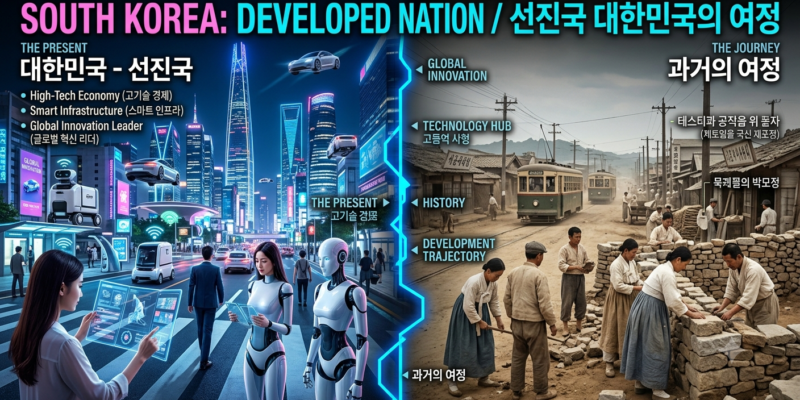
The question of whether South Korea is a developed or developing country is one that comes up frequently among Indian students, researchers, and travelers who are considering South Korea as a destination for higher education, career opportunities, or long-term migration. The answer is clear and well-established in global economic literature: South Korea is a fully developed country.
However, the full picture is more nuanced and more fascinating than a simple label. South Korea’s transformation from one of the poorest nations in the world in the 1950s to a high-income, technologically advanced economy in just six decades is one of the most remarkable development stories in modern history. This guide breaks down exactly what makes South Korea a developed nation and why this matters for Indian students and professionals.
Defining What Makes a Country Developed
Before examining South Korea specifically, it is useful to understand what international organizations and economists mean when they classify a country as developed or developing.
A developed country typically satisfies most or all of the following criteria:
A high Gross Domestic Product (GDP) per capita, generally above 20,000 USD, indicating significant individual wealth and economic productivity. A high Human Development Index (HDI) score, which measures life expectancy, education level, and income. Strong and stable political institutions, rule of law, and low levels of corruption. Advanced infrastructure including transportation, telecommunications, healthcare, and education systems. A diversified economy with strong service, manufacturing, and technology sectors. High standards of living, including access to clean water, healthcare, housing, and social safety nets.
South Korea meets and in many cases exceeds these benchmarks across the board.
South Korea GDP and Economic Status in 2026
South Korea is classified as a high-income country by the World Bank and is a member of the Organisation for Economic Co-operation and Development (OECD), a group of 38 highly developed and economically advanced nations. OECD membership is one of the clearest markers of developed country status.
South Korea’s GDP in 2026 is estimated to be approximately 1.7 to 1.8 trillion USD, making it one of the top fifteen economies in the world by nominal GDP. The GDP per capita stands at around 33,000 to 36,000 USD, which is firmly in high-income territory and comparable to countries like New Zealand and certain Southern European nations.
South Korea’s economy is driven by several globally dominant sectors. The semiconductor industry, led by Samsung Electronics and SK Hynix, makes South Korea one of the world’s largest producers of memory chips and semiconductors. The automotive sector, with brands like Hyundai and Kia, has a major global presence. Consumer electronics, shipbuilding, petrochemicals, and steel manufacturing are other pillars of the Korean economy.
The service sector, including finance, retail, healthcare, and the increasingly prominent Korean Wave cultural exports such as K-pop and Korean cinema, also contributes significantly to GDP. This economic diversity is a hallmark of developed nation status.
For Indian students who are exploring opportunities to study and work in South Korea, the country’s strong economy means better job prospects, higher wages, and greater professional development opportunities.
South Korea Human Development Index: World Rankings
The United Nations Development Programme (UNDP) publishes the Human Development Index annually, measuring countries on health, education, and standard of living. South Korea consistently ranks in the Very High Human Development category.
In recent HDI rankings, South Korea has placed between 19th and 23rd globally. This places it ahead of many European nations and significantly ahead of most Asian countries. India, by comparison, sits in the Medium Human Development category, ranked around 130th to 135th.
Life expectancy at birth in South Korea is approximately 83 to 84 years, one of the highest in the world. This reflects the quality of the healthcare system, the diet, the low homicide rate, and the overall safety of the country. In comparison, India’s average life expectancy is around 70 to 71 years.
The literacy rate in South Korea is effectively 100 percent, with near-universal completion of secondary education. Higher education enrollment is also among the highest in the world, with a large proportion of the population holding university degrees.
Infrastructure and Technology: South Korea as a Global Leader
One of the clearest indicators of South Korea’s developed status is its extraordinary infrastructure and technological advancement. South Korea consistently ranks first or second in the world for internet speed and broadband penetration. The country was among the first in the world to deploy 5G mobile networks at a national scale.
Public transportation in Seoul and other major Korean cities is a model for the world. The Seoul Metropolitan Subway system is one of the largest and most used urban rail systems globally. High-speed trains called KTX connect major cities across the Korean Peninsula in remarkably short travel times.
Urban planning in South Korea reflects a high level of development. Smart cities, digital public services, e-government platforms, and cashless payment infrastructure are deeply embedded in daily Korean life. Services ranging from banking to government paperwork can be completed entirely through smartphone apps.
This level of infrastructure has a direct positive impact on the daily life of Indian students studying in South Korea. Getting around, accessing services, and staying connected are all straightforward and efficient.
Education System in South Korea: World-Class Standards
South Korea’s education system is internationally recognized for its rigor, outcomes, and investment. Korean students consistently score near the top in PISA (Programme for International Student Assessment) rankings, which test 15-year-old students in mathematics, reading, and science across OECD countries.
Universities in South Korea are ranked among the best in Asia and the world. Seoul National University, Korea University, and Yonsei University form the SKY group, which is South Korea’s equivalent of the Ivy League. KAIST (Korea Advanced Institute of Science and Technology) and POSTECH are globally ranked science and technology universities that attract top research talent from around the world.
The South Korean government invests heavily in research and development, allocating around 4 to 5 percent of GDP to R&D, which is one of the highest ratios in the world. This research culture creates an environment where academic and industrial innovation thrive together.
For Indian students, enrolling in a Korean university for international students means access to world-class academic resources, internationally recognized degrees, and an environment that prepares graduates for global careers.
South Korea Healthcare System: Developed Nation Standards
South Korea operates a national health insurance program called the National Health Insurance (NHI) system, which covers the vast majority of the population. International students enrolled at Korean universities are typically included in this program, giving them access to quality healthcare at subsidized rates.
South Korean hospitals are equipped with cutting-edge medical technology. The country has developed expertise in fields like robotic surgery, cancer treatment, cosmetic surgery, and medical tourism. Several Korean hospitals are internationally accredited and attract medical tourists from across Asia and beyond.
The healthcare system’s strength is a significant advantage for Indian students and professionals living in South Korea, particularly those coming from regions where access to quality medical care is limited.
South Korea vs India: Development Gap and What It Means for Indian Students
The development gap between South Korea and India is substantial but should not be viewed as a source of discouragement. Rather, it reflects the very reason that Indian students choose South Korea as a destination for education and career growth.
South Korea’s per capita income is roughly 14 to 16 times higher than India’s. The infrastructure, research facilities, healthcare access, and quality of urban life in South Korea offer Indian students exposure to a living and working environment that is quite different from what many parts of India currently provide.
This exposure has transformative value. Indian graduates who complete their education in South Korea return home with international experience, Korean language skills, professional networks, and a global perspective that significantly enhances their career prospects in India or abroad.
At the same time, South Korea has a growing appreciation for international talent from India. Indian students in South Korea contribute to the country’s academic diversity, and many go on to find professional employment in Korea after graduation. The Korean government has also expanded visa pathways for skilled international graduates, recognizing the value of retaining global talent.
Is South Korea a G7 or G20 Member
South Korea is a member of the G20, a group of the world’s twenty largest economies. It is not a member of the G7, which is a more exclusive group of seven major developed economies: the United States, United Kingdom, Canada, France, Germany, Italy, and Japan. However, South Korea has participated in G7 summits as an invited guest nation on multiple occasions, reflecting its growing geopolitical and economic prominence.
South Korea is also a member of the World Trade Organization, the International Monetary Fund, the World Bank, and the United Nations, and holds positions of leadership in various international bodies.
The Miracle on the Han River: South Korea’s Development Story
No discussion of South Korea’s development status is complete without acknowledging its extraordinary historical trajectory. At the end of the Korean War in 1953, South Korea was one of the poorest countries in the world. GDP per capita was estimated at around 67 USD, lower than many sub-Saharan African nations at the time.
Over the next five decades, South Korea achieved what economists call the Miracle on the Han River, a period of unprecedented economic growth driven by export-oriented industrialization, heavy government investment in education, and the rise of large conglomerate companies called chaebols such as Samsung, Hyundai, LG, and Lotte.
Understanding this history is important for Indian students because it demonstrates that rapid development is possible and that education, innovation, and strategic investment are the key drivers. South Korea’s story is often studied in Indian business schools and policy institutions as a model of successful economic transformation.
South Korea’s Cultural Global Influence: Another Marker of Development
Beyond economics and infrastructure, South Korea’s cultural soft power has grown enormously in recent years. The Korean Wave, or Hallyu, refers to the global spread of Korean popular culture including K-pop music, Korean dramas, Korean cuisine, and Korean cinema.
Korean film earned global recognition when the movie Parasite became the first non-English language film to win the Academy Award for Best Picture. K-pop groups like BTS and BLACKPINK have sold out stadiums across every continent. Korean skincare and beauty products, collectively known as K-beauty, are now sold in over 100 countries.
This cultural influence is a sign of a mature, confident, and globally integrated developed nation. It also makes South Korea an exciting and culturally rich destination for Indian students who want to experience a vibrant, modern Asian country with deep historical roots. You can explore more about Korean culture and its global appeal on our dedicated resources page.
Social Safety and Quality of Life in South Korea
South Korea is consistently ranked among the safest countries in the world. Crime rates, particularly violent crime, are extremely low. The country has strong rule of law, an independent judiciary, and effective law enforcement.
Women’s safety, which is a concern raised by many Indian families considering sending their daughters to study abroad, is taken seriously in South Korea. The legal framework includes strong anti-harassment and anti-discrimination laws. University campuses have dedicated safety support for international students, including emergency contacts, counseling services, and 24-hour security.
South Korea also scores highly on environmental quality, with clean air standards (outside of occasional yellow dust events from China during spring months), well-maintained public spaces, and strong recycling and waste management infrastructure.
Conclusion: South Korea Is a Fully Developed Country With Outstanding Opportunities for Indians
There is no ambiguity in the classification: South Korea is a developed country by every meaningful measure. Its GDP, HDI rankings, infrastructure, education quality, healthcare system, and global cultural influence all confirm its status as one of the most advanced economies and societies in the world.
For Indian students, this status translates into real-world advantages. Studying in South Korea means access to world-class universities, a safe and well-organized living environment, strong employment opportunities, and an internationally recognized degree that opens doors globally.
Whether you are preparing to study in South Korea after Class 12 or researching career options in a developed Asian economy, South Korea represents one of the most compelling and underexplored opportunities available to Indian students and professionals today.
For comprehensive guidance on studying, living, and thriving in South Korea, visit Study in South Korea.