


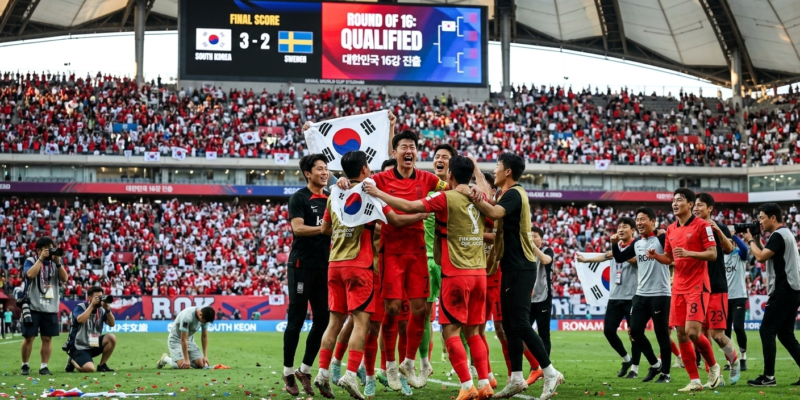
When the question of whether South Korea can qualify for the Round of 16 at a major international football tournament comes up, it carries genuine weight. South Korea is not a football minnow. The country has one of Asia’s strongest football traditions, has produced globally recognized players, and carries the memory of one of the most extraordinary World Cup runs in tournament history.
This blog covers everything you need to know about South Korea’s journey to the Round of 16 across different tournaments, the 2026 FIFA World Cup analysis, the current squad’s capabilities, and what Korean football fans are watching for heading into the future.
South Korea’s World Cup History: A Foundation Built on Determination
South Korea first appeared at the FIFA World Cup in 1954 in Switzerland, making them one of the earliest Asian nations to qualify for the tournament. However, their most memorable international football history has been written in the decades since.
Before 2002, South Korea had made appearances at the World Cup but consistently fell short of advancing past the group stage. That all changed in dramatic fashion when South Korea co-hosted the tournament with Japan.
The 2002 FIFA World Cup: When South Korea Shocked the World
The 2002 FIFA World Cup, co-hosted by South Korea and Japan, produced what many consider the most stunning individual national team performance in World Cup history. South Korea did not merely qualify for the Round of 16. They went significantly further.
South Korea defeated Poland, Spain, Italy, and Germany’s neighbor Portugal across various stages, becoming the first and only Asian team to ever reach the FIFA World Cup semi-finals. The run captivated the entire country and created scenes of mass celebration across South Korea that remain etched in national memory.
The team, managed by Guus Hiddink and captained by Hong Myung-bo, played with extraordinary collective spirit, tactical intelligence, and fitness that overwhelmed opponents. The Red Devils (the nickname of the South Korean national team) became a symbol of what organized team football could achieve against supposedly superior opposition.
For anyone curious about the broader differences in Korean life and society, it is worth understanding how deeply national sporting achievements like 2002 are woven into Korean identity. Our guide on differences between North and South Korea touches on how South Korea’s open, globally engaged society channels national pride into sports and cultural achievement.
South Korea’s Round of 16 Record: Tournament by Tournament
2002 FIFA World Cup (Co-Host, South Korea and Japan)
Result: Semi-final (4th place overall)
South Korea qualified for the Round of 16 and went all the way to the final four. This remains Asia’s greatest ever World Cup achievement.
2006 FIFA World Cup (Germany)
Result: Group stage exit
Despite high expectations following 2002, South Korea went out at the group stage in Germany. The tournament proved how difficult it is to sustain extraordinary runs at the highest level.
2010 FIFA World Cup (South Africa)
Result: Round of 16
South Korea qualified for the Round of 16 in South Africa, defeating Greece and drawing with Argentina before going through as group runners-up. They faced Uruguay in the Round of 16 and were eliminated 2-1 in a competitive match.
2014 FIFA World Cup (Brazil)
Result: Group stage exit
South Korea struggled in Brazil and failed to advance past the group stage, finishing last in a group containing Algeria, Belgium, and Russia.
2018 FIFA World Cup (Russia)
Result: Group stage exit, but with a famous victory
South Korea’s 2018 campaign included one of the World Cup’s biggest upsets: defeating the defending champions Germany 2-0 in the final group match. While South Korea themselves went out at the group stage, knocking out Germany was a moment that resonated globally.
2022 FIFA World Cup (Qatar)
Result: Round of 16
South Korea produced a dramatic late comeback to qualify from their group in Qatar. Needing to beat Portugal and relying on other results going their way, they delivered. Son Heung-min, despite playing through a facial injury requiring a protective mask, delivered key moments. Hwang Hee-chan scored a last-minute winner against Portugal to send South Korea through.
In the Round of 16, South Korea faced Brazil and were defeated 4-1, but their qualification from the group in such dramatic circumstances generated enormous excitement across the country.
Key Players Who Help South Korea Qualify and Advance
Understanding South Korea’s ability to qualify for the Round of 16 requires knowing the players who have driven the team’s success across different eras.
Son Heung-min: The Modern Icon
Son Heung-min of Tottenham Hotspur is unquestionably South Korea’s greatest current football player and one of the most complete attacking players in world football. Born in 1992, Son has been the focal point of the Korean national team for over a decade and has scored crucial goals in World Cup qualifying matches and tournament games alike.
His ability to operate across the front line, create from deep, finish with both feet, and contribute defensively makes him a matchday changer against any level of opposition. South Korea’s chances of qualifying for the Round of 16 at any tournament are directly and significantly linked to Son’s fitness and form.
Hwang Hee-chan
Hwang Hee-chan, who plays club football in the English Premier League for Wolverhampton Wanderers, was the hero of the 2022 Qatar World Cup group stage with his last-minute goal against Portugal. His pace, directness, and ability to score under pressure make him a vital player for Korea’s attacking options.
Kim Min-jae
Kim Min-jae, a central defender who has played for Napoli and Bayern Munich at club level, represents the transformation of Korean football. A physically dominant, technically excellent centre-back, Kim provides South Korea with the kind of defensive foundation that allows the team to compete with top nations.
Lee Kang-in
Lee Kang-in has emerged as one of the most technically gifted Korean players of his generation. His performances in La Liga for Paris Saint-Germain and Barcelona (his former club) demonstrate elite-level quality. His creativity and vision add a dimension to Korea’s midfield that enhances the team’s overall attacking threat.
South Korea and the 2026 FIFA World Cup: Can They Qualify for Round of 16
The 2026 FIFA World Cup is being hosted across the United States, Canada, and Mexico, and for the first time, the tournament will feature 48 teams rather than the traditional 32. This expansion fundamentally changes the qualification mathematics for teams like South Korea.
What the 48-Team Format Means for South Korea
The expanded format means the Round of 16 is now reached from a group stage that features 12 groups of four teams, with two teams advancing from each group plus the best-performing eight third-place teams. In total, 32 teams advance to the Round of 16.
This gives Asian confederations (AFC) more slots at the tournament itself, and within the tournament, the broader field means South Korea is more likely to face opponents of comparable or lower quality in group stage matchups than they might have in a 32-team field.
For South Korea, a team with genuine quality at international level, the expanded format should improve their chances of not just reaching the Round of 16 but potentially advancing further.
Asian World Cup Qualification for 2026
The Asian Football Confederation (AFC) has received 8 direct qualification spots for the 2026 World Cup plus an additional inter-confederation playoff path. South Korea, as one of Asia’s top-ranked football nations, entered qualification as strong favorites to claim one of these direct berths.
South Korea’s FIFA ranking has consistently placed them in the top 25 to 35 in the world, which is a reflection of the quality they bring relative to other AFC members. Japan, Australia, Saudi Arabia, Iran, and South Korea are generally regarded as Asia’s top five football nations.
South Korea’s 2026 World Cup Qualification Campaign
South Korea competed in the third round of AFC qualification for the 2026 World Cup and navigated their path with competitive performances. Their group included challenging opponents but the quality of players like Son Heung-min, Kim Min-jae, and Lee Kang-in provided a significant advantage.
For those following the qualification campaign closely, South Korea’s qualifying fixtures and results were closely watched by fans across the country, with an intensity that reflects how deeply football connects to Korean national identity.
Korean Football Culture: More Than Just the National Team
To fully understand South Korea’s relationship with football and the significance of qualifying for the Round of 16, it helps to understand the domestic football landscape.
K League 1: The Korean Top Division
The K League 1 is the top tier of Korean domestic football and features 12 clubs. Teams like Jeonbuk Hyundai Motors FC, Ulsan Hyundai FC, and Suwon Samsung Bluewings have historically dominated. The league serves as the developmental platform for players who go on to represent the national team.
The AFC Champions League
South Korean clubs have been consistently competitive in the AFC Champions League, the continent’s premier club competition. Victories in the Champions League by Korean clubs add to the country’s football prestige and often feature players who subsequently strengthen the national team.
The Role of Football in Korean Society
Football in South Korea sits alongside baseball as one of the nation’s most popular sports. The 2002 World Cup experience in particular created a generation of fans for whom football is deeply personal. Red Devil supporter groups, who organize mass public viewings and create extraordinary atmospheres at national team matches, are famous for their passion and organized support.
For anyone living or studying in South Korea, experiencing a national team match during a major tournament is one of the defining cultural experiences available. The communal viewing culture, the energy of watching games on massive outdoor screens in places like Gwanghwamun Square in Seoul, reflects the broader Korean sense of collective identity and enthusiasm.
For those exploring Korean culture more deeply during their time in the country, understanding social customs around group activities is helped by reading about Korean manners and etiquette.
Challenges South Korea Faces in Qualifying for and Advancing Past the Round of 16
While South Korea’s football quality is not in question, there are genuine structural and strategic challenges that have historically prevented consistent deep runs at World Cups.
Squad Depth
South Korea’s quality drops significantly beyond the top eight to ten players. While the first-choice lineup featuring Son Heung-min, Kim Min-jae, and Lee Kang-in is competitive with many global teams, the bench depth and backup options are less reliable. Against elite European or South American nations, rotation and injury contingencies become critical.
Management Consistency
South Korea has cycled through a number of coaches in the years since their 2002 peak. Managerial continuity is critical for tournament success, and inconsistent appointments have occasionally disrupted team cohesion and tactical clarity.
Physical Intensity at Knockout Level
Top European nations in particular bring physical intensity and tactical sophistication at the Round of 16 and beyond that historically tests Korean teams. The 4-1 defeat to Brazil in the 2022 Round of 16 was a clear demonstration of the quality gap against the very best teams in the world, even when Korea had qualified brilliantly from their group.
Age of Key Players
Son Heung-min, who was born in 1992, will be 33 to 34 during the 2026 World Cup. While players of his class can perform at the highest level well into their mid-thirties, the question of what comes after Son is one that Korean football fans and administrators are focused on. Lee Kang-in and Hwang Hee-chan represent the next generation, but replicating Son’s level is an enormous challenge for any player.
What South Korea Qualifying for Round of 16 Means Culturally
When South Korea qualifies for the Round of 16 at a major tournament, the national atmosphere transforms in ways that are genuinely extraordinary to witness. South Korea is a country where collective experiences are deeply valued, and sporting success creates moments of national unity that transcend normal daily life.
The scenes in Seoul when South Korea beat Portugal in Qatar 2022 and secured Round of 16 qualification were broadcast globally: millions of fans in red jerseys watching on outdoor screens, streets filling with celebration, and a shared emotional moment that connected Koreans at home and abroad.
For Indian students and visitors who are in South Korea during a major tournament, this collective celebration is one of the most memorable cultural experiences available. Understanding how sport connects to Korean identity also connects to broader themes around Korean student life and the social fabric of Korean society.
South Korea vs the World: How They Compare in Knockout Football
South Korea’s record in knockout football at the World Cup tells an interesting story:
- 2002: Won in the Round of 16 (defeated Uruguay), then defeated Italy in the Quarter-final
- 2010: Lost in the Round of 16 to Uruguay
- 2022: Lost in the Round of 16 to Brazil
The pattern shows that when South Korea reaches the knockout stages, they are competitive but the ceiling against top European and South American opposition remains a challenge. The expanded 2026 format offers a potential path where Korea could face a more favorable Round of 16 matchup, giving them a better chance of advancing to the Quarter-final for the first time since 2002.
Conclusion: South Korea’s Future in International Football
South Korea’s journey in international football, particularly their ability to qualify for the Round of 16 at World Cups, reflects a country with deep football passion, genuine world-class talent at the top end, and the organizational commitment to compete internationally.
The 2026 FIFA World Cup, with its expanded format and multiple hosting nations, represents one of the best opportunities South Korea has had since 2002 to make a genuine deep run in the tournament. If Son Heung-min remains fit and influential, if Lee Kang-in and the next generation of Korean talent delivers, and if the tactical setup is right, South Korea qualifying for the Round of 16 is almost certain, and pushing further is genuinely possible.
For Korean football fans and international supporters of Korean sport, 2026 is a tournament to watch with genuine excitement.
For everything related to living, studying, and experiencing life in South Korea, visit Study in South Korea, your complete resource for Korean education and culture.