


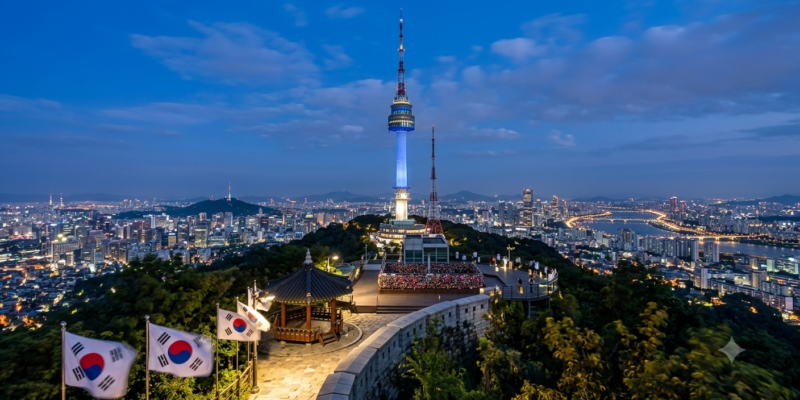
There are landmarks, and then there are icons. The N Seoul Tower, perched atop Namsan Mountain at 479 meters above sea level and visible from virtually every corner of the city, belongs to the latter category. For anyone visiting South Korea, whether on a short holiday or a long-term stay for studies at a Korean university, a visit to Seoul Tower is not optional. It is one of those experiences that fundamentally changes how you see and feel the city.
This complete 2026 guide covers everything you need to know about visiting N Seoul Tower including how to get there, what it costs, what to do when you are there, the best time to visit, and why this landmark has become one of South Korea’s most beloved symbols.
What Is N Seoul Tower: An Introduction
N Seoul Tower, officially named Namsan Seoul Tower but universally known as N Seoul Tower (the N standing for Namsan and New), is a combined communication and observation tower that stands 236.7 meters tall. When you add the elevation of Namsan Mountain itself (243 meters above sea level), the tower’s observation deck sits at approximately 479 meters above the city streets below, making it one of the highest viewpoints in the Korean peninsula.
The tower was originally built in 1969 as a broadcasting antenna and was first opened to the public in 1980. It has since undergone multiple renovations and expansions, with the most significant redevelopment coming in 2005 when it was rebranded as N Seoul Tower and transformed into the multi-experience destination it is today.
Today, N Seoul Tower is far more than a viewpoint. It is a symbol of Seoul, a cultural landmark, a romantic destination, and a hub of food, entertainment, and experience that draws millions of visitors each year.
Why N Seoul Tower Is One of South Korea’s Most Important Landmarks
Understanding what makes N Seoul Tower special requires understanding Seoul itself. Seoul is one of the world’s great megacities, home to nearly 10 million people within the city proper and over 25 million in the greater metropolitan area. It is a city of extraordinary density, energy, and visual complexity.
From the streets below, navigating Seoul can feel overwhelming in the best possible way. But from the observation deck of N Seoul Tower, the entire city spreads out before you in a moment of extraordinary clarity. To the north, you can see Bukhansan National Park and the mountain ridges that define Seoul’s northern boundary. To the south, the city extends to Gangnam and beyond. The Han River, Seoul’s great artery, winds through the cityscape in a broad silver ribbon.
For visitors who are just beginning to explore South Korea, this view from N Seoul Tower provides something deeply valuable: spatial understanding. After you have seen Seoul from above, navigating the city below feels more intuitive and personal.
For students completing a 7-day South Korea itinerary, N Seoul Tower is typically recommended as a day one or day two experience precisely because it orientates you to the scale and geography of the city you are about to explore.
How to Get to N Seoul Tower: All Transport Options
Getting to N Seoul Tower requires a two-stage journey: first to Namsan, then up the mountain to the tower itself. Here are all the options:
Option 1: Namsan Cable Car
The most popular and iconic way to reach N Seoul Tower is via the Namsan Cable Car. The cable car departs from Myeong-dong Station area (a 10-minute walk from Myeong-dong Subway Station, Exit 3) and runs continuously throughout the day and into the evening.
Cable car details:
- Operating hours: 10:00 AM to 11:00 PM (Monday to Friday), 10:00 AM to midnight (weekends and public holidays)
- One-way fare: KRW 9,000 (adults), KRW 7,000 (children)
- Round-trip fare: KRW 15,000 (adults), KRW 10,000 (children)
- Duration: Approximately 3 minutes
Note: On weekends and during peak tourist seasons, queues for the cable car can be significant. Arriving early or visiting on a weekday significantly reduces wait times.
Option 2: Namsan Circular Bus (Green Bus 02)
Seoul operates a dedicated Namsan Circular Bus service (Green Bus 02) that loops around Namsan Mountain and stops near the base of the tower. The bus runs from several nearby subway stations including Myeong-dong (Line 4), Dongguk University (Line 3), and Seoul Station.
Bus fare is the standard Seoul bus rate (KRW 1,500 for adults using a T-money card), making it significantly cheaper than the cable car. The bus journey takes approximately 15 to 20 minutes depending on traffic.
Option 3: Walking Trails
For the health-conscious and those who want to experience Namsan Park itself, multiple walking trails lead from the base of the mountain to the tower. The most popular routes:
- From Myeong-dong: Approximately 40 to 50 minutes walking
- From Itaewon: Approximately 20 to 30 minutes via Namsan Park entrance near the Grand Hyatt Hotel
- From Dongguk University Station: Approximately 30 to 40 minutes
Walking Namsan is a beloved Seoul tradition, particularly in spring when the cherry blossoms bloom along the hiking paths and in autumn when the maple leaves turn brilliant red and orange. Many Seoul residents walk Namsan regularly as part of their fitness routine, and foreigners who join them quickly understand why.
Getting to the Myeong-dong Cable Car Base Station
The most common subway approach:
- Line 4 to Myeong-dong Station, Exit 3, then walk approximately 10 minutes following signs to the Namsan Cable Car
- Line 3 to Dongguk University Station, Exit 6, then take Bus 02
N Seoul Tower Observation Deck: What to Expect
The observation deck is the primary attraction at N Seoul Tower and is divided into two main levels:
Indoor Observation Floor
The indoor observation floor offers 360-degree panoramic views of Seoul through floor-to-ceiling windows. The space is climate controlled, making it equally comfortable in Seoul’s hot summer (temperatures regularly exceed 35 degrees Celsius) and cold winter (temperatures regularly drop below minus 10 degrees Celsius). High-powered binoculars are positioned around the floor for closer looks at specific parts of the city.
Interactive digital displays provide information about the landmarks visible from each viewpoint, helping visitors identify key neighborhoods, palaces, parks, and mountains in the panorama. On clear days, it is possible to see all the way to the distant mountain ranges north of Seoul and, on exceptional days, as far as the western sea.
Outdoor Observation Deck
The outdoor deck offers an unobstructed, open-air experience for those who want to feel genuinely above the city. Wind can be significant at this altitude, so bringing a layer even in warmer months is advisable. Photography from the outdoor deck is magnificent, particularly at golden hour (approximately one hour before sunset) when the city glows warmly before the night city lights take over.
Nighttime Views
Many visitors agree that N Seoul Tower’s most spectacular views are at night. Seoul illuminated after dark is a genuinely breathtaking sight, with the city’s neon signs, streaming traffic, and lit tower blocks creating a visual spectacle that is difficult to describe without seeing. If your schedule allows only one visit, consider evening arrival to watch the transition from daylight to dusk to full nighttime illumination.
N Seoul Tower Ticket Prices in 2026
Here is a breakdown of current ticket prices for N Seoul Tower in 2026:
Observatory Only
- Adults: KRW 21,000
- Teenagers (ages 13 to 18): KRW 17,000
- Children (ages 3 to 12): KRW 12,000
Observatory and Cable Car Combined Package
- Adults: KRW 33,000
- Teenagers: KRW 28,000
- Children: KRW 21,000
Note: Prices are approximate based on 2025 to 2026 figures and may be adjusted by the tower management. Always check the official N Seoul Tower website before visiting to confirm current pricing.
For Indian travelers converting to Indian Rupees, at the mid-2026 exchange rate of approximately 1 INR = 16 to 17 KRW:
- Observatory adult ticket: approximately INR 1,250 to INR 1,310
- Combined cable car and observatory: approximately INR 1,940 to INR 2,060
This places N Seoul Tower firmly in the “affordable” category for international visitors, particularly given the quality of the experience.
The Love Lock Fence: N Seoul Tower’s Most Romantic Feature
If you have seen photographs of N Seoul Tower and noticed a fence or railing covered entirely in padlocks of every size and color, you have seen the world-famous Love Lock Fence, one of N Seoul Tower’s most distinctive and internationally recognized features.
The tradition began organically in the early 2000s when couples started attaching padlocks to fences near the tower as a symbol of eternal love, writing their names and a message on the lock before throwing the key away or keeping it. The practice spread dramatically, partly fueled by K-dramas that filmed scenes at the tower, and eventually became an official and celebrated part of the N Seoul Tower experience.
Today, the Love Lock sections are carefully managed to prevent structural damage, and special designated areas for new locks are available. Padlocks in various colors, shapes, and sizes can be purchased from nearby vendors for prices ranging from KRW 2,000 to KRW 15,000 depending on size and design.
For couples visiting South Korea and for visitors who want to participate in a uniquely Korean romantic tradition, attaching a Love Lock at N Seoul Tower is a meaningful and memorable activity. For those traveling alone, the atmosphere around the Love Lock sections is warm and communal, with people writing messages for family members, friends, and personal aspirations.
Restaurants and Dining at N Seoul Tower
One of the most distinctive dining experiences available in Seoul is a meal with a view at N Seoul Tower. The tower houses several dining options ranging from casual to upscale:
N Grill
N Grill is the tower’s premium rotating restaurant, positioned at the top of the tower and completing a full 360-degree rotation approximately every 48 minutes. The restaurant serves a fusion of Korean and Western cuisine in an elegant setting with impeccable service. Reservations are strongly recommended, particularly for dinner on weekends. Dining at N Grill is one of those experiences that combines spectacular views with genuinely excellent food.
Price range: KRW 80,000 to KRW 150,000 per person for dinner with wine.
HANCOOK Restaurant
HANCOOK offers a more accessible price point with traditional Korean cuisine and excellent views. The menu features Korean classics including bulgogi, galbi, jeon (savory pancakes), and seasonal Korean specialties. The restaurant provides a culturally immersive dining experience that pairs well with the cultural significance of the tower itself.
Top Cloud Cafe
For a lighter experience, Top Cloud Cafe offers beverages, desserts, and light meals with the tower’s signature panoramic backdrop. The cafe is a popular spot for afternoon tea or coffee with friends, and the dessert presentation is typically Instagram-worthy in the best Korean hospitality tradition.
Outdoor Food Vendors
On Namsan Mountain itself, particularly along the walking paths leading to the tower and in the surrounding park area, outdoor vendors sell traditional Korean street food including tteokbokki (spicy rice cakes), hotteok (sweet pancakes), roasted chestnuts, and corn on the cob. These vendors are particularly beloved in autumn and winter when the combination of cold mountain air and warm street food is irresistible.
N Seoul Tower in K-Dramas and Korean Pop Culture
N Seoul Tower’s cultural footprint extends far beyond tourism into the heart of Korean popular culture. The tower has appeared in dozens of major Korean dramas and films, cementing its status as a symbol of Korean romance, urban life, and national identity.
Some of the most notable cultural appearances include:
The tower featured prominently in “My Love from the Star” (별에서 온 그대), one of the most watched Korean dramas globally, where it served as a backdrop for key romantic scenes. The tower similarly appeared in “Boys Over Flowers,” “Pinocchio,” and “W: Two Worlds,” among many other productions.
The Love Lock tradition, as mentioned earlier, gained enormous momentum through K-drama storytelling, which portrayed the tower as a destination for couples marking significant relationship milestones. For international fans of K-dramas who arrive in South Korea, N Seoul Tower is often among the first real-world locations they want to visit, connecting the lived experience of Seoul to the fictional world they fell in love with through Korean television.
For those who are interested in studying Korean language and culture as part of their South Korea experience, understanding how K-dramas and cultural products reflect and shape Korean society is explored in our guide on Korean courses and cultural learning.
Seasonal Highlights at N Seoul Tower
N Seoul Tower offers a genuinely different experience in each of Korea’s four distinct seasons, and each season has particular advantages:
Spring (March to May)
Spring in Seoul is spectacular. Namsan Mountain is covered in cherry blossoms in late March and early April, and the walking paths up to the tower are lined with flowering trees that create an extraordinary natural frame for the tower above. The cherry blossom period typically lasts two to three weeks and draws enormous crowds.
Summer (June to August)
Summer offers long days with maximum daylight for observation and outdoor activities. The city from above is green and lush. However, Seoul summers are hot and humid, and visibility can be reduced by summer haze. Evenings are particularly lovely in summer when the heat moderates and the city lights come on.
Autumn (September to November)
Autumn is many visitors’ favorite season for N Seoul Tower. The Namsan maple trees turn brilliant shades of red, orange, and gold in October and November, creating one of Seoul’s most photographed natural displays. Air quality is typically excellent in autumn, providing the clearest long-distance views of the year.
Winter (December to February)
Winter at N Seoul Tower has its own magic. Snow on Namsan Mountain creates a peaceful, almost silent atmosphere on the walking paths. The city below is clear and crisp in winter air, and the observation deck provides one of the sharpest panoramic views of the year. The Love Lock fence takes on a particularly romantic quality when dusted with snow.
N Seoul Tower and Namsan Park: More Than Just the Tower
The experience of N Seoul Tower is inseparable from the experience of Namsan Park that surrounds it. Namsan (South Mountain) is a 270-hectare urban national park sitting at the heart of Seoul, and it is one of the city’s most valuable natural resources.
Namsan Park offers:
- Extensive walking and jogging trails through forested areas
- Traditional Korean pavilions and cultural structures
- An outdoor amphitheatre that hosts seasonal cultural events
- The Beacon Fire Station (봉수대), a historical site where ancient Korea’s signal fire system operated
- Beautiful gardens and seasonal flower displays
- N Fountain Plaza at the tower’s base, a gathering spot for visitors and locals alike
For students living in Seoul who are looking for free or low-cost activities that combine exercise, nature, and cultural exploration, Namsan Park is an easily accessible escape from the intense urban energy of the city. Many Korean university students treat Namsan walks as a regular weekend activity.
Practical Tips for Visiting N Seoul Tower in 2026
Before you go, here are the most useful practical tips:
Best time of day to visit: Late afternoon to evening offers both daylight panoramic views and the magical transition to nighttime city lights in a single visit.
Best days to visit: Tuesday through Thursday offer shorter queues at the cable car and observation deck compared to weekends and public holidays.
What to bring: Camera or smartphone with a good camera, a light layer even in summer, comfortable walking shoes if you plan to walk Namsan, and cash for street food vendors (not all accept cards).
Accessibility: The cable car is accessible for visitors with mobility limitations. Inside the tower, elevators serve all floors. Walking trails to the tower are not wheelchair accessible.
Photography: No restrictions on personal photography from the observation deck. Drone photography in the Namsan area is heavily restricted by Seoul air traffic regulations.
Language: Tower staff at major desks generally speak basic English. Multilingual signage covers Korean, English, Chinese, and Japanese throughout the facility.
Connecting N Seoul Tower to Your Broader South Korea Experience
N Seoul Tower is magnificent on its own terms, but its power deepens when connected to the broader context of exploring Seoul and South Korea. After visiting the tower, many travelers find themselves naturally drawn to:
- Myeongdong (within walking distance downhill): South Korea’s most vibrant street shopping district for South Korean products including beauty, fashion, and food
- Itaewon (accessible from the mountain’s western flank): Seoul’s multicultural neighborhood with international dining, nightlife, and Antique stores
- Gyeongbokgung Palace (a short subway ride away): The grandest of Seoul’s five Joseon dynasty palaces, a necessary complement to understanding Korean history
- Insadong: Traditional Korean art, crafts, and tea culture in a well-preserved historic street
For a complete itinerary that connects all of these locations across an organized multi-day visit, read our 7-day South Korea travel guide.
Final Thoughts on Visiting N Seoul Tower
N Seoul Tower is one of those rare landmarks that earns its iconic status completely. The view is genuinely extraordinary, the atmosphere is culturally rich, the dining options are excellent, and the surrounding Namsan Park adds layers of natural beauty that elevate a simple tower visit into a half-day or full-day experience.
For Indian travelers visiting South Korea, the tower represents one of the clearest windows into what Seoul is: a city of enormous scale, remarkable beauty, and constant energy, seen from a point of extraordinary calm and perspective high above.
Whether you come on your first day in Seoul to get your bearings, return on a clear autumn evening to watch the sunset, or visit with a partner to add your lock to the Love Lock fence, N Seoul Tower will leave you with images and feelings that stay long after you return home.
For everything you need to plan your South Korea journey, from booking the right flight from India to South Korea to understanding famous Korean cultural experiences, Study in South Korea has the complete resources you need.