

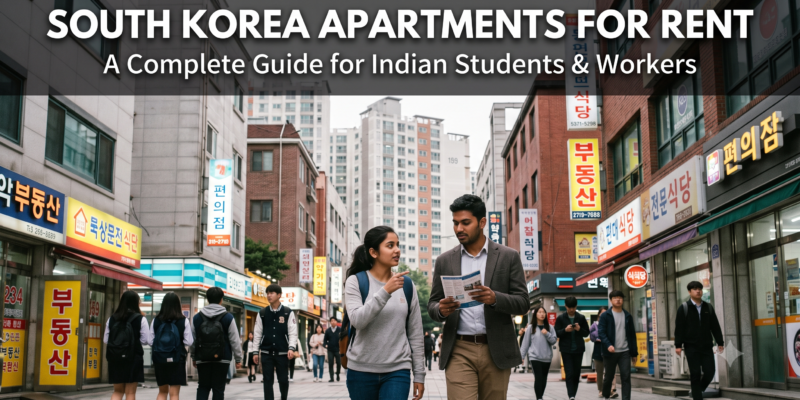
Searching for south korea apartments for rent can feel confusing the first time around, mainly because the rental system there works very differently from what most Indian renters are used to. Instead of a flat monthly rent paired with a small, one or two month security deposit, most contracts in Korea use Jeonse, a very large lump sum deposit, or Wolse, a smaller deposit combined with a fixed monthly rent. Neither system has a direct equivalent back home, so arriving with a clear understanding of how they work will save you time, money, and unnecessary stress while you study in South Korea.
This guide walks through both rental systems, realistic cost ranges by city and housing type, the exact steps to follow when signing a lease as a foreigner, and the common risks you should watch out for before handing over any deposit money.
Understanding Jeonse and Wolse
South Korea’s rental market is built almost entirely around two contract types, and understanding the difference between them is the single most important thing to get right before you start apartment hunting.
Jeonse requires a very large upfront deposit, typically somewhere between fifty and eighty percent of the property’s full market value, in exchange for paying little to no monthly rent for the duration of the lease, which is usually set at two years. At the end of the contract, the landlord is expected to return the entire deposit in full. This system works well for people with significant savings or access to large sums of capital, since the deposit effectively replaces monthly rent payments entirely, but it is rarely practical for international students or anyone on a limited budget, given that Jeonse deposits can run from roughly two hundred million to eight hundred million Korean won depending on the property and location.
Wolse is the far more common choice for foreigners, students, and young professionals. Under this system, you pay a comparatively smaller deposit, often referred to as “key money,” somewhere in the range of five to thirty million Korean won, along with a fixed monthly rent that typically falls between five hundred thousand and one point two million Korean won, depending on the city, neighborhood, and size of the unit. A useful rule to keep in mind is that increasing your upfront deposit will generally lower your monthly rent, so if you have some savings available, it is often worth negotiating a slightly higher deposit in exchange for a lower monthly payment over a one or two year lease.
There is also a middle option called Semi-jeonse, which combines a moderate deposit with a reduced monthly rent, sitting somewhere between the two main systems. Most Indian students and short term workers end up choosing Wolse simply because the upfront cash requirement is dramatically lower and far more manageable on a student budget or an entry level salary, without requiring access to tens of millions of won in savings before you even arrive in the country.
Typical Costs by City and Housing Type
Rent in South Korea varies sharply depending on both the city and the type of property you choose, so it helps to think in terms of rough budget tiers rather than a single national average.
Seoul is by far the most expensive city to rent in, reflecting its status as the capital and the center of most major universities, companies, and job opportunities. Busan, as the second largest city, tends to run noticeably cheaper, and smaller university towns across the country are generally the most affordable option of all. If your course or job placement gives you any flexibility in choosing a city, it is worth factoring housing costs into that decision early, since the difference between Seoul and a smaller city can easily be thirty to fifty percent on comparable apartments.
In terms of property type, officetels are a particularly popular choice among students and single professionals. These are compact, studio style units that combine residential and light commercial zoning, often come furnished or semi-furnished, and are usually located close to subway lines and city centers. Goshiwons are an even more budget friendly option, offering very small private rooms, sometimes just large enough for a bed and desk, with shared bathroom and kitchen facilities, and are popular among students who need short term or ultra low cost housing while they search for something more permanent. Traditional apartments, known locally as apateu, tend to be larger, more expensive, and more common among families or longer term residents rather than students on a tight budget.
As a rough guide, you can expect affordable housing to run below roughly seven hundred thousand Korean won a month, mid range housing to fall somewhere between seven hundred thousand and one point two million won a month, and higher end apartments, particularly in central Seoul neighborhoods, to run well above that figure. On top of whatever rent figure you agree to, nearly every building in Korea charges a separate monthly maintenance fee, known locally as gwanlibi, which covers shared utilities, building upkeep, cleaning, and common area maintenance. This fee is not optional and is rarely included in the advertised rent, so always ask for the exact gwanlibi amount before signing anything, since it can add a meaningful amount to your total monthly housing cost. Your realistic housing budget will often depend heavily on which city your South Korea courses are based in, since Seoul rents can run well above those in smaller, less central university towns.
Step by Step: How to Rent an Apartment in Korea as a Foreigner
Renting an apartment in Korea as a foreigner follows a fairly predictable sequence of steps, even though the specific terminology and paperwork can feel unfamiliar at first.
- Decide between Jeonse, Wolse, or a no deposit monthly option based on realistically how much upfront cash you have available and how long you plan to stay in the country.
- Work with a licensed real estate agent or a reputable rental app rather than relying purely on informal listings found through social media groups, since agents are familiar with the documentation foreigners typically need and can help flag unusual or risky terms.
- Check the property registry before paying any deposit, to confirm that the person you are dealing with actually owns the property and that it is not already carrying significant existing debt or liens that could put your deposit at risk.
- Negotiate the balance between deposit size and monthly rent so that the final arrangement genuinely fits your budget, keeping in mind that a higher deposit generally buys you a lower monthly payment.
- Sign the lease and register your contract at the local district office, since this registration step is what legally protects your deposit and establishes your priority as a tenant if any disputes arise later.
- Seriously consider deposit insurance, especially if you are entering into any form of Jeonse or semi-jeonse arrangement, through providers such as HUG or SGI Seoul Guarantee, which can protect you if the landlord is ever unable to return your deposit.
- Budget separately for the maintenance fee and utility bills, which are billed on top of your base rent and are rarely included in the advertised monthly figure.
Getting your housing arrangements sorted early, well before classes or work begin, also makes it significantly easier to settle into student life in South Korea without the added stress of apartment hunting during your first few hectic weeks in a new country.
Avoiding Deposit Fraud and Common Rental Risks
Jeonse fraud, where a landlord becomes unable to repay a tenant’s deposit at the end of a lease, has become a well documented and genuinely serious risk in Korea’s rental market in recent years, with several large scale fraud cases making national news. The core problem usually arises when a landlord has taken on more debt against a property than its actual market value can cover, leaving nothing left to return to the tenant once the lease ends and the property is sold or seized by creditors.
Foreigners without strong Korean language skills are particularly vulnerable to this kind of risk, since contract terms, verbal promises, and property registry documents are typically written entirely in Korean, and it is easy to miss red flags if you are relying solely on a translation app or a landlord’s own summary of the terms.
Checking the property registry before paying any deposit remains the single most important safeguard available to any renter, since this document reveals existing mortgages, liens, and ownership history on the property, and will often expose warning signs before you ever hand over a deposit. Deposit insurance is also genuinely worth the relatively modest cost, particularly for larger Jeonse deposits, since it provides a safety net that can return your money even if a worst case scenario plays out with the landlord.
First time renters, especially those arriving in Korea for the first time without local connections, are generally far better off involving a trusted local contact, a senior student who has already been through the process, or a licensed agent rather than attempting to negotiate a lease entirely alone in an unfamiliar language and legal system. If you want guidance specific to your own situation, budget, and city before signing anything, you can contact us and our team can help point you toward safer, more reliable housing options.
FAQ: Renting an Apartment in South Korea
Can foreigners sign a Jeonse contract in South Korea?
Yes, foreigners are legally permitted to sign Jeonse contracts, though the very large deposit requirement makes Wolse the far more practical choice for most students and early career workers.
What is the average deposit for Wolse as a student?
Student friendly Wolse deposits typically start from around five million Korean won, with the exact figure and corresponding monthly rent varying significantly depending on the city, neighborhood, and apartment size.
Can I rent an apartment in Korea without speaking Korean?
Yes, it is possible, though working with an English speaking agent or a rental platform designed for foreigners makes the entire process noticeably smoother and reduces the risk of misunderstanding key contract terms.
What is included in the maintenance fee? \
The maintenance fee, known locally as gwanlibi, usually covers shared utilities, building cleaning, and the upkeep of common areas, and is charged separately from your personal electricity, water, and internet bills.
How long do typical rental contracts last in Korea?
Most long term Jeonse and Wolse contracts run for two years, though shorter term arrangements are available, often at a higher relative cost, for students or workers who only need housing for a few months.