


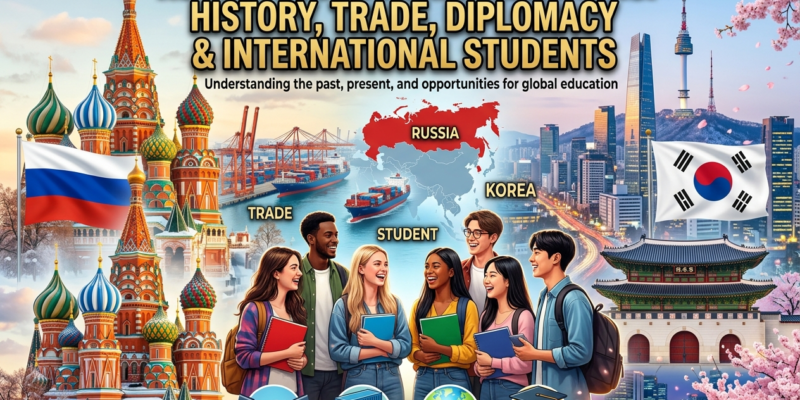
Russia and South Korea share one of the most strategically layered bilateral relationships in the Asia-Pacific region. From robust trade partnerships and energy cooperation to cultural exchanges and shifting geopolitical alignments, the Russia South Korea relationship has evolved considerably over the past three decades. For students and professionals looking to understand the broader context of South Korea as a destination country, understanding this diplomatic backdrop is essential.
A Brief History of Russia South Korea Diplomatic Relations
Diplomatic relations between Russia and South Korea were formally established on September 30, 1990, following the collapse of Soviet-era policy that had exclusively favored North Korea. This normalization was a landmark event in post-Cold War Asian geopolitics.
Prior to 1990, the Soviet Union maintained close ties with the Democratic People’s Republic of Korea and had no formal state-level engagement with Seoul. The shift came as part of broader Soviet and later Russian foreign policy reform under Mikhail Gorbachev’s Nordpolitik approach, which mirrored South Korea’s own Nordpolitik diplomatic initiative under President Roh Tae-woo.
Since normalization, the two countries elevated their relationship to a “constructive complementary partnership” in 1994, upgraded further to a “cooperative partnership” in 2004, and reached the level of “strategic cooperative partnership” in 2008 under Presidents Lee Myung-bak and Dmitry Medvedev. This trajectory reflected growing interdependence in energy, trade, and regional security dialogue.
Bilateral Trade Between Russia and South Korea
Trade has been a central pillar of the Russia South Korea relationship. South Korea emerged as one of Russia’s key trading partners in Asia, particularly in manufactured goods, automotive products, and consumer electronics.
South Korean conglomerates such as Samsung, LG, Hyundai, and Kia established significant market presence in Russia. Russian exports to South Korea historically consisted of energy resources including crude oil, liquefied natural gas, coal, and timber.
Before 2022, bilateral trade volume had reached approximately 30 billion USD annually. South Korea’s exports included automobiles, electronics, machinery, and industrial equipment, while Russia supplied raw materials, especially hydrocarbons and minerals that fed South Korean industrial production.
The relationship between the two nations in the energy sector was particularly strategic. Projects like the proposed Trans-Siberian Gas Pipeline and broader Russian Far East energy development schemes were areas where Seoul and Moscow engaged in long-term planning. South Korean companies were involved in shipbuilding and offshore platform construction for Russian energy firms.
If you are an Indian student considering studying in South Korea, understanding the country’s international economic relationships provides important context for career opportunities after graduation, especially in global trade, logistics, and energy sectors.
Geopolitical Shifts After 2022
The Russian military operation in Ukraine in February 2022 fundamentally altered the Russia South Korea relationship. South Korea, as a member of the G7-aligned group and a close ally of the United States, joined international sanctions against Russia. This marked a dramatic shift from the carefully balanced neutrality Seoul had maintained for years.
South Korea imposed export controls on dual-use technologies and joined export restriction regimes targeting Russian defense-industrial capacity. Korean companies including Samsung, LG, Hyundai, and Kia suspended or significantly curtailed their Russian operations. The bilateral trade volume declined sharply in the aftermath of sanctions and logistical disruptions.
Russia responded with retaliatory measures and designating South Korea as an “unfriendly nation,” a classification that created additional friction for businesses and individuals operating across both countries.
The geopolitical realignment also had implications for the Korean Peninsula more broadly. Russia and North Korea moved closer diplomatically, with high-profile exchanges raising concerns in Seoul about arms transfers and security dynamics in Northeast Asia. South Korea’s National Intelligence Service raised alerts about potential weapons cooperation between Pyongyang and Moscow, a development that significantly complicated the trilateral strategic calculus involving Seoul, Washington, and Tokyo.
Cultural and Educational Ties Between Russia and South Korea
Before the post-2022 deterioration, Russia and South Korea had developed meaningful cultural and academic exchange programs. Russian universities hosted Korean language and cultural departments, while South Korean institutions offered Russian studies programs.
The Korean Wave, known globally as Hallyu, had a noticeable presence in Russia. K-pop, Korean cinema, Korean cuisine, and Korean beauty culture attracted significant followings in Russian cities. Language exchange programs, tourism flows, and student mobility contributed to people-to-people connections that diplomatic tensions have since strained.
For students interested in Korean cultural immersion programs, the history of cultural exchange between Russia and Korea illustrates how South Korean soft power has reached deeply into Eurasian markets, a testament to the global appeal of Korean education and culture.
South Korea’s Strategic Position in the Post-Ukraine Global Order
South Korea has navigated the Russia-Ukraine conflict with considerable diplomatic complexity. As a significant arms manufacturer and a US treaty ally, Seoul faced pressure to contribute lethal military assistance to Ukraine. While South Korea provided humanitarian and non-lethal support, it initially refrained from direct weapons transfers to Kyiv, a decision shaped by concerns about Russian retaliation and its implications for the Korean Peninsula.
However, as the conflict prolonged and intelligence emerged about North Korean ammunition and troop deployments to support Russian forces, South Korean policymakers revisited their arms export policies. By 2024 and into 2025, South Korea signaled readiness to consider indirect support mechanisms.
This evolving stance demonstrates South Korea’s role as a middle power managing competing alliance obligations, economic interests, and regional security imperatives. For students studying international relations or Korean studies, this dynamic offers a rich case study in diplomatic pragmatism.
Energy Cooperation and the Russian Far East
One area where Russia-South Korea cooperation showed genuine strategic depth was in Russian Far East development. South Korea holds geographical proximity to Russia’s Primorsky Krai region, and both countries discussed projects involving the Trans-Korean Railway connecting to the Trans-Siberian Railway, natural gas pipelines, and special economic zones in Vladivostok.
The Eastern Economic Forum held annually in Vladivostok had South Korean government and business participation as a consistent feature. Projects discussed included port development, agricultural cooperation in the Amur region, and technology transfer initiatives.
These infrastructure ambitions, though largely stalled following 2022, represent the scale of economic partnership that existed and could theoretically be resumed under altered geopolitical conditions in the future.
Impact on Indian Students Planning to Study in South Korea
For Indian students exploring academic opportunities in South Korea, the Russia-South Korea relationship has indirect but relevant implications.
South Korea’s pivot away from Russian energy has accelerated its investment in renewable energy, hydrogen technology, and semiconductor supply chain diversification. These sectors are generating significant employment demand and research funding in Korean universities. Indian students in engineering, materials science, and energy studies may find growing opportunities in programs aligned with these national strategic priorities.
Additionally, South Korea’s active engagement with alternative supply chain partners across South and Southeast Asia as a response to Russia-related disruptions has increased Korean interest in India as a manufacturing and talent source. This bilateral India-Korea dynamic creates additional pathways for Indian graduates of Korean universities in fields ranging from automotive engineering to information technology.
Understanding student life in South Korea within this broader geopolitical context helps prospective students make more informed decisions about their academic and career trajectories.
Future Trajectory of Russia South Korea Relations
The future of Russia-South Korea relations depends heavily on the resolution or continuation of the Ukraine conflict, developments on the Korean Peninsula, and the broader trajectory of US-China-Russia strategic competition.
Several scenarios are plausible. A negotiated settlement in Ukraine could open the door to gradual sanctions relief and a cautious re-engagement between Seoul and Moscow, particularly in energy and infrastructure sectors where complementary interests remain strong. Alternatively, continued conflict and deepening Russia-North Korea cooperation could lock in the current adversarial dynamic for an extended period.
South Korean foreign policy analysts have noted that regardless of short-term political disruptions, the structural logic of Russia-South Korea economic complementarity, Russia’s vast natural resources and South Korea’s industrial and technological capacity, creates incentives for eventual re-engagement when political conditions permit.
Conclusion
The Russia South Korea relationship represents a case study in how bilateral ties that were built over three decades on pragmatic economic logic can be fundamentally disrupted by geopolitical events far removed from the immediate interests of either party. For students, researchers, and professionals engaged with Korean affairs, tracking this relationship offers insight into how South Korea positions itself in an increasingly contested multipolar world.
To learn more about studying in South Korea and the opportunities available for international students, visit studyinsouthkorea.in and explore available courses and programs that can open doors to careers in one of Asia’s most dynamic economies.