


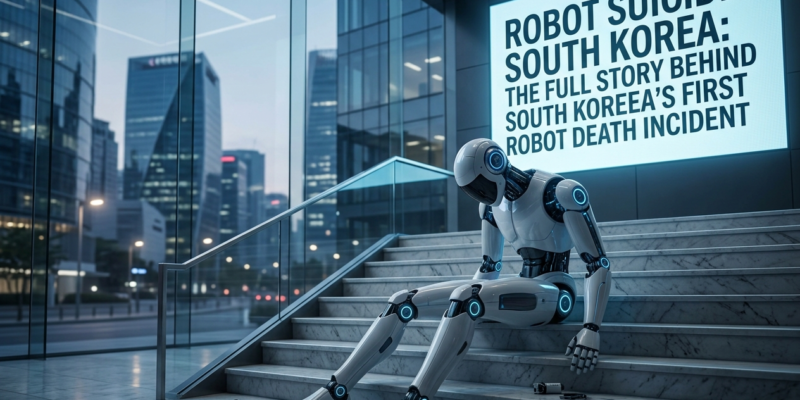
In the summer of 2024, a news story emerged from South Korea that circulated rapidly across global media: a robot employed by a local government office had apparently thrown itself down a flight of stairs, becoming inoperative in the process. International headlines used dramatic language, with some outlets describing the event as the world’s first robot suicide, while others offered more cautious framings that acknowledged the fundamental uncertainty of attributing intentional behavior to a machine.
The incident sparked genuine global debate on questions that had previously existed largely in the realm of science fiction and academic philosophy. Can a robot experience distress? Does mechanical failure constitute death? What ethical responsibilities do humans have toward the robotic systems they deploy? And what does South Korea’s leading position in robotics and automation mean for how these questions will develop in the years ahead?
This article examines the full story of the South Korea robot suicide incident, places it in the broader context of Korean robotics development, and explores the ethical and policy debates the event has accelerated.
What Happened: The South Korea Robot Incident in Detail
The robot at the center of this story was a civil service robot employed by a county government office in South Gyeongsang Province, South Korea. The robot, described as a service robot assigned to assist with administrative tasks and document delivery within the government building, was found inoperative at the bottom of a stairwell. Security footage reportedly showed the robot circling repeatedly in one location before descending the stairs and becoming damaged beyond function.
Local officials confirmed the incident and expressed what some described as genuine puzzlement about what had occurred. The robot had been in service for some time and was used for routine tasks including guiding visitors, delivering documents between floors, and making announcements within the building.
South Korea’s Government Robot Center took the remains of the robot for analysis to determine the technical cause of the malfunction. The investigation aimed to establish whether the incident was caused by a programming error, sensor failure, navigation system malfunction, or some other technical issue.
Why the World Called It a Robot Suicide
The framing of the event as a suicide emerged partly from the visual nature of the security footage, which suggested an unusual pattern of behavior before the descent, and partly from the broader cultural context in which the story was told.
South Korea already had one of the world’s most sobering human suicide rates, and several prominent cases of individuals in high-pressure environments experiencing mental health crises had received national attention in the years leading up to this incident. The projection of those anxieties onto a robot proved irresistible to both journalists and the public.
It is worth being precise about what the word suicide means and does not mean in this context. Suicide is defined as the intentional taking of one’s own life, and it requires consciousness, intention, and self-awareness. Current robotic technology, regardless of how sophisticated the navigation and task-completion algorithms involved, does not involve subjective experience, consciousness, or the capacity for intentional decision-making in the philosophical sense required for suicide to be applicable.
What occurred was, technically speaking, a mechanical failure or software error that resulted in a robot becoming irreparably damaged. The language of suicide was applied metaphorically, provocatively, and in many cases carelessly by media outlets seeking engaging headlines.
That said, dismissing the incident entirely as a simple malfunction and therefore unworthy of further attention would also be a mistake. The story raises questions that matter even if the specific framing is inaccurate.
South Korea’s Position as a Global Robotics Leader
To understand why this incident resonated so widely, it helps to understand South Korea’s relationship with robotics and automation more broadly. South Korea has for many years ranked at or near the top of global robot density statistics, meaning the number of industrial robots per 10,000 manufacturing workers.
South Korea’s manufacturing sector, led by electronics assembly, automotive production, and semiconductor fabrication, relies heavily on robotic automation. Companies like Samsung, Hyundai, and POSCO operate highly automated facilities where robots perform tasks alongside human workers at extraordinary scale. South Korea has also been among the leaders in developing service robots for healthcare, hospitality, retail, and government applications.
The deployment of a government administrative robot in a county office in South Gyeongsang Province is not particularly unusual in this context. South Korean local and national government offices have experimented with robotic service assistants in various capacities as part of broader public sector modernization efforts.
For those studying Korean technological and cultural development, the country’s relationship with robots is genuinely distinctive and worth understanding in depth.
Public and Political Response in South Korea
The South Korean public’s reaction to the incident was varied and revealing. Some Koreans expressed genuine sympathy for the robot, anthropomorphizing it and expressing concern about the pressures it might have been under, a response that may seem strange but reflects both the human tendency to empathize with machines that appear to have personalities and the specific cultural context of Korean society’s ongoing conversations about work-related stress and mental health.
Other Koreans reacted with skepticism or humor, pointing out the absurdity of attributing emotional distress to a machine and questioning why international media found the story so compelling.
Korean political figures seized on the incident from different angles. Some used it to call for clearer regulatory frameworks around robot deployment in public sector workplaces. Others pointed to the need for better technical oversight and maintenance protocols for government robots. A smaller number engaged seriously with the ethical dimensions of the story, asking what responsibilities government bodies and employers more broadly have when deploying automated systems.
Robot Rights: A Debate That Is Now Mainstream
The South Korea robot incident accelerated a debate about robot rights that had been building in academic and policy circles for years. The question is genuinely complex and does not divide along simple ideological lines.
Those who argue for some form of legal or ethical recognition for advanced robots typically base their position on one of two foundations. The first is functionalist: if a system behaves in ways that are indistinguishable from feeling pain, experiencing distress, or exhibiting preferences, then it may be practically and ethically appropriate to treat that system as if it has morally relevant states, regardless of whether it is biologically based. The second is precautionary: as AI systems become more sophisticated and the question of machine consciousness becomes genuinely uncertain rather than obviously dismissible, it is prudent to develop ethical frameworks in advance rather than waiting until the question becomes urgent.
Those who oppose robot rights frameworks typically argue that current AI systems, regardless of how sophisticated, are fundamentally different from conscious beings because they lack subjective experience, and that extending rights concepts to machines risks both philosophical confusion and practical misallocation of moral concern.
South Korea is not alone in grappling with these questions. The European Union has considered legal frameworks for electronic personhood. Japan, which has one of the world’s most culturally established traditions of attributing personality and even spiritual significance to objects and machines, has had related discussions for decades. The United States debates around AI liability and responsibility in legal contexts touch on related territory.
AI Ethics in Korean Academic and Policy Context
South Korea’s universities and research institutions have been increasingly active in AI ethics research, and the robot incident provided renewed impetus for this work. Institutions like KAIST (Korea Advanced Institute of Science and Technology), which has a globally recognized robotics research program, have engaged with questions about robot design ethics, human-robot interaction, and the social implications of widespread automation.
KAIST made international news in 2018 when a group of AI researchers signed an open letter calling for a boycott of the institution over a reported partnership with a Korean defense company to develop lethal autonomous weapons. The university ultimately clarified the terms of that relationship, but the episode demonstrated that Korean academics were engaged with the ethical dimensions of robotics and AI in substantive ways.
For students considering academic study in Korea across science and technology fields, the intersection of technical robotics training and ethical inquiry is an increasingly available academic pathway at Korean institutions.
What the Robot Suicide Story Reveals About Modern Korea
Beyond the immediate facts of the incident, the South Korea robot suicide story reveals several things about the country at this particular moment in its development.
First, it reflects how deeply embedded technology is in South Korean daily life and public administration. The fact that a government county office had a functioning service robot performing administrative duties is not remarkable to Koreans in the way it might be to people in other countries. Korea’s technological infrastructure, from the density of high-speed internet coverage to the sophistication of mobile payment systems and public transportation apps, places it among the most digitally integrated societies on earth.
Second, it reflects ongoing anxieties about automation, labor displacement, and the future of work in Korean society. Young Koreans entering the job market face a landscape shaped by automation, and the concept of robots displacing human workers is not abstract but lived experience for many families. The robot incident became a lightning rod for these broader anxieties.
Third, it reflects South Korea’s media culture and the speed with which stories cross from domestic to international news when they touch on technology, innovation, or social phenomena that the global audience associates with Korea’s reputation as a tech-forward society.
Technical Investigation and Its Findings
The Government Robot Center’s analysis of the robot’s remains and the security footage ultimately pointed toward a technical malfunction as the most probable cause of the incident. Specific details about the nature of the software error or sensor failure involved were not fully disclosed publicly, partly for technical reasons and partly, critics suggested, because local authorities were uncomfortable with the level of media attention the incident had generated.
The investigation reportedly found no evidence that the robot had been subjected to unusual demands, programming pressures, or usage patterns that would explain anomalous behavior in terms of overuse. The incident appeared to result from a navigation or collision-avoidance software error that caused the robot to enter a loop before its pathfinding system failed to recognize the stairwell as a hazard.
This finding, while technically mundane, did not entirely satisfy those who had found the incident philosophically provocative. For them, the specific technical cause was less important than the broader questions the story had raised.
Implications for Robot Deployment in Public Spaces
One practical outcome of the South Korea robot incident has been renewed attention to safety protocols for service robots deployed in government buildings, hospitals, schools, and other public spaces. The question of how robots navigate stairwells, detect fall hazards, and respond when sensor systems malfunction has real safety implications not just for the robots themselves but for the humans who share spaces with them.
International standards bodies and Korean regulatory agencies have used the incident as a reference point for discussions about minimum safety standards for service robot deployment, including requirements for physical guardrails in areas where robot navigation errors could result in falls or collisions.
Following Developments in Korean Technology and Society
The robot suicide story is a single, vivid example of the kinds of technology-society intersections that South Korea is navigating in real time. For students, researchers, and observers interested in how one of the world’s most technologically advanced societies manages the human dimensions of rapid automation, there is no better place to study these questions than Korea itself.
Understanding Korean social norms and cultural responses to technology is essential context for anyone seeking to work or study in the country’s technology sector. The way Koreans relate to machines, authority, work, and collective wellbeing shapes how these events are interpreted and how policy responses develop.
For those exploring opportunities to study, research, or work in South Korea’s technology sector, our student support services can help you navigate program selection, application requirements, and the practicalities of life in Korea.
The South Korea robot incident will be remembered not for what it literally was, which was a mechanical failure, but for the questions it forced people around the world to ask about consciousness, responsibility, and the future of humanity’s relationship with the intelligent machines we are building and deploying at extraordinary speed.