


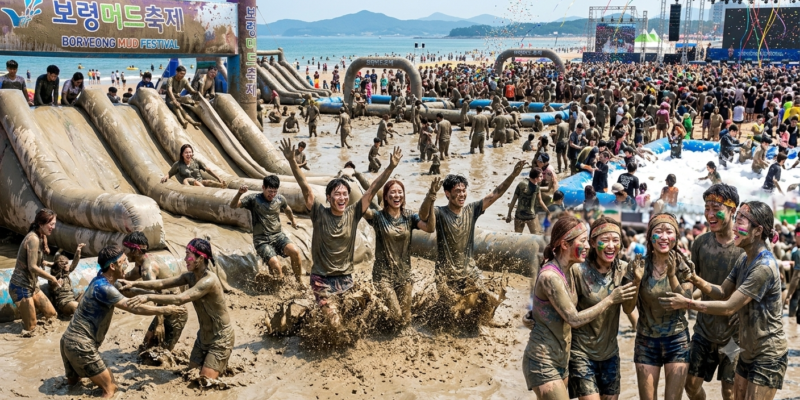
The South Korea Mud Festival, officially known as the Boryeong Mud Festival (보령 머드 축제), is one of the most iconic, exhilarating, and internationally recognized cultural events in the Korean calendar. Every summer, hundreds of thousands of visitors, both Korean locals and international tourists, descend on the coastal city of Boryeong in South Chungcheong Province to participate in one of the world’s most uniquely joyful festivals.
This comprehensive guide covers everything from the history and origins of the festival to practical travel logistics, accommodation options, what to bring, how to enjoy the experience fully, and how the mud festival fits within the broader landscape of famous things of South Korea that draw visitors from around the world.
What Is the South Korea Mud Festival
The Boryeong Mud Festival is an annual outdoor summer festival held on and around Daecheon Beach (대천해수욕장), one of South Korea’s most popular coastal stretches. The festival centers on mud sourced from the tidal flats of Boryeong, which is renowned for its mineral-rich composition said to have significant skincare and therapeutic benefits.
The core experience involves participants covering themselves, their friends, and willing strangers in gray-brown mineral mud through a spectacular array of activities including mud wrestling, mud slides, mud pools, mud obstacle courses, mud painting, and mud prison games. Live music, food stalls, fireworks, and military demonstrations round out the broader festival program.
What began as a regional marketing initiative for Boryeong’s cosmetics industry has evolved into an internationally famous event that has been covered by major media outlets worldwide and placed on bucket lists across Asia, Europe, and North America.
The festival is deeply connected to the K-culture of celebration, community, and the Korean philosophy of enjoying shared experiences with full commitment.
History and Origins of the Boryeong Mud Festival
Understanding how the Boryeong Mud Festival came to exist reveals interesting dimensions of South Korean local government creativity and economic strategy.
The cosmetics connection:
Boryeong is located along a stretch of the Yellow Sea coast where the tidal mud flats contain high concentrations of germanium, bentonite, and various mineral compounds. Local cosmetics companies including Cosmecca Korea discovered that this mineral-rich mud had legitimate skincare properties, including moisture retention, exfoliation, and potentially anti-inflammatory benefits.
In the early 1990s, the Boryeong city government and local cosmetics industry began marketing Boryeong mud as a premium ingredient in skincare products. However, building consumer awareness required creative promotional approaches.
Birth of the festival:
In 1998, city officials and local entrepreneurs launched the first Boryeong Mud Festival as a marketing vehicle for Boryeong’s cosmetics products and as a summer tourism draw for the beach city. The concept was straightforward but brilliantly executed: invite people to play in the mud, demonstrate the mud’s skincare properties through direct experience, and position Boryeong as a summer destination.
The first festival attracted approximately 200,000 visitors, a remarkable success that immediately established the event as an annual fixture.
International recognition:
By the mid-2000s, the Boryeong Mud Festival had become famous among the significant community of foreign military personnel stationed at US military bases in South Korea, particularly Camp Humphreys and Osan Air Base. Thousands of American and other international military personnel attended annually, and their social media sharing and word-of-mouth recommendations spread awareness of the festival globally.
By the 2010s, the Boryeong Mud Festival was appearing in international travel media as one of Asia’s “must-do” summer experiences, attracting organized tour groups from Japan, China, Southeast Asia, Australia, and North America.
Today the festival attracts between 2 and 3 million total visitors across its duration, with international visitors consistently accounting for 30 to 40 percent of attendance.
Boryeong Mud Festival 2026: Dates and Schedule
The Boryeong Mud Festival 2026 is scheduled for mid-July, running approximately two weeks. Based on the established annual pattern, the festival typically runs from the second Friday of July through the third Sunday of July.
For 2026, the expected dates are July 17 to July 26, 2026, though visitors should confirm exact dates through official Boryeong city tourism channels as announcements are typically finalized in late spring.
Peak days:
The opening weekend (first Saturday and Sunday) and closing weekend are the most heavily attended periods. If you prefer the full festival atmosphere with maximum crowds and energy, these are the ideal days to visit.
Weekdays during the festival offer a somewhat less crowded experience while still featuring the core mud activities, performances, and food culture.
For those planning a visit within a 7-day South Korea itinerary, scheduling Boryeong as a day trip from Seoul or as part of a coastal exploration of South Chungcheong Province fits well within a comprehensive Korea travel plan.
Festival Location: Daecheon Beach and Boryeong City
Daecheon Beach (대천해수욕장) is the heart of the Boryeong Mud Festival. The beach stretches approximately 3.5 kilometers along the Yellow Sea coast and is one of the most developed beach resort areas in South Korea.
The surrounding city of Boryeong (population approximately 100,000) serves as the festival’s infrastructure base. Accommodations, restaurants, and transportation hubs are concentrated in the areas directly around the beach and the city’s main commercial district.
Geographic context:
Boryeong is located in South Chungcheong Province (충청남도), approximately 200 kilometers southwest of Seoul. The journey from Seoul takes between 1.5 and 2.5 hours depending on transportation mode.
The beach faces the Yellow Sea (West Sea in Korean usage), which is characterized by significant tidal variations. The tidal flats that produce Boryeong’s famous mineral mud are visible at low tide and are part of the ecological and economic identity of the entire coastal region.
How to Get to the Boryeong Mud Festival from Seoul
Transportation logistics are one of the most common planning questions for first-time attendees. South Korea’s excellent public transportation makes the journey from Seoul very manageable.
By train (recommended):
The KTX high-speed train does not currently serve Boryeong directly, but a combination route using the Janghang Line is available. Take the KTX from Seoul Station to Cheonan-Asan Station (approximately 35 minutes), then transfer to the Janghang Line to Daecheon Station (approximately 1 hour 20 minutes). The full journey from Seoul to Daecheon Station takes approximately 2 hours.
During festival season, additional train services are typically added to handle increased demand. Booking tickets in advance through the Korail website or app is strongly recommended, particularly for weekend dates.
By express bus:
Express buses run directly from Seoul Express Bus Terminal (Gangnam) to Daecheon Bus Terminal in Boryeong. The journey takes approximately 2 to 2.5 hours depending on traffic. Buses run frequently throughout the day and are comfortable with guaranteed seating when booked in advance.
By private vehicle or chartered bus:
Driving from Seoul via the Seohaean Expressway takes approximately 2 hours under normal traffic conditions. During peak festival weekends, congestion near Boryeong can add significant time. Festival-specific shuttle buses also operate from Boryeong city to the beach area.
Festival shuttle buses:
During the festival, free or low-cost shuttle buses run continuously between Boryeong Station, the bus terminal, and Daecheon Beach. This is the most convenient option once you reach the city.
The transportation infrastructure connecting Seoul to Boryeong is part of the excellent national network that makes traveling throughout South Korea so accessible for both domestic and international visitors.
Main Activities at the Boryeong Mud Festival
The festival offers a remarkable range of mud-themed activities across the beach and adjacent areas. Here is what to expect:
Mud Experience Zone (머드체험존):
The central attraction area features designated pools filled with Boryeong mineral mud. Visitors can wade in, apply mud to themselves and companions, and experience the full immersive mud experience in a controlled environment. This zone is free to access with festival entry and is the quintessential Mud Festival experience.
Mud Slides:
Large inflatable slides coated in mud deliver participants into shallow mud pools below. The slides are set up along the beach and operate continuously during festival hours. Queue times are longest on weekend afternoons.
Mud Obstacle Course:
One of the most physically engaging elements, the mud obstacle course challenges participants to crawl through tunnels, climb over barriers, and navigate through stretches of mud within a timed competitive format. Teams can compete together, and the course has become a beloved festival tradition.
Mud Wrestling:
Organized mud wrestling competitions run throughout the festival. Both competitive formats (with prizes for winners) and casual open wrestling areas allow participants of all fitness levels to engage. This is consistently one of the most photographed and remembered festival activities.
Mud Prison:
A uniquely Korean festival game where participants are placed in a mud enclosure and challenged to escape without being recaptured by guards who are also armed with mud. The game is entirely good-natured and typically ends with both “prisoners” and “guards” thoroughly covered.
Mud Massage and Skincare:
In a more sedate corner of the festival experience, trained staff apply Boryeong mineral mud as a face pack and body treatment, allowing participants to experience the cosmetic properties that launched the festival concept. This is particularly popular with visitors specifically interested in K-beauty culture.
Fireworks:
Evening fireworks displays over the Yellow Sea are one of the festival’s most visually spectacular elements. The displays run on select evenings throughout the festival period, with the closing night fireworks being the most elaborate.
Military Demonstration:
The Korean military, particularly helicopter units and special forces teams, performs demonstrations during the festival that draw large crowds. The demonstrations have become a beloved festival tradition that adds spectacle beyond the mud activities.
Live Music and Cultural Performances:
The festival features extensive live music across multiple stages, covering K-pop, indie rock, traditional Korean music (gugak), and international acts. Evening concerts are free with festival entry and contribute significantly to the festive atmosphere.
What to Wear and Bring to the Mud Festival
First-time attendees are often uncertain about what to pack. Here is a practical guide:
Clothing:
Wear clothes you do not mind ruining. Old t-shirts, shorts, and swimwear are ideal. Many visitors choose to buy inexpensive festival-branded clothing at Daecheon Beach shops or bring designated “mud clothes” they discard afterward.
Swimwear underneath is highly recommended as clothing will be completely saturated with mud.
Avoid wearing anything with significant sentimental or monetary value.
Footwear:
Waterproof sandals or old sneakers that you can rinse off easily. Some participants prefer to go barefoot on the beach, but the mud obstacle course and some areas require foot protection.
Protection:
Sunscreen is absolutely essential. Korean summers are intensely sunny, and the beach environment accelerates sunburn. Apply high-SPF sunscreen (SPF 50+) before attending and bring additional applications for reapplication after mud removal.
A hat for when you are not in the mud areas is also advisable.
Waterproof phone case:
Your phone will be in danger of mud damage throughout the festival. A waterproof case or pouch (available at convenience stores near the beach) is a worthwhile investment.
Contact lens considerations:
Those who wear contact lenses should consider wearing glasses on mud activity days or using daily disposable lenses that can be discarded after the festival.
Towels and change of clothes:
Showering facilities are available at the beach (fee-based), and changing areas are provided. Bringing two to three towels and a complete dry change of clothing is essential for a comfortable departure from the festival.
Cash:
While South Korea’s cashless payment infrastructure is excellent in cities, busy festival environments benefit from having some cash on hand for food stalls, small vendors, and locker rentals.
Where to Stay for the Boryeong Mud Festival
Accommodation around Daecheon Beach books out extremely quickly for festival weekends. Planning ahead is essential.
Daecheon Beach Area (Boryeong):
The beach area itself has numerous guesthouses, minbak (Korean-style homestay accommodation), pensions (Korean resort pensions typically offering simple rooms with outdoor cooking facilities), and motels. These fill up within hours of becoming available for festival weekends, sometimes months in advance.
Expect significant price increases during festival dates compared to standard summer rates. A budget pension room that normally costs 80,000 KRW per night may cost 150,000 to 200,000 KRW during peak festival weekend.
Glamping and camping:
Several glamping and camping facilities operate near Daecheon Beach and are popular with groups of younger Korean visitors and families. These require early reservation but can offer a fun outdoor festival experience.
Boryeong City Center:
Staying in the city center rather than directly on the beach offers more availability at slightly lower prices. Festival shuttle buses make the commute to the beach manageable.
Day trip from Seoul:
Many visitors, particularly those with limited time or budget, treat the Mud Festival as a day trip from Seoul. The 2 to 2.5 hour journey each way is manageable, though it requires an early start. This approach avoids accommodation pressure entirely.
For those incorporating Boryeong into a broader Korean adventure, the complete South Korea 7-day itinerary guide suggests how to sequence coastal experiences with Seoul and other destinations.
Food at the Boryeong Mud Festival
The festival environment creates a vibrant street food culture alongside the mud activities. Daecheon Beach is already known for seafood, and the festival amplifies the food experience significantly.
Must-try festival foods:
Haemul pajeon (해물파전) are savory seafood pancakes made with green onions and various shellfish and squid. The Boryeong coast’s proximity to Yellow Sea fishing grounds means the seafood is exceptionally fresh.
Ganjang gejang (간장게장) is raw crab marinated in soy sauce and is a regional Chungnam specialty. Locals refer to it as “rice thief” because it is so flavorful it makes you eat extra rice.
Jjukkumi (쭈꾸미) are small octopus served stir-fried with spicy sauce, skewered and grilled, or in a hot pot preparation. These are a quintessential Korean beach food experience.
Corn on the cob (옥수수) grilled at beach stalls is deceptively simple but consistently excellent at Korean summer festivals.
Tteokbokki (떡볶이) and fried chicken are ubiquitous Korean comfort foods available everywhere at the festival. They serve as ideal post-mud recovery food.
The food culture at the Mud Festival exemplifies how Korean events weave culinary experience into celebration, a dimension explored throughout the Korean culture section of Study in South Korea.
The Mud Festival for International Students in South Korea
For the large and growing community of international students studying at Korean universities, the Boryeong Mud Festival represents an unmissable summer experience that combines cultural immersion with pure outdoor fun.
The festival timing (mid-July) falls during the summer semester break at most Korean universities, making it perfectly positioned for student attendance. Most university international student offices organize group trips to the festival, providing transportation, accommodation coordination, and Korean student companions to enhance the experience.
For Indian students in particular, the Mud Festival offers a distinct form of cultural participation that differs fundamentally from familiar Indian festival experiences. The emphasis on physical participation, communal joy, and complete surrender to a messy, uncontrolled environment has a liberating quality that resonates across cultural backgrounds.
The festival is also one of the most genuinely inclusive events in South Korea’s calendar. Language barriers virtually disappear when everyone is covered in the same mud. This shared experience is a powerful bridge-builder among the diverse international student communities at Korean universities.
Those exploring student life in South Korea consistently rank the Mud Festival among the most memorable experiences of their Korean university years.
Tips for Getting the Most Out of the Mud Festival
Based on the experience of repeat festival attendees, here are the most useful practical tips:
Arrive early on weekend days. The most popular activity areas develop significant queues by mid-morning. Arriving when the festival grounds open (typically around 9 or 10 AM) gives access before the largest crowds arrive.
Designate a meeting point with your group before entering the mud areas. Mobile phones in waterproof pouches may be unreliable in the middle of mud pools, and groups frequently separate. Agree on a landmark meeting point in advance.
Rent a locker. Storage facilities near the beach allow you to lock valuables before entering mud activities. This is essential for passports, wallets, and non-waterproofed electronics.
Rinse thoroughly before leaving. Shower facilities at the beach charge a small fee but are essential for removing mud before traveling home or to accommodation. Mud left in hair and ears overnight is significantly more difficult to remove.
Budget for transport on return. The journey back to Seoul on Sunday evenings is extremely busy. Book your return train or bus ticket in advance and build in extra time for the inevitable delays caused by festival crowds.
Stay hydrated. July in South Korea is intensely hot and humid. The physical activities and sun exposure at the festival create real dehydration risk. Carry a water bottle and refill it consistently throughout the day.
Respect the environmental guidelines. Festival organizers have implemented measures to minimize the ecological impact of the event on the tidal flat ecosystem. Following the designated activity zones and disposal guidelines is part of responsible festival participation.
Beyond the Beach: Boryeong City and South Chungcheong Province
Extending your visit beyond the beach and festival grounds reveals a genuinely rewarding Korean regional destination.
Muchangpo Beach: A quieter beach about 30 kilometers north of Boryeong known for a remarkable natural phenomenon: at low tide, the sea parts to create a narrow walkable path to Seokdaedo island, earning it comparisons to the “Moses Miracle” effect. This phenomenon occurs on specific days and is entirely natural, driven by tidal patterns.
Boryeong Coal Museum (보령석탄박물관): An unexpected but genuinely interesting museum documenting the coal mining history of South Chungcheong Province, which was an important energy production region during South Korea’s industrialization period.
Cheosu Bay Sunset: The area around Boryeong offers some of South Korea’s most spectacular Yellow Sea sunsets, particularly from elevated viewpoints above the tidal flats. Sunset timing in July falls around 7:45 to 8:00 PM and creates extraordinary viewing conditions.
Haemieupseong Fortress: Located in nearby Haemi town, this remarkably well-preserved Joseon Dynasty fortress town wall dates to 1491 and offers a compelling contrast to the beach festival atmosphere. The walled town area contains a tree famous in Korean Christian history where Catholics were executed during 19th century religious persecution.
Environmental Considerations and Festival Sustainability
As the Boryeong Mud Festival has grown, organizers have faced increasing scrutiny over its environmental impact on the Yellow Sea coastal ecosystem, which includes internationally significant wetlands and tidal flat habitats.
Boryeong’s tidal flats (갯벌) are part of the broader Yellow Sea tidal flat ecosystem recognized for its importance to migratory shorebird populations and unique marine biodiversity. Several sections of South Korean and Chinese Yellow Sea tidal flats have been designated UNESCO World Heritage Sites due to their ecological significance.
Festival organizers have responded to environmental concerns by restricting mud extraction, using recycled water systems in mud pools, implementing waste management protocols, and educating visitors about the ecological value of the tidal flat environment.
Visitors who want to combine festival attendance with environmental awareness can participate in organized beach cleanup activities that take place during the festival period.
The Boryeong Mud Festival and Korean Community Values
The Mud Festival is more than entertainment. It embodies several core values embedded in Korean social culture that are worth understanding for anyone seeking deeper engagement with Korean society.
Nunchi (눈치) and communal participation: Korean social culture emphasizes reading the group atmosphere and participating appropriately. The Mud Festival is an explicit invitation to abandon inhibition and fully participate in shared experience, a form of social bonding (jeong, 정) that runs deep in Korean community values.
Han (한) and joy: The Korean concept of han describes a mixture of sorrow, endurance, and resilience. Korean celebration festivals like the Mud Festival are sometimes interpreted as expressions of collective release and joy that balances this cultural undertone, creating uninhibited communal happiness.
Seasonal celebration: Traditional Korean culture marks seasonal transitions with festivals and communal gatherings. The Mud Festival fits within this tradition, aligning with the arrival of summer and the farming calendar’s period of relaxation before harvest preparation.
Understanding these cultural dimensions transforms the Mud Festival from a novelty tourist attraction into a window into Korean community life. For those who want to understand Korean manners and social customs more deeply, observing how Koreans navigate the joyful chaos of the Mud Festival is genuinely instructive.
Conclusion: Why the South Korea Mud Festival Belongs on Your Korean Bucket List
The South Korea Mud Festival at Boryeong is unlike any other event in East Asia. It combines the sensory experience of mineral-rich mud play, the beauty culture context of Korean skincare traditions, the energy of live music and summer beach atmosphere, and the warmth of Korean communal celebration into an experience that stays with visitors for a lifetime.
For international students at Korean universities, it is a rite of passage that creates bonds and memories across cultural backgrounds. For tourists exploring Korea’s coastal regions, it is an anchor experience that reveals a spontaneous, joyful dimension of Korean culture not visible in city museums or temples. For anyone seeking to understand what makes South Korea a truly distinctive destination, the Mud Festival offers an unforgettable answer.
Plan your visit, book your transport early, pack your worst clothes, and prepare to discover why hundreds of thousands of people travel to a small coastal city every July to cover themselves in mud.
For more on planning your time in South Korea, from university admissions to travel itineraries, the Study in South Korea resource hub is your complete guide.