


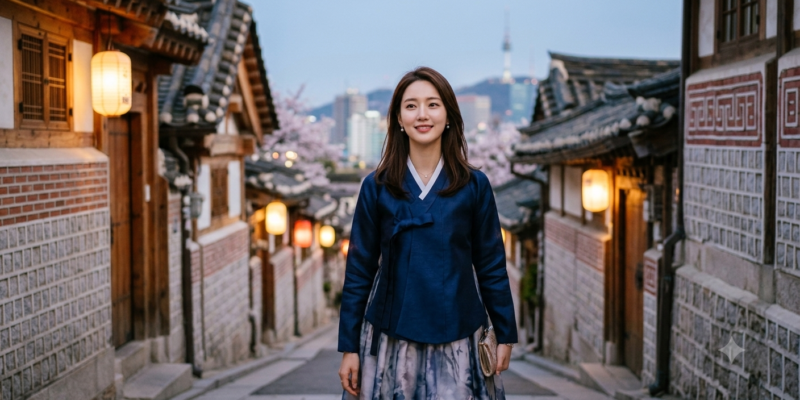
South Korea has become one of the world’s most recognized sources of beauty culture, fashion, and aesthetic influence. Discussions around the most beautiful woman in South Korea reflect not just individual recognition but an entire cultural framework around beauty that has shaped global trends. This guide explores Korean beauty ideals, the most recognized and celebrated Korean women across entertainment, sports, and culture, the K-beauty industry that drives global cosmetics trends, and what this all means for those planning to visit or study in South Korea.
Understanding Korean Beauty Standards in 2026
Korean beauty standards have evolved significantly over the past two decades, shaped by the entertainment industry, social media, and changing social values. To understand which women are considered most beautiful in South Korea, it helps first to understand what beauty means within Korean cultural context.
Traditional Korean beauty ideals emphasized pale, clear skin (referred to as “baek-ok-gat-eun-pi-bu” or skin like white jade), graceful features, dark expressive eyes, and a composed, elegant manner. These ideals stretch back centuries and can be observed in Joseon Dynasty portraiture of the yangban (aristocratic) class.
Contemporary Korean beauty standards have broadened and in some ways intensified through the influence of K-pop and K-drama. The modern standard typically includes:
Clear, luminous skin with minimal visible pores or blemishes, achieved through elaborate skincare routines
A small V-shaped face with defined jawline and high cheekbones
Large, bright eyes with double eyelids (either natural or surgically assisted)
A small, straight nose
Slim, proportionate body with a focus on overall health and posture
Full, defined lips
These standards have been both celebrated for promoting skincare culture and criticized for creating unrealistic expectations. Increasingly, younger Koreans and Korean celebrities are pushing back against rigid beauty norms, promoting body positivity and natural beauty alongside traditional aesthetics.
Understanding these standards provides important context for the K-culture landscape that permeates South Korean society and has spread globally through the Korean Wave (Hallyu).
Most Celebrated Korean Women in Global Culture
Rather than offering a simple ranked list, this section highlights categories of Korean women who have been consistently recognized for their beauty, talent, and influence both within South Korea and internationally.
Korean Actresses Known for Beauty and Talent:
Song Hye-kyo is perhaps the most internationally recognized Korean actress and has appeared on virtually every list of most beautiful Korean women for over two decades. Her roles in productions like “Full House,” “Descendants of the Sun,” and “The Glory” made her a household name across Asia and beyond. She is recognized for porcelain skin, classic facial symmetry, and a consistent screen presence that has defined Korean actress beauty standards for a generation.
Jun Ji-hyun (also known as Gianna Jun) became internationally famous through “My Sassy Girl” in the early 2000s and returned to global prominence with “My Love from the Star.” She represents a distinct Korean beauty aesthetic characterized by strong features, height, and confidence that diverges slightly from the typical soft-featured standard.
Han Ga-in gained recognition for a delicate facial structure and porcelain complexion, appearing on beauty rankings consistently throughout the 2010s and into the 2020s. Her portrayal of natural-looking Korean beauty, without heavy cosmetic intervention, resonated broadly with audiences.
Kim Tae-hee is a former Seoul National University student whose academic credentials combined with widely recognized physical beauty made her a unique figure in Korean celebrity culture. She consistently ranks highly in Korean polls of most beautiful Korean women and has appeared in major advertising campaigns across Asia.
Son Ye-jin gained massive international recognition through the Netflix drama “Crash Landing on You,” which introduced her to a global audience. Her warm, expressive features and natural-looking beauty drew a new generation of admirers across Southeast Asia, India, and beyond.
K-pop Artists Recognized for Beauty:
The K-pop industry has produced many women globally recognized for beauty, with agency training and image cultivation creating polished, distinctive visual identities.
Jisoo from BLACKPINK has been called the “visual” of the group, a Korean entertainment term specifically denoting the member considered most traditionally beautiful. She became a global ambassador for Dior Beauty, reflecting international recognition of her appeal.
Irene from Red Velvet, whose real name is Bae Joo-hyun, became a reference standard for “face genius” (얼굴천재) in Korean fan culture, a term used for individuals whose face is considered extraordinarily beautiful even by the demanding standards of the entertainment industry.
Tzuyu from TWICE, despite being Taiwanese, has been recognized repeatedly in Korean beauty rankings and represents the international dimension of K-pop beauty standards that transcend national borders.
IU, whose real name is Lee Ji-eun, is unique in Korean celebrity culture for being recognized as much for her talent and authenticity as for her appearance. Her aesthetic is associated with natural, warm, approachable beauty rather than the polished perfection common in K-pop, and she has a devoted fanbase that spans generational demographics.
Women in Sports and Other Fields:
Korean beauty recognition is not limited to entertainment. Athletes including figure skater Kim Yuna, who won the 2010 and 2014 Olympic medals, have been recognized for combining athletic excellence with widely admired appearance. Golf has produced numerous Korean women recognized internationally both for competitive achievement and personal style.
The K-Beauty Industry: How South Korea Became the World’s Beauty Capital
The global fascination with the most beautiful women from South Korea is inseparable from the K-beauty industry, which has transformed global skincare and cosmetics over the past decade.
K-beauty market size:
South Korea’s beauty and personal care market generates approximately 13 to 15 billion USD annually in domestic sales alone. Exports of Korean cosmetics exceeded 8 billion USD in 2025, with primary markets in China, the United States, Japan, and Southeast Asia including India.
India has become one of the fastest-growing markets for K-beauty products, driven in large part by young Indian consumers exposed to Korean entertainment through Netflix and YouTube. This cultural connection is one reason the Study in South Korea destination has resonated strongly with Indian students.
The 10-step Korean skincare routine:
Perhaps the most globally influential export of K-beauty culture is the multi-step skincare routine that prioritizes skin health over heavy makeup coverage. The classic routine includes:
Oil cleanser to remove makeup and sunscreen
Water-based cleanser for deeper cleaning
Exfoliator (used two to three times weekly)
Toner to balance skin pH and provide initial hydration
Essence, a lightweight hydrating treatment unique to Korean skincare
Serum or ampoule targeting specific skin concerns
Sheet mask (used two to three times weekly)
Eye cream
Moisturizer
Sunscreen as the final and most critical step
This philosophy, sometimes condensed to fewer steps in practice, emphasizes prevention, hydration, and long-term skin health rather than short-term coverage.
Major K-beauty brands:
Amorepacific Group, the largest Korean beauty conglomerate, owns brands including Sulwhasoo, Laneige, Etude House, and Innisfree. Its premium brand Sulwhasoo is positioned as a luxury skincare line rooted in traditional Korean herbal medicine.
LG Household and Health Care is the second major conglomerate, owning brands including The History of Whoo, Ohui, and CNP. The History of Whoo positions itself around royal Korean court beauty traditions and is particularly popular in luxury Asian markets.
COSRX has become a globally popular K-beauty brand through social media, particularly known for its snail mucin products and acne-treatment items that gained viral attention on platforms like TikTok and Instagram.
Innisfree promotes a natural, Jeju Island-inspired aesthetic using ingredients sourced from the island. It operates retail stores across Asia and has expanded into Western markets.
Korean Beauty Culture and Its Connection to K-Culture
The beauty standards and celebrity culture around the most beautiful Korean women cannot be separated from the broader K-culture phenomenon that has reshaped global popular culture.
K-drama and beauty influence:
Korean dramas consistently feature actresses in highly produced visual environments that showcase Korean beauty ideals. The costumes, makeup, and lighting in K-drama productions are designed to present an aspirational aesthetic that viewers globally find compelling. When famous things of South Korea are discussed internationally, Korean actress beauty is frequently mentioned alongside food, technology, and cultural tourism.
K-pop visual culture:
Korean music companies dedicate enormous resources to visual production. Music videos, album photoshoots, and television appearances are designed with cinematic quality. The result is a visual identity for K-pop groups that is distinctive, polished, and globally appealing.
The “idol” system in Korean entertainment involves years of training before debut, during which appearance is cultivated alongside singing, dancing, and performance skills. This system has produced a generation of Korean women whose public presentation reflects extreme dedication to craft.
Social media and global reach:
Korean entertainment celebrities maintain massive social media followings globally. Instagram, YouTube, and TikTok have accelerated the spread of K-beauty tutorials, product recommendations, and Korean beauty culture to audiences in India, Southeast Asia, South America, and Africa who may never have consumed Korean content through traditional channels.
Indian audiences in particular have developed strong connections to Korean entertainment and beauty culture, creating demand for K-beauty products, Korean food, and Korean education that helps explain the growing interest in studying in South Korea after 12th grade.
The Korean Cosmetics Surgery Industry
Any honest discussion of beauty in South Korea must acknowledge the country’s prominent cosmetic surgery industry. South Korea is one of the world’s leading destinations for aesthetic procedures, and this plays a real role in shaping both individual appearances and broader beauty standards.
Scope of the industry:
South Korea performs more cosmetic procedures per capita than virtually any other country. The Gangnam district in Seoul, particularly the area around Apgujeong-dong, contains hundreds of aesthetic clinics and has become internationally synonymous with cosmetic surgery tourism.
Common procedures:
Double eyelid surgery (blepharoplasty) is by far the most common procedure in South Korea, undertaken by hundreds of thousands of Koreans annually. The procedure creates a fold in the upper eyelid to make eyes appear larger and more defined.
Rhinoplasty (nose reshaping) is the second most common category, typically focused on raising the nose bridge and refining the tip.
Facial contouring, including jaw reduction and cheekbone reduction surgery, remains a distinctly Korean aesthetic procedure designed to create the V-line facial profile considered ideal in Korean beauty culture.
Evolving attitudes:
A notable generational shift is occurring in Korean society around cosmetic surgery. Younger Koreans increasingly value natural beauty, with social media movements promoting “no-makeup selfies” and body positivity gaining traction. Many celebrities who were previously associated with an obviously altered appearance are now openly discussing natural beauty or reversing earlier procedures.
This shift reflects broader cultural evolution that Korean students studying abroad, including those at Korean universities in international environments, often discuss in nuanced ways.
Korean Beauty Compared to Indian Beauty Standards
For Indian audiences discovering Korean beauty through K-drama and K-pop, the comparison between Korean and Indian beauty standards offers interesting insights.
Similarities:
Both Korean and Indian beauty traditions strongly emphasize clear, healthy skin. Both cultures have elaborate skincare traditions rooted in natural ingredients (Korean ginseng, green tea, and snail mucin parallel Indian turmeric, neem, and sandalwood).
Both cultures value elegance and grace alongside physical appearance, with behavioral qualities (voice, manner, expression) considered part of overall beauty.
Hair care is prioritized in both traditions, with thick, lustrous hair considered a beauty asset.
Differences:
Indian beauty standards have historically celebrated darker, richer skin tones (though colorism remains a problematic issue in both countries). Korean standards emphasize pale skin, which reflects different historical and cultural contexts.
Eye appearance differs significantly: Korean beauty emphasizes large double-lidded eyes, while Indian beauty traditions have historically celebrated almond-shaped, kohl-lined eyes of varying lid configurations.
Body type ideals also differ, with Indian traditions more broadly celebrating curves at various points in history, while Korean standards have leaned toward a slimmer silhouette.
As global beauty culture evolves, these distinctions are both maintained and blurred, with Indian consumers adopting aspects of K-beauty while Korean brands increasingly customize formulations for South and Southeast Asian skin tones and concerns.
Beauty Tourism in South Korea
South Korea has successfully marketed itself as a beauty tourism destination, attracting visitors from across Asia, the Middle East, and beyond specifically for cosmetic procedures, skincare consultations, and access to K-beauty products at source.
For those visiting South Korea, whether as tourists or students, the beauty retail landscape alone is worth exploring. Areas to know:
Myeongdong (Seoul): The cosmetic shopping district with dozens of brand flagship stores and specialty beauty shops. International tourists flood this area specifically for K-beauty product shopping, often taking advantage of duty-free limits.
Olive Young: South Korea’s dominant health and beauty retail chain, found across every major city, functions as a beauty culture hub. Product launches, viral items, and exclusive collaborations make Olive Young visits a ritual for K-beauty enthusiasts.
Gangnam beauty clinics: International visitors who come specifically for cosmetic treatments navigate a well-developed industry of clinics offering multi-language consultations and medical tourism packages.
For those planning a visit as part of a 7-day South Korea itinerary, including a dedicated beauty shopping and wellness experience adds a uniquely Korean dimension to any trip.
Korean Women Who Made History Beyond Beauty
While this blog explores beauty recognition, it is worth honoring Korean women who have shaped their country and the world through achievement, courage, and intellect, qualities that represent their own form of beauty.
Queen Seondeok of Silla (7th century) was the first female ruler of a Korean kingdom, celebrated for her intelligence, political skill, and visionary leadership during a period of intense inter-kingdom conflict.
Shin Saimdang (16th century) was a poet, painter, calligrapher, and scholar during the Joseon Dynasty, and the first woman to appear on a Korean banknote (the 50,000 Won note). Her legacy combines artistic brilliance with the role of an exemplary mother who raised one of Korea’s greatest scholars.
Kim Yuna, figure skater, is widely considered the greatest South Korean athlete and one of the greatest figure skaters in history. Her achievements on the Olympic and world championship stage brought unprecedented international attention to South Korea and transformed figure skating globally.
These women reflect the depth of Korean women’s contribution to their society, a dimension that adds richness to any understanding of what Korean beauty truly encompasses.
Conclusion: Beauty in South Korea Is More Than Appearance
The concept of the most beautiful woman in South Korea is genuinely complex. It encompasses internationally celebrated actresses and K-pop artists, the skincare traditions embedded in daily Korean life, the industrial K-beauty complex reshaping global cosmetics, the evolving dialogue around natural beauty and body positivity, and the historical legacy of Korean women who shaped their civilization through talent and courage.
For visitors, students, and admirers of Korean culture worldwide, engaging with Korean beauty culture goes beyond aesthetics. It is an entry point into understanding Korean values around discipline, presentation, self-care, and cultural identity.
Those who choose to study in South Korea discover that Korean beauty culture, like so much else about the country, rewards deeper exploration beyond the surface.