


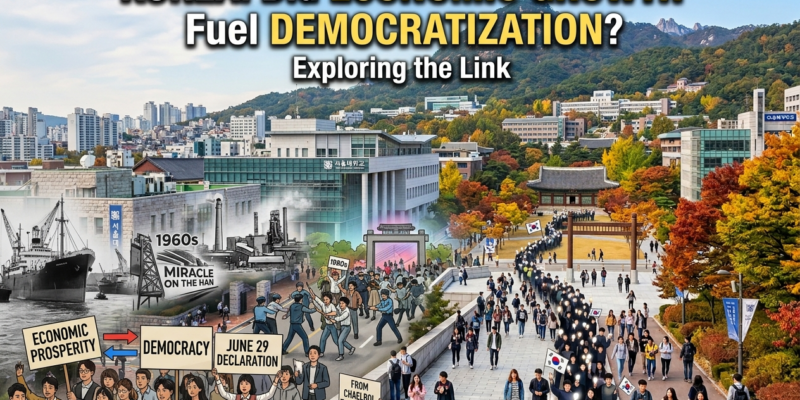
Did Economic Growth in South Korea Contribute to its Democratisation?
The relationship between economic prosperity and political freedom is one of the most debated topics in modern history. For those looking to study in South Korea, understanding this journey is essential. South Korea stands as a primary global example of how rapid industrialization can pave the way for a stable democracy. This phenomenon, often referred to as the “Miracle on the Han River,” suggests that economic development was not just a byproduct of stability but a primary driver for the country’s democratic transition.
The Economic Foundation of the Korean Democracy
In the early 1960s, South Korea was one of the poorest nations in the world. Under the leadership of Park Chung-hee, the country adopted an export-oriented industrialization strategy. This period of “compressed modernization” focused on building heavy industries and supporting massive family-owned conglomerates known as chaebols. While this era was marked by authoritarian rule, it simultaneously built the structural foundation for a future democracy. The rapid growth created a society that was increasingly urbanized and literate. As the nation moved away from agrarian roots, the shifting social landscape began to demand more than just economic security.
How Economic Growth Sparked Political Change
The connection between wealth and liberty is often explained through Modernization Theory. In the South Korean context, this theory manifested in several distinct ways:
- Emergence of the Middle Class: Industrialization led to the rise of a professional and educated middle class. By the 1980s, this group became the backbone of the democratization movement, as they sought to protect their economic interests through the rule of law and political representation.
- Expansion of Education: High investment in human capital meant a more informed citizenry. Students at top universities in South Korea became the catalysts for protests, leveraging their knowledge of global democratic norms to challenge the regime.
- Global Integration: As South Korea became a major player in international trade, it could no longer remain isolated from global political expectations. Hosting the 1988 Seoul Olympics served as a tipping point, forcing the government to concede to democratic demands to maintain its international reputation.
The 1987 June Democracy Movement
The culmination of these economic and social pressures was the June Democracy Movement of 1987. Unlike previous uprisings, this movement saw a unique alliance between radical student activists and the moderate middle class. The “white-collar” workers, who had gained financial stability through the country’s economic success, took to the streets to demand direct presidential elections. This unified front made it impossible for the authoritarian government to maintain control without risking total economic collapse.
Modern South Korea: A Mature Democracy
Today, the country is a vibrant democracy with a high score in global freedom indices. For international students and visitors, this history adds a layer of depth to the famous things of South Korea, from its technological prowess to its cinematic masterpieces that often reflect on this turbulent past. If you are planning a south korea itinerary, visiting sites like the Gwangju 5.18 Liberty Park offers a sobering look at the sacrifices made for these freedoms. Understanding the link between the economy and the ballot box provides a clearer picture of why South Korea remains such a resilient and influential global power in 2026.