


South Korea is one of the most talked-about nations in Asia, yet many people still ask: how big is South Korea exactly? Whether you are a traveler planning a trip, a student researching the country, or someone curious about the Korean Peninsula, understanding the actual size of South Korea helps you put everything into perspective. This detailed guide covers every dimension of South Korea size, from land area and population to city sizes and how it compares with other countries around the world.
What Is the Total Land Area of South Korea
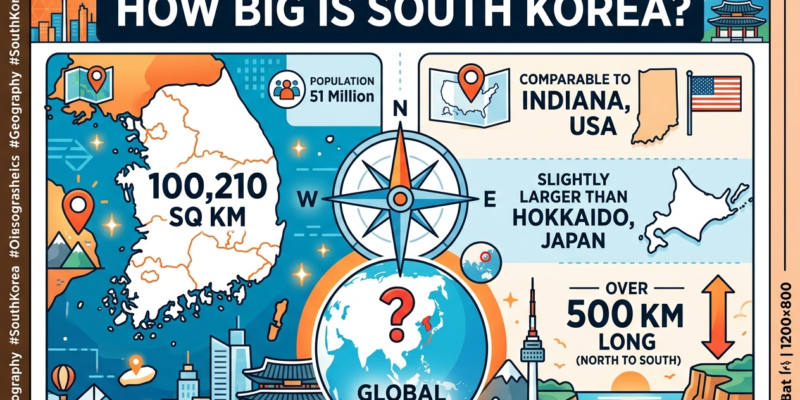
South Korea total area is approximately 100,210 square kilometers, which is roughly 38,691 square miles. This makes South Korea a relatively small country by global standards, but it packs an extraordinary amount of geography, culture, and urban development into that space.
To put the South Korea land area into clearer terms, the country stretches about 500 kilometers from north to south and roughly 300 kilometers from east to west at its widest point. The Korean Peninsula as a whole is longer and narrower than most people imagine when they first look at a map.
South Korea is situated on the southern half of the Korean Peninsula in East Asia. It shares a land border only with North Korea to the north, while its remaining borders are formed by the Yellow Sea to the west, the Korea Strait to the south, and the East Sea (also referred to as the Sea of Japan) to the east.
South Korea also governs over 3,000 islands, the largest and most famous of which is Jeju Island, a volcanic island located off the southern coast that is popular among tourists and students alike. If you are planning a visit to the country, you can explore more about destinations and travel planning through the South Korea 7 Day Itinerary guide available on this site.
How Big Is South Korea Compared to Other Countries
When people ask how big is South Korea compared to other nations, the answer often surprises them because South Korea is smaller than many expect yet denser and more developed than almost anywhere on earth.
Here is how South Korea size compares to several well-known countries and regions:
South Korea vs United States: South Korea is roughly the size of the state of Indiana or Kentucky. The entire United States is about 96 times larger than South Korea. Despite this massive size difference, South Korea has a population density that dwarfs most American states.
South Korea vs United Kingdom: South Korea is slightly smaller than the United Kingdom, which covers about 243,000 square kilometers. The UK is approximately 2.4 times the land area of South Korea.
South Korea vs Japan: Japan covers approximately 377,915 square kilometers, making it nearly 3.8 times the size of South Korea. However, both countries share similar densely populated coastal urban zones and mountainous inland areas.
South Korea vs Germany: Germany has a total area of about 357,000 square kilometers, making it roughly 3.5 times larger than South Korea. Yet South Korea produces a similarly significant share of global economic output.
South Korea vs Portugal: Portugal covers around 92,000 square kilometers, making it slightly smaller than South Korea. These two countries are actually among the closest in total area among commonly compared nations.
South Korea vs India: India is approximately 32 times the size of South Korea, covering over 3.2 million square kilometers. India is home to one of the largest student populations sending learners to South Korea, a trend you can learn about through the Study in South Korea after 12th for Indian Students guide.
The key takeaway is that South Korea is a small country in terms of land area but punches far above its weight in terms of economic output, population, cultural influence, and global presence.
South Korea Population Size and Density
South Korea population is approximately 51.7 million people as of 2026. This figure makes South Korea one of the most densely populated countries in the world. The South Korea population density sits at roughly 516 people per square kilometer, which places it among the top ten most densely populated nations on earth.
To understand what this means in practice, consider that the entire population of South Korea is squeezed into an area roughly the size of Portugal or Indiana. Most of that population is further concentrated in the metropolitan areas, particularly in and around Seoul.
South Korea has been experiencing a declining birth rate for many years, which is one reason why the country has actively worked to attract international students and skilled workers. The universities in South Korea for international students have grown significantly as a result of this push, welcoming students from across Asia, including a large number from India.
The population of South Korea is also highly urbanized. Over 80 percent of the population lives in urban areas, which explains the country’s extremely developed public transportation infrastructure, dense apartment housing, and high concentration of services and businesses in compact zones.
How Big Is Seoul Compared to South Korea
Seoul, the capital city of South Korea, is a city that often astonishes visitors with its sheer scale. Seoul proper covers an area of approximately 605 square kilometers, which represents just about 0.6 percent of South Korea’s total land area. Yet the Seoul metropolitan area, including the surrounding Gyeonggi Province and Incheon, covers close to 11,800 square kilometers and is home to roughly 25 to 26 million people.
This means that approximately half of South Korea’s entire population lives within the greater Seoul metropolitan region, making it one of the most concentrated urban populations anywhere on the planet.
Seoul itself is divided into 25 autonomous districts known as gu, each functioning almost like a small city with its own administrative office, commercial zones, residential areas, and cultural features. Districts like Gangnam, Mapo, Jongno, and Hongdae each have their own distinct character, despite all being part of the same city.
For students and young professionals moving to South Korea, the size and density of Seoul can be both exciting and overwhelming at first. Understanding how student life works in this kind of urban environment is important. The student life in South Korea section of this site covers practical aspects of living and studying in a high-density city like Seoul.
South Korea Geography: Mountains, Coastlines, and Terrain
Understanding the physical geography of South Korea helps explain why the country feels both compact and diverse at the same time. Roughly 70 percent of South Korea’s land area is covered by mountains, which means the population and most economic activity are concentrated in the remaining 30 percent of flat or low-lying land.
The Taebaek Mountain Range runs along the eastern coast and forms the backbone of the Korean Peninsula’s southern half. This mountain range creates a dramatic eastern coastline where steep cliffs meet the East Sea, while the western and southern coastlines are gentler, with tidal flats, estuaries, and thousands of islands.
The highest peak in South Korea is Hallasan on Jeju Island, which rises to 1,950 meters above sea level. On the mainland, Jirisan at 1,915 meters is the tallest mountain. The mountainous terrain has historically shaped where Koreans settled and how infrastructure developed, with major cities built in valleys and along river systems.
South Korea’s four coastlines face very different environments. The western coast along the Yellow Sea is known for dramatic tidal ranges, with some areas experiencing tidal differences of over 9 meters. The southern coast is dotted with thousands of small islands that form the Hallyeohaesang National Park area. The eastern coast is known for cleaner water and sandy beaches.
Jeju Island, the country’s largest island, functions almost like a separate world within South Korea. Its volcanic origin gives it a dramatically different landscape compared to the mainland, and it has become a major destination for both Korean domestic tourism and international visitors. Jeju even has its own unique dialect that many mainland Koreans find difficult to understand.
The rivers of South Korea also shape its geography. The Han River runs through the heart of Seoul and has been dramatically transformed over decades of urban development into a massive recreational corridor. The Nakdong River is the longest river in the country, flowing through the southeastern regions and into the Korea Strait near Busan.
How Big Is South Korea Compared to North Korea
One of the most frequently asked geographic questions about the Korean Peninsula is how South Korea compares in size to North Korea. This comparison is particularly relevant because the two countries were once one nation and share a common history, language, and cultural heritage, despite decades of political division.
North Korea covers approximately 120,538 square kilometers, which is about 20 percent larger than South Korea’s 100,210 square kilometers. In simple terms, North Korea is roughly 1.2 times the size of South Korea in terms of land area.
However, the population situation is reversed. South Korea has a population of approximately 51.7 million, while North Korea is estimated to have around 26 million people. This means South Korea has roughly twice the population of North Korea despite having less land area, resulting in significantly higher population density in the south.
Economically, the contrast is even more dramatic. South Korea is one of the world’s largest economies by GDP, while North Korea remains one of the most isolated and underdeveloped nations. For a detailed look at the contrasts between these two countries across multiple dimensions, the 10 Differences Between North and South Korea guide provides a thorough breakdown.
The border between North and South Korea is known as the Demilitarized Zone, or DMZ. Despite its name, it is one of the most heavily militarized borders in the world. The DMZ stretches approximately 250 kilometers across the width of the peninsula and is about 4 kilometers wide, serving as a buffer zone between the two countries.
South Korea Administrative Regions and Their Sizes
South Korea is divided into a number of administrative regions, each with its own government, distinct identity, and varying land area. Understanding these regions helps explain how South Korea organizes its 100,210 square kilometers into manageable governance units.
South Korea has one special city, six metropolitan cities, one special autonomous city, eight provinces, and one special autonomous province. Here is a breakdown of the major regions and their approximate sizes:
Seoul Special City: 605 square kilometers, population approximately 9.4 million. The capital and largest city, Seoul is the political, cultural, and economic center of the country.
Gyeonggi Province: 10,183 square kilometers, population approximately 13.6 million. Surrounding Seoul, Gyeonggi is the most populous province and one of the most economically productive regions in the country.
Gyeongsang Region (North and South): Together these two provinces in the southeast cover over 26,000 square kilometers and include major cities like Busan, Daegu, and Ulsan, which are centers of manufacturing, trade, and maritime industry.
Jeolla Region (North and South): Located in the southwest, the Jeolla provinces are known for their agricultural output, traditional cuisine, and cultural heritage. Together they cover approximately 20,000 square kilometers.
Chungcheong Region (North and South): Located in the central part of the country, these provinces are home to Daejeon and the administrative capital city of Sejong, which was developed to reduce congestion in Seoul.
Gangwon Province: Covering approximately 16,874 square kilometers, Gangwon is the largest province in South Korea by land area. It is home to the Taebaek Mountains and hosted the 2018 Winter Olympics. Despite its size, it is one of the least densely populated regions.
Jeju Special Autonomous Province: Located on Jeju Island off the southern coast, this province covers about 1,849 square kilometers and is South Korea’s smallest province by area but one of its most visited regions.
Economic Size of South Korea: GDP and Global Rank
When discussing how big South Korea is, land area alone does not tell the full story. South Korea’s economic size is perhaps its most globally significant dimension. South Korea has a Gross Domestic Product of approximately 1.7 to 1.8 trillion US dollars, which consistently places it among the top 12 to 15 largest economies in the world depending on the measurement method used.
South Korea achieved this level of economic development in an extraordinarily short period of time. Following the Korean War in the early 1950s, South Korea was one of the poorest countries on earth. Within roughly two generations, it transformed into a high-income, technology-driven economy. This transformation is often referred to as the Miracle on the Han River.
South Korea is home to some of the world’s largest companies by market capitalization and brand value. Samsung, Hyundai, LG, SK Group, and POSCO are among the conglomerates, known locally as chaebols, that have driven South Korea’s economic growth and established its reputation as a manufacturing and technology powerhouse.
South Korea is the world’s largest shipbuilder, a leading producer of semiconductors, and a major manufacturer of automobiles, electronics, and petrochemicals. It is also a significant exporter of cultural products through K-pop, K-drama, and K-film, which have expanded the country’s global soft power far beyond what its geographic size might suggest.
For Indian students and professionals considering opportunities in this economic powerhouse, there are detailed resources available. The jobs in Korea for Indians guide explains how to navigate the South Korean job market as a foreign national, while information about costs and currency exchange can be found in the 1 Indian Rupee in South Korea currency guide.
How South Korea Feels Bigger Than Its Size
One of the most common experiences visitors and students report about South Korea is that it feels much larger than its actual geographic area. Several factors contribute to this perception.
First, the density of experience in South Korea is exceptional. Within a single day in Seoul, you can visit a 14th-century royal palace, walk through a traditional neighborhood of centuries-old hanok houses, eat street food in a bustling market, shop in a cutting-edge underground mall, and attend a live K-pop concert. The variety of experience compressed into a small area is genuinely extraordinary.
Second, South Korea’s transportation infrastructure makes even distant parts of the country feel accessible. The KTX high-speed rail network connects Seoul to Busan, a distance of roughly 400 kilometers, in approximately two and a half hours. The subway systems in Seoul, Busan, Incheon, and other major cities are among the most efficient and extensive in the world.
Third, South Korea’s cultural output has given it an outsized global presence. K-pop groups, Korean dramas, Korean cinema, and Korean food have reached audiences in every corner of the world. This global cultural footprint makes South Korea feel like a much larger presence on the world stage than its 100,210 square kilometers would suggest. If you want to understand this cultural phenomenon more deeply, the K-culture section of this site explores Korean culture in detail.
Fourth, the diversity of landscapes within South Korea’s borders is remarkable for such a compact country. In a single trip, you can experience the mega-urban environment of Seoul, the beach resort atmosphere of Busan, the traditional Korean landscape of Gyeongju, the volcanic scenery of Jeju Island, and the mountain wilderness of Seoraksan National Park.
Is South Korea a Good Size for Travel
For travelers, South Korea’s compact size is actually one of its greatest advantages. The country is small enough that you can realistically visit multiple major destinations in a single trip without spending an unreasonable amount of time on transportation.
From Seoul, you can reach Busan by KTX in about two and a half hours. Gyeongju, a city famous for its ancient Silla-era monuments and temples, is reachable from Seoul in about two hours by high-speed rail. Jeju Island is accessible by a one-hour domestic flight from Seoul or Busan.
A well-planned seven-day trip to South Korea can comfortably include Seoul, a day trip to the DMZ, Gyeongju, Busan, and perhaps the scenic Andong or Jeonju regions. This kind of itinerary packs an enormous variety of experiences into a short trip, which is exactly what makes South Korea so appealing for first-time visitors. The South Korea 7 Day Itinerary on this site provides a detailed day-by-day plan for making the most of the country’s compact geography.
South Korea’s small size also means that infrastructure investments go further. High-speed internet, modern airports, world-class hospitals, and excellent public transportation reach most of the country rather than being limited to a few large cities as in larger nations.
For students planning to live in South Korea for a semester or full degree program, the compact size means that even if your university is not in Seoul, you are never far from the capital’s resources, cultural events, and international connections. Learning about K-manners and etiquette will also help you adapt smoothly to life in this densely social and culturally rich environment.
Key Facts About South Korea Size at a Glance
Total Land Area: 100,210 square kilometers (38,691 square miles)
North-South Length: Approximately 500 kilometers
East-West Width: Approximately 300 kilometers at the widest point
Total Population: Approximately 51.7 million (2026)
Population Density: Approximately 516 people per square kilometer
Largest City: Seoul (605 sq km, population approximately 9.4 million)
Seoul Metro Area Population: Approximately 25 to 26 million
Longest River: Nakdong River (525 kilometers)
Highest Peak: Hallasan on Jeju Island (1,950 meters)
Number of Islands: Over 3,000
Largest Island: Jeju Island (1,849 square kilometers)
Number of Administrative Regions: 17 major units (1 special city, 6 metropolitan cities, 1 special autonomous city, 8 provinces, 1 special autonomous province)
GDP: Approximately 1.7 to 1.8 trillion USD
Global GDP Rank: Top 12 to 15 worldwide
Conclusion: South Korea Size in Perspective
South Korea may be a small country by land area, but its significance on the world stage is anything but small. With a total area of just over 100,000 square kilometers, it has built one of the world’s most advanced economies, produced globally influential culture, and created an urban environment of extraordinary density and sophistication.
Understanding how big South Korea is requires looking beyond square kilometers. It means considering the population packed into that space, the mountains and coastlines that define its landscape, the cities that rise from river valleys, and the economic and cultural output that flows outward from this peninsula to the rest of the world.
Whether you are a student considering studying at one of South Korea’s top universities, a traveler mapping out a 7-day South Korea itinerary, a professional researching jobs in Korea for Indians, or simply someone curious about the famous things in this remarkable nation, South Korea’s size is just the beginning of the story. The real dimensions of South Korea are measured in the depth of its history, the ambition of its people, and the warmth of its culture.
For more information about famous things in South Korea and how Korean culture shapes daily life, continue exploring the resources available on this site.Share