

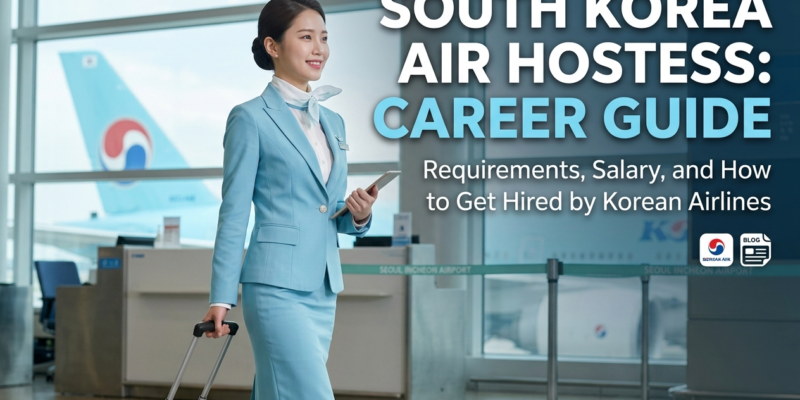
The role of a South Korea air hostess, known as a flight attendant or cabin crew member, is one of the most sought-after careers among young women and men in Korea and among international candidates who aspire to work for prestigious Korean airlines. Korean cabin crew are globally recognized for their exceptional service standards, professional grooming, and composed demeanor, reflecting the high expectations Korean aviation culture places on its in-flight workforce.
This comprehensive guide covers everything you need to know about becoming an air hostess with a South Korean airline, including qualification requirements, the application and selection process, salary and benefits, major airlines hiring cabin crew, and how international candidates especially from India can prepare for this career.
South Korean Aviation Industry Overview
South Korea is home to some of the most respected airlines in the world. The Korean aviation sector has expanded significantly over the past two decades, driven by rising tourism, increasing trade, and the country’s strong position as a regional hub in Northeast Asia.
Incheon International Airport, located near Seoul, is the primary gateway to South Korea and has been consistently rated among the top three airports in the world for service quality by Skytrax. The airport’s world-class facilities and the airlines operating from it set extraordinarily high standards for cabin crew performance.
Students and professionals interested in exploring career opportunities in South Korea often consider the aviation sector as one of the most prestigious and rewarding paths available.
Major South Korean Airlines That Hire Cabin Crew
Korean Air (대한항공) Korean Air is South Korea’s flag carrier and the largest airline in the country. Founded in 1969, it operates flights to over 120 destinations in 43 countries across six continents. Korean Air is a member of the SkyTeam global airline alliance and is considered a full-service premium carrier. It is consistently recognized for the quality of its in-flight service and cabin crew training.
Asiana Airlines (아시아나항공) Asiana is South Korea’s second-largest full-service carrier and a member of Star Alliance. Known for its warm and attentive service style, Asiana has won numerous awards from Skytrax for cabin crew performance. It flies to approximately 90 international destinations and maintains high grooming and service standards for its flight attendants.
Jeju Air (제주항공) Jeju Air is South Korea’s largest low-cost carrier (LCC), founded in 2005. It operates domestic and short-to-medium-haul international routes across Asia. As an LCC, it hires large numbers of cabin crew and is considered a good entry point for people beginning their aviation careers.
Jin Air (진에어) Jin Air is a subsidiary of Korean Air and operates as a low-cost carrier on domestic Korean routes and short-haul international routes. It hires both Korean and international cabin crew, particularly for routes to Japan, China, Southeast Asia, and Guam.
Air Busan (에어부산) Based in Busan, South Korea’s second-largest city, Air Busan is a low-cost carrier affiliated with Asiana Airlines. It primarily serves domestic Korean routes and select Asian international destinations.
T’way Air (티웨이항공) T’way is a growing low-cost airline in South Korea with an expanding network of Asian destinations. It regularly holds open cabin crew recruitment campaigns.
Eastar Jet and Air Seoul These smaller carriers round out South Korea’s budget aviation market and periodically recruit cabin crew for their growing route networks.
South Korea Air Hostess Requirements
Korean airlines have specific and detailed requirements for cabin crew applicants. While exact criteria vary between full-service and low-cost carriers, the following are the standard expectations:
Age Most Korean airlines recruit candidates between 18 and 27 years old for fresh applications. However, experienced candidates may apply up to 32 or 35 years depending on the airline.
Height Korean Air typically requires female cabin crew candidates to be between 162 cm and 173 cm tall. Male cabin crew must be between 173 cm and 185 cm. Asiana Airlines and other carriers have similar ranges. Height requirements exist primarily because cabin crew must be able to reach overhead safety equipment and emergency exits without difficulty.
Vision Corrected vision of 0.8 or above is generally required. Most airlines accept candidates who wear contact lenses, though candidates with uncorrected vision requirements may vary.
Language Proficiency Korean language proficiency is required for all cabin crew positions at Korean carriers, since safety announcements, crew communication, and service delivery are conducted in Korean. Additionally, English proficiency is mandatory. Candidates who speak additional Asian languages (Japanese, Chinese, Thai, Vietnamese, etc.) are highly preferred, as these skills are operationally valuable on specific routes.
Education A minimum of a high school diploma (or equivalent) is required. A bachelor’s degree, particularly in tourism, hospitality, aviation management, or communication, is preferred but not always mandatory.
Swimming Ability Candidates must be able to swim at least 25 meters without assistance. This is a safety requirement related to water ditching emergency procedures.
BMI and Physical Fitness Korean airlines pay close attention to physical fitness and overall health. Candidates are expected to maintain a healthy body weight relative to their height. Medical examinations are conducted during the selection process to assess physical fitness, cardiovascular health, and absence of conditions that could affect performance at altitude.
No Visible Tattoos Tattoos that are visible in uniform are typically a disqualifying factor for cabin crew positions at full-service Korean carriers.
South Korea Air Hostess Salary and Benefits
Cabin crew compensation in South Korea is competitive and includes a range of benefits that make the package highly attractive overall.
Korean Air Flight Attendant Salary Fresh cabin crew at Korean Air can expect a starting monthly base salary of approximately 1.8 million to 2.2 million KRW (roughly 1,400 to 1,700 USD). With flight allowances, layover allowances, and additional pay for international long-haul routes, monthly take-home pay can range from 3 million to 5 million KRW depending on hours flown and seniority.
Asiana Airlines Flight Attendant Salary Fresh Asiana cabin crew start at a similar base salary range of 1.8 million to 2 million KRW, with comparable allowances. Senior purser-level crew at Asiana can earn significantly more.
Low-Cost Carrier Salary Budget airline cabin crew in South Korea generally earn less than their full-service counterparts. Starting salaries at LCCs like Jeju Air or Jin Air range from 1.5 million to 2 million KRW monthly before allowances.
Benefits and Perks Beyond salary, Korean airline cabin crew enjoy substantial non-monetary benefits. These typically include:
- Free or heavily discounted airline tickets for personal travel and family members
- Full health insurance coverage
- Accommodation subsidies for layovers in foreign cities
- Meal allowances during duty
- Uniform provision and laundry service
- Access to airline employee lounges worldwide
- Retirement and pension contributions
- Annual bonuses tied to company performance
For international candidates, especially Indians who are exploring professional opportunities in South Korea, the full compensation package represents a compelling career proposition.
Korean Air Cabin Crew Selection Process
Korean Air conducts one of the most structured and rigorous cabin crew selection processes in Asia. The process typically involves multiple stages spanning several weeks or months.
Stage 1: Online Application Candidates submit their application, resume (in Korean format), photographs, and supporting documents through the Korean Air careers portal. Applications are typically open for 2 to 4 weeks during each recruitment cycle.
Stage 2: Document Screening The HR team reviews all submitted applications against the minimum requirements for age, height, education, and language ability. Successful candidates are invited to the first interview round.
Stage 3: First Interview (Group Interview) Candidates are interviewed in groups, typically of 5 to 10 people. Interviewers assess communication skills, confidence, teamwork, presentation, and overall first impression. Both Korean and English language ability is evaluated in this round.
Stage 4: Second Interview (Individual Interview) Candidates who pass the first interview face a more detailed individual interview. This round assesses the candidate’s motivation for the role, understanding of Korean Air’s service values, crisis management thinking, and situational judgment.
Stage 5: Physical Examination Selected candidates undergo a comprehensive medical examination including vision tests, blood tests, cardiovascular assessment, and general health screening. The swim test is also conducted at this stage.
Stage 6: Background Check and Final Selection The final stage includes reference checks and verification of all submitted documents. Candidates who pass all stages receive a job offer and are enrolled in the pre-service training program.
Stage 7: Initial Cabin Crew Training New recruits undergo approximately 8 to 12 weeks of intensive training covering aircraft safety procedures, emergency evacuation, first aid and CPR, inflight service standards, grooming and personal presentation, and Korean cultural values in service delivery.
How International Candidates Can Apply to Korean Airlines
Many Korean airlines, including Korean Air and Asiana, actively recruit international cabin crew, particularly those with fluency in languages that serve their major route networks.
For Indian Candidates Indian candidates applying to Korean airlines must meet the same requirements as Korean nationals. The key differentiating factors for international applicants are typically Korean language proficiency, relevant aviation or hospitality experience, and strong English language skills.
Korean language proficiency is assessed using the TOPIK (Test of Proficiency in Korean) score. A TOPIK Level 3 or above is typically preferred for cabin crew positions, though some airlines may accept candidates at Level 2 if other qualifications are strong.
For Indian students already studying Korean language programs in South Korea, this represents a significant advantage when applying for airline positions after completing their studies.
Language Preparation Enrolling in a structured Korean language course is the single most impactful step an international candidate can take. TOPIK preparation courses are available both online and through Korean language institutes in India and South Korea.
JLPT or HSK as an Add-On Candidates who also hold Japanese (JLPT N3 or above) or Chinese (HSK 4 or above) language certifications are especially valued by airlines with dense route networks to Japan and China.
Grooming and Presentation Standards for Korean Cabin Crew
Korean airline cabin crew are recognized worldwide for impeccable grooming and presentation. These standards are enforced strictly both during the recruitment process and throughout the career.
Hair Hair must be neatly styled and kept off the face. Long hair is typically worn in a structured bun or chignon during duty. Hair color must be natural tones unless specified otherwise.
Skin and Makeup Korean airlines have detailed makeup guidelines. For female crew, this typically includes foundation, light blush, defined brows, and lip color. Skin must be clear and well-maintained. A significant number of female cabin crew invest in Korean skincare routines to maintain the expected standard.
Nails Nails must be short or moderately short and polished in neutral or light shades. Elaborate nail art is not permitted during duty.
Uniform Korean airline uniforms are designed by leading Korean fashion houses and are regarded as some of the most elegant in the global aviation industry. Korean Air’s uniforms, for example, have been designed in partnership with renowned Korean designers.
Understanding Korean cultural norms around presentation and first impressions, which is deeply tied to Korean social manners and etiquette, is essential for both the interview process and the career itself.
Career Progression for Korean Airline Cabin Crew
A career as an air hostess with a Korean airline offers clear progression opportunities over time.
Cabin Crew Rank Structure at Korean Airlines:
- Probationary Cabin Crew (first 6 to 12 months)
- Junior Cabin Crew
- Senior Cabin Crew
- Chief Cabin Crew / Senior Flight Attendant
- Purser / Cabin Manager
- Chief Purser / Cabin Director
Senior purser-level positions involve overseeing the entire cabin crew team on a flight, managing service delivery, handling escalated passenger issues, and coordinating with the cockpit. These positions command significantly higher salaries and are typically reached after 8 to 15 years of service.
Many experienced cabin crew at Korean airlines transition into ground roles in training, recruitment, customer experience management, or corporate communication.
Life as a South Korean Air Hostess: A Day in the Flight
Understanding what daily life looks like for a Korean airline cabin crew member helps applicants set realistic expectations.
Pre-Flight Crew must report to the airline’s crew center 2.5 to 3 hours before departure. This time is used for briefing, grooming checks, safety review, service planning, and role assignments. The captain’s briefing covers weather conditions, flight duration, special passenger requirements, and any safety notices.
Inflight Korean cabin crew deliver service with exceptional attentiveness. On long-haul routes (such as Seoul to New York or Seoul to London), crew work in shifts with rest periods mid-flight. Meal service, drink rounds, entertainment assistance, and passenger care are the primary responsibilities. Emergency readiness is always maintained.
Layovers International routes involve layovers in destination cities ranging from one night to three days. Crew receive a daily allowance to cover meals and personal expenses. These layovers provide opportunities to explore cities around the world, which many cabin crew count as one of the most rewarding aspects of the job.
Physical and Mental Demands The job is physically demanding. Long hours on your feet, irregular sleep patterns due to time zone changes, and the emotional labor of remaining calm and pleasant in all situations require strong physical health and mental resilience.
How Studying in South Korea Can Help You Become a Korean Air Hostess
International candidates who spend time studying in South Korea have a measurable advantage in Korean airline recruitment. Living and studying in Korea accelerates Korean language acquisition to a functional and conversational level, provides direct exposure to Korean culture, service values, and social norms, builds a network of Korean contacts and university alumni who can provide references, and demonstrates commitment and adaptability that impresses Korean employers.
Students who enroll in tourism, hospitality, aviation, or language programs at Korean universities through Study in South Korea are well-positioned to pursue cabin crew careers immediately after graduation. Many Korean universities also have industry partnerships with Korean Air and Asiana that include internship and recruitment pipelines.
Frequently Asked Questions About South Korea Air Hostess Careers
Can non-Korean nationals become a cabin crew member at Korean Air? Yes. Korean Air and Asiana Airlines hire international cabin crew, particularly those fluent in Korean and other major Asian languages. Candidates must meet all standard requirements.
Is Korean language required to apply? Yes. Korean language proficiency is a core requirement. A TOPIK score is typically required as proof of ability.
How long does the selection process take? From online application to job offer, the process typically takes 2 to 4 months at major carriers.
What is the typical contract length? Most Korean airlines hire fresh cabin crew on 1-year contracts initially, with renewal based on performance. Many crew transition to permanent positions after 2 to 3 years.
Do Korean airlines hire male flight attendants? Yes. Both Korean Air and Asiana hire male cabin crew. Requirements for male candidates follow the same process with height standards adjusted accordingly.
Final Thoughts on Becoming a South Korea Air Hostess
A career as a South Korea air hostess is competitive, rewarding, and globally prestigious. Korean airlines set the benchmark for inflight service excellence, and their cabin crew are among the best-trained and most professionally presented in the world.
Whether you are a Korean national or an international candidate from India or another country, the pathway to this career is clear: build strong Korean language skills, maintain excellent physical fitness, develop hospitality experience, and understand Korean cultural and service values deeply.
For international candidates who want to prepare for this career through structured education and cultural immersion, beginning with a study program in South Korea is one of the most effective strategies. The team at Study in South Korea can help you identify the right program, prepare your application, and build the foundation for a successful career in Korean aviation.