

South Korea Emergency Martial Law 2024: What Happened and Why It Matters
On the night of December 3, 2024, South Korea went through something its people had not seen in more than four decades. President Yoon Suk Yeol declared emergency martial law live on national television, and for a few tense hours the country’s democracy looked genuinely uncertain. If you are researching South Korea for study, travel, or general interest, understanding this event matters, because it shapes how the country’s politics, legal system, and public mood look today in 2026.
This guide walks through what emergency martial law actually means, why Yoon declared it, how the National Assembly reversed it, and where the legal fallout stands now. If you are weighing South Korea as a study destination, this explainer also addresses the safety question directly.
What Is Emergency Martial Law in South Korea
Under Article 77 of the South Korean Constitution, the president can declare martial law only during wartime, armed conflict, or a comparable national emergency, and only to mobilize the military for public order. South Korea has declared some form of martial law more than ten times since its founding, almost always under the country’s earlier authoritarian governments between the 1950s and the 1980s. The last time it happened was in 1980, under a military-backed government, before South Korea’s democratic transition in 1987.
That is what made the December 2024 declaration so jarring. It was the first use of martial law in a fully democratic South Korea, breaking a 44-year gap, and it arrived with no war, invasion, or comparable national emergency behind it.
Internal link: anchor “South Korea’s National Assembly” linking to https://studyinsouthkorea.in/uncategorized/south-korea-assembly-complete-guide-to-the-national-assembly-of-south-korea/ in the next section, where the Assembly’s role becomes central to the story.
Why President Yoon Suk Yeol Declared Martial Law
President Yoon made his announcement in a surprise late-night address on December 3, 2024, broadcast on YTN. He framed the move as necessary to protect the country from what he called pro-North Korean, anti-state forces operating inside South Korea’s own legislature, and said the opposition Democratic Party had been obstructing government functions through impeachment motions and a trimmed-down budget bill. He did not point to any direct military threat from North Korea itself.
The immediate trigger was a budget standoff: the opposition-controlled National Assembly had cut several trillion won from the government’s proposed budget, and had also filed impeachment motions against a state auditor and a senior prosecutor. Yoon characterized this as the opposition holding the parliamentary process hostage.
Almost nobody outside Yoon’s inner circle expected the declaration, including members of his own People Power Party, several of whom publicly opposed it within minutes of the announcement.
For context on the governing body Yoon accused of overreach, see South Korea’s National Assembly, which explains how the body is structured and why its approval mattered so much in the hours that followed.
The Night Martial Law Troops Entered the National Assembly
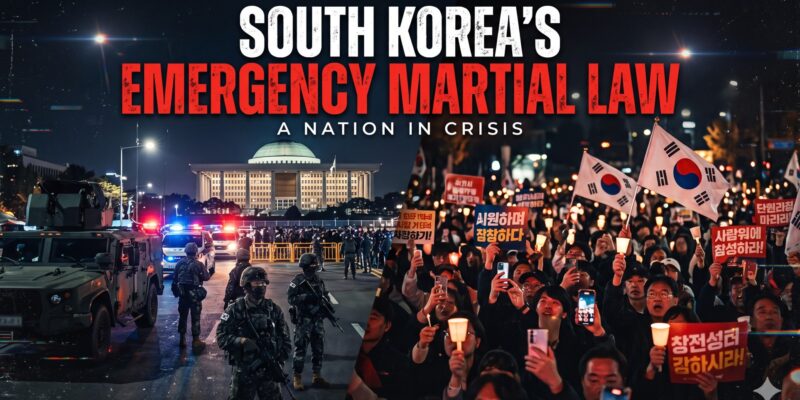
Within roughly two hours of the declaration, martial law forces moved toward the National Assembly compound in Seoul. Key moments that night:
- Around 10:30 pm, Yoon’s address airs and martial law takes effect across the country.
- Helicopters bring troops toward the Assembly compound; soldiers attempt to enter the main building.
- Citizens, reporters, and parliamentary staff physically block soldiers at the entrance.
- Opposition leader Lee Jae-myung live-streams himself scaling a wall to get inside and vote.
- Around 1 am on December 4, 190 of 190 present lawmakers vote to demand the martial law be lifted.
- Yoon accepts the resolution through a cabinet meeting and formally ends martial law roughly six hours after it began.
No one was killed and the disruption to daily life outside the Assembly compound was limited mostly to that single night. Markets reacted immediately, with the Korean won weakening sharply against the US dollar before recovering once the declaration was reversed.
The Aftermath: Impeachment, Arrest, and Yoon’s Criminal Trials
The political and legal consequences stretched well into 2026. Here is where the main threads stand:
| Event | Status |
|---|---|
| Impeachment by National Assembly | Passed; Yoon removed from office |
| Arrest and detention | Yoon arrested in connection with the martial law order |
| First criminal verdict (obstruction and related charges) | Sentenced to 5 years in prison, January 16, 2026 |
| Insurrection trial (ringleader charge) | Separate trial ongoing through February 2026, prosecutors sought the death penalty; legal analysts widely expect a long prison term rather than execution |
| Aiding-the-enemy charge | Separate trial tied to alleged drone flights over North Korea |
Courts handling related cases, including that of former defense minister Kim Yong-hyun, have already described the martial law order as an insurrection carried out from the top of government. Yoon has consistently maintained that his declaration was a lawful exercise of presidential authority and has shown no public remorse, even as his legal team argues the move was only a symbolic warning rather than an attempt to seize full control.
Is South Korea Safe for Indian Students After the 2024 Crisis
This is the question that matters most if you are planning to study in South Korea rather than simply following the news. The short answer is yes. The crisis was resolved inside South Korea’s own institutions within hours, through a parliamentary vote and later through ordinary court proceedings, not through prolonged unrest or a breakdown of public order. University campuses, visa processing, and daily life for international students were not meaningfully disrupted beyond the night of December 3 to 4, 2024.
If anything, the episode reinforced how functional South Korea’s checks and balances are: a sitting president tried to impose martial law and was overruled by his own legislature within hours, then held accountable through the courts rather than through force. For a deeper look at day-to-day conditions, safety data, and what the current political climate means for newcomers, see our full guide on whether South Korea is safe for Indian students.
Frequently Asked Questions
What is South Korea’s emergency martial law of 2024?
On December 3, 2024, President Yoon Suk Yeol declared emergency martial law, the first such declaration in a democratic South Korea since 1980. It lasted only a few hours before the National Assembly forced its reversal.
Why did South Korea declare martial law in December 2024?
Yoon cited alleged anti-state activity and pro-North Korean sympathies among opposition lawmakers, tied to a budget dispute and impeachment motions against government officials.
How long did the martial law declaration last?
Roughly six hours, from the late-night announcement on December 3 to its formal lifting in the early morning of December 4, 2024, after a 190 to 0 Assembly vote against it.
Is South Korea safe for international students after the martial law crisis?
Yes. The crisis was contained to one night and resolved through institutional means, with no lasting disruption to university life or public safety.
What happened to President Yoon Suk Yeol after the martial law declaration?
He was impeached, removed from office, arrested, and is facing multiple criminal trials. A Seoul court sentenced him to five years in prison in January 2026 on obstruction-related charges, with a separate and more serious insurrection trial still proceeding.