


South Korea has undergone one of the most remarkable physical transformations in modern history. Over the past seven decades, the average height for men in South Korea has increased faster than in almost any other nation on earth. This change is not accidental. It reflects massive improvements in nutrition, healthcare, economic development, and living standards that followed the Korean War.
If you are planning to study in South Korea, travel to the country, or simply want to understand Korean society at a deeper level, knowing how physical development has shaped Korean culture and self-image can be genuinely useful. This guide covers everything you need to know about Korean male height, from current statistics to historical trends, regional differences, and what drives these numbers.
What is the Average Height for Men in South Korea in 2026
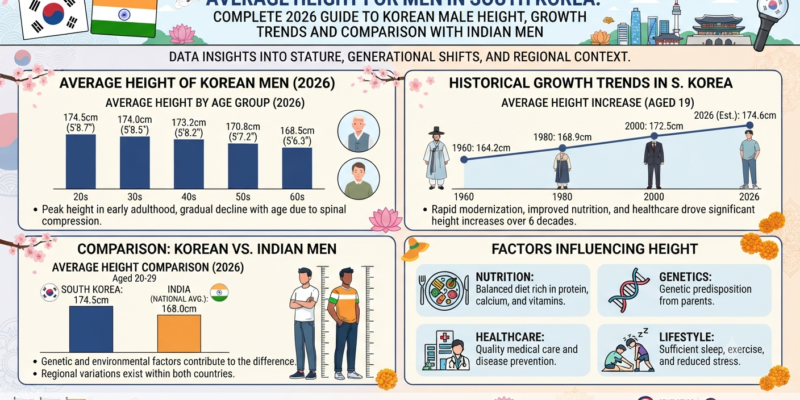
The average height for men in South Korea in 2026 stands at approximately 174 centimeters, which equals around 5 feet 8.5 inches. This figure places South Korean men among the tallest populations in Asia and significantly above the global male average of approximately 171 centimeters.
Military conscription data from the Republic of Korea Armed Forces provides the most reliable annual measurements because all South Korean men between the ages of 18 and 28 must serve in the military. These records consistently show that the average height of men entering military service has remained steady between 173.5 centimeters and 174.5 centimeters over the past several years.
Among younger cohorts, particularly men aged 20 to 29, the average edges slightly higher at around 174.5 to 175 centimeters. This suggests that the generational shift driven by improved nutrition continues to show measurable effects even today, though the rate of increase has slowed compared to earlier decades.
How Korean Male Height Has Changed Over the Past 100 Years
The historical data on Korean male height is striking. A century ago, the average Korean man stood at roughly 161 to 163 centimeters. That means South Korean men have grown by an average of 11 to 12 centimeters over the course of a single century. This is one of the largest generational height gains recorded anywhere in the world.
The most dramatic period of growth occurred between the 1950s and the 1990s. Following the devastation of the Korean War, South Korea rebuilt its economy at extraordinary speed. Per capita income rose, food security improved dramatically, protein consumption increased, and public health infrastructure expanded to cover the entire population. Children born during this period received better nutrition from infancy through adolescence compared to any previous generation.
By the 1980s and 1990s, the average height of Korean men had already surpassed 170 centimeters. The steady improvement continued through the 2000s and 2010s. Today the pace of increase has flattened, which is a normal pattern once a population reaches its genetic height potential under optimal nutritional conditions.
Factors That Determine the Average Height for Korean Men
Nutrition and Diet
The most significant factor driving height gains in South Korea is nutrition. Traditional Korean cuisine is rich in fermented vegetables, fish, soybean products, and rice. As South Korea modernized, dairy consumption increased substantially. Milk, yogurt, and cheese became regular parts of the Korean diet from the 1970s onward, providing calcium and protein critical for bone development.
Protein intake from meat also increased sharply. South Koreans today consume significantly more chicken, pork, and beef than their grandparents did. High-quality protein during childhood and adolescence is one of the strongest predictors of adult height.
Healthcare and Maternal Health
Improvements in maternal health directly affect the height of the next generation. Better prenatal care, reduced rates of infant malnutrition, and improved access to vaccinations all contributed to healthier children who could reach their full genetic height potential.
Physical Activity
Korean schools have traditionally emphasized physical education. Regular structured activity during childhood supports healthy bone and muscle development. The emphasis on sports and outdoor activity during school years contributed positively to physical development across generations.
Genetics and Regional Variation
Genetics set the upper boundary for individual height. While diet and environment determine how close a person gets to that genetic ceiling, the gene pool itself has remained broadly stable. What changed was the environment allowing more people to reach closer to their genetic potential.
Within South Korea, there is modest regional variation. Men from urban centers such as Seoul, Busan, and Incheon tend to average slightly taller than men from rural agricultural regions, likely reflecting differences in income and access to diverse nutrition. However, these differences are small, typically less than 2 centimeters.
Average Height for Men in South Korea Compared to Other Asian Countries
Understanding where South Korean men rank within Asia provides useful context.
South Korean men at 174 centimeters are among the tallest in East and Southeast Asia. Japanese men average approximately 171 centimeters. Chinese men average around 172 centimeters nationally, though northern Chinese men are often taller. Vietnamese men average approximately 164 centimeters. Filipino men average around 163 centimeters.
In Central Asia, Kazakh men average approximately 174 centimeters, similar to South Koreans. In South Asia, Indian men average approximately 165 centimeters nationally, though there is considerable regional variation across Indian states.
This means that the cost of living in South Korea is not the only thing Indian students notice when they arrive. The visible physical difference in average height between Indian and Korean men is immediately apparent.
How Average Height for Men in South Korea Compares to Indian Men
The average height for men in India is approximately 165 centimeters, making the difference between Indian and Korean men approximately 9 centimeters on average. This gap reflects decades of difference in nutrition quality, healthcare investment, and economic development between the two countries.
India has also been making progress. Average heights in India have been rising, particularly in urban areas and among more affluent populations. However, persistent issues including child malnutrition in certain states, inconsistent access to healthcare, and widespread poverty in rural areas have slowed the pace of height gain compared to South Korea.
For Indian students who are considering studying in South Korea after 12th grade, this height difference rarely creates any practical challenges. Korean universities and hostels accommodate students of all heights and sizes, and the Korean people are welcoming and respectful toward international students regardless of physical differences.
How Average Height for Men in South Korea Compares to Global Averages
On a global scale, South Korean men rank comfortably above average but are not among the world’s tallest populations. The Netherlands consistently produces the world’s tallest men, averaging approximately 182 to 183 centimeters. Other tall populations include men from Montenegro, Bosnia and Herzegovina, and several Scandinavian countries.
Within the Asia-Pacific region, however, South Korean men consistently rank near the top. When researchers compare height data across populations that were at similar development levels 70 years ago, South Korea’s rise is even more remarkable because it happened within living memory.
Korean Beauty Standards and Height
Height holds significant cultural importance in South Korea. Korean beauty and dating culture places notable emphasis on male height. The informal social expectation among many young Koreans is that a man should ideally be at least 180 centimeters tall to be considered conventionally attractive. This has created a cultural phenomenon where height is discussed openly in ways that might seem unusual in Western countries.
Height appears prominently in K-pop idol profiles, where agencies regularly list the exact heights of their artists. Many male K-pop idols are listed at 180 centimeters or above, which reinforces the cultural ideal even if reported heights are sometimes optimistic.
This emphasis on height has also driven demand for height-increasing insoles, posture-correction devices, and in extreme cases, limb-lengthening surgeries. South Korea’s plastic surgery industry is one of the world’s most sophisticated, and while limb lengthening is a small part of this sector, it exists and reflects how seriously some Korean men take height-related social pressures.
Average Height for Men in South Korea by Age Group
Age significantly affects recorded average heights in South Korea because older generations grew up under worse nutritional conditions.
Men aged 60 and older average approximately 168 to 170 centimeters. Men aged 40 to 59 average approximately 171 to 173 centimeters. Men aged 20 to 39 average approximately 174 to 175 centimeters. These numbers illustrate the generational shift clearly and demonstrate that the height gains made during South Korea’s economic development were real and measurable.
What Indian Students Should Know About Height and Daily Life in South Korea
For Indian students and travelers visiting or living in South Korea, the height difference between Korean and Indian men is noticeable but creates no significant practical problems. Public transport, furniture, and accommodation are all designed for a range of heights.
One area where height can occasionally matter is clothing shopping. If you are significantly shorter than the Korean average, standard Korean clothing sizes may fit differently. This is particularly relevant for Indian men who are below the Korean average height. Visiting tailoring shops or shopping at stores with international size ranges is a practical solution.
Summary: Average Height for Men in South Korea
The average height for men in South Korea in 2026 is approximately 174 centimeters. This represents one of the most impressive generational height gains in modern history, driven by improved nutrition, healthcare, and economic development following the Korean War. Korean men rank among the tallest in Asia and well above the global male average. The cultural emphasis on height in Korea is significant and visible in media, dating culture, and social expectations.
If you want to learn more about living, studying, and working in South Korea, explore the complete resources available at Study in South Korea. Whether you are researching universities in South Korea for international students or planning your first visit, this platform provides everything you need to make an informed decision.