


South Korea is one of the most economically powerful nations in Asia. Home to global giants like Samsung, Hyundai, LG, SK Group, and Lotte, the country offers a sophisticated job market that attracts both domestic talent and international professionals. Understanding the average salary in South Korea per month is essential whether you are planning to work there, evaluating job offers, or considering long-term migration.
This guide provides an in-depth breakdown of Korean monthly salaries across industries, experience levels, and job types. It also covers the minimum wage for 2026, salaries available to foreign workers including Indian professionals and students, and how Korean income compares to the cost of living.
Average Monthly Salary in South Korea in 2026
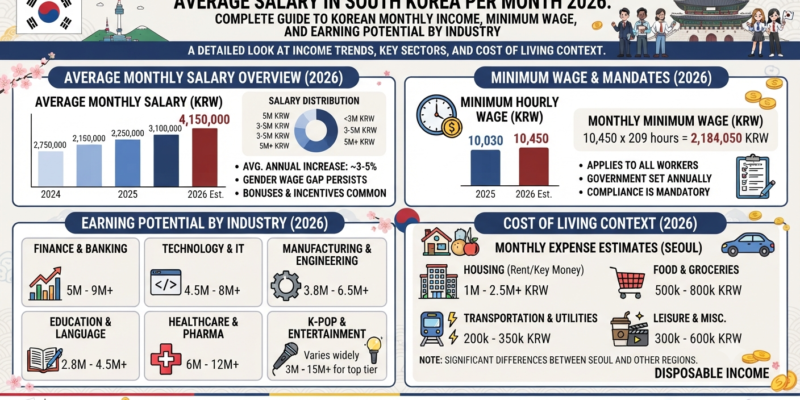
The average salary in South Korea per month in 2026 is approximately 3,500,000 Korean Won to 4,000,000 Korean Won before taxes. This translates to roughly 2,100 to 2,400 US dollars per month, or approximately 175,000 to 200,000 Indian Rupees per month at current exchange rates.
This average includes all full-time employed workers across industries and experience levels. The median salary, which more accurately represents what a typical worker earns, is slightly lower at approximately 3,000,000 to 3,200,000 Won per month. The gap between mean and median reflects the presence of very high earners at the top of the distribution, particularly in finance, technology, and senior corporate roles.
It is important to understand that these figures represent gross salary. South Korea has a progressive income tax system, and workers also contribute to national health insurance, the national pension scheme, employment insurance, and workers compensation insurance. After all deductions, take-home pay is typically around 80 to 85 percent of gross salary for average earners.
Minimum Wage in South Korea for 2026
The minimum wage in South Korea is set annually by the Minimum Wage Council and approved by the Ministry of Employment and Labor. For 2026, the minimum hourly wage in South Korea is 10,030 Korean Won per hour.
Based on a standard 40-hour work week and the legal maximum of 209 hours per month including overtime calculations, the minimum monthly wage in South Korea for 2026 works out to approximately 2,096,270 Korean Won per month. This is the legally mandated floor below which no employer can pay any worker, including foreign workers on valid work visas.
For Indian students or workers just arriving in Korea, this minimum wage provides a reasonable baseline for evaluating part-time or entry-level work opportunities. Part-time jobs available to students on D-2 visas are capped at 20 hours per week during semesters, which means a student working the maximum allowed hours at minimum wage can earn approximately 800,000 to 900,000 Won per month from part-time work.
Average Salary in South Korea Per Month by Industry
Technology and IT
The technology sector is one of the highest-paying industries in South Korea. Software engineers and developers at large Korean conglomerates or technology companies earn between 4,500,000 and 8,000,000 Won per month depending on experience. Senior engineers and architects at companies like Samsung Electronics or Kakao can earn considerably more, with total compensation packages that include bonuses pushing annual earnings well above 100,000,000 Won.
Professionals working in areas such as artificial intelligence, cloud computing, semiconductor design, and cybersecurity are in particularly high demand and command premium salaries. For Indian IT professionals exploring jobs in Korea for Indians, the technology sector represents the most accessible and lucrative pathway.
Finance and Banking
Financial professionals in Seoul earn among the highest salaries in the Korean economy. Investment bankers, asset managers, and corporate finance professionals at major banks such as KB Kookmin, Shinhan, Hana, and Woori earn between 5,000,000 and 10,000,000 Won per month. Those at foreign investment banks or hedge funds can earn significantly more, with total compensation comparable to counterparts in Hong Kong and Singapore.
Healthcare and Medicine
Doctors and specialists in South Korea earn high incomes. General practitioners employed in hospitals earn between 6,000,000 and 10,000,000 Won per month. Specialists in surgery, cardiology, and oncology earn considerably more. Dentists in private practice often earn 8,000,000 Won or above per month. Nurses earn between 2,800,000 and 4,500,000 Won per month depending on experience and the type of facility.
Education and Academia
University professors at major Korean institutions earn between 4,000,000 and 7,000,000 Won per month. English teachers from English-speaking countries working at public schools through programs like EPIK earn approximately 1,800,000 to 2,650,000 Won per month, which is entry-level by Korean standards but comes with free housing and benefits that make it financially attractive.
Private tutoring academies known as hagwons pay English teachers between 2,000,000 and 3,500,000 Won per month depending on qualifications and location.
Manufacturing and Engineering
South Korea’s manufacturing backbone includes automotive, shipbuilding, steel, and electronics. Engineers in these sectors earn between 3,500,000 and 6,000,000 Won per month. Senior engineers and managers at companies like Hyundai, Kia, POSCO, and Samsung Heavy Industries earn more, and performance bonuses can add significantly to base pay.
Retail and Service
Entry-level positions in retail, food service, and hospitality typically pay close to the minimum wage. Front-line workers in convenience stores, restaurants, and coffee shops earn approximately 2,000,000 to 2,500,000 Won per month for full-time hours. Managers and supervisors in these sectors earn between 2,800,000 and 3,500,000 Won per month.
Average Salary in South Korea Per Month by Experience Level
Work experience is a major determinant of salary in South Korea. Korean corporate culture follows a relatively structured seniority-based compensation system, though younger companies and startups have begun moving toward performance-based pay models.
Entry-level workers with zero to three years of experience typically earn between 2,500,000 and 3,200,000 Won per month. Mid-level professionals with four to nine years of experience earn between 3,500,000 and 5,500,000 Won per month. Senior professionals with ten or more years of experience earn between 5,500,000 and 9,000,000 Won per month. Executive and director-level positions command 10,000,000 Won or more per month.
Average Salary in South Korea Per Month in Seoul vs Other Cities
Location significantly affects earnings in South Korea. Seoul and the surrounding Gyeonggi Province, which together form the Seoul Capital Area, account for roughly half of South Korea’s entire economic output. Salaries in Seoul are consistently higher than in other cities.
In Seoul, the average monthly salary runs approximately 10 to 20 percent above the national average. Professionals in Suwon, Incheon, and Seongnam, which are part of the greater Seoul metropolitan area, earn salaries broadly comparable to Seoul due to proximity to major corporate headquarters.
In Busan, South Korea’s second city, salaries are somewhat lower than in Seoul but competitive within the logistics, shipping, and maritime industries where Busan specializes. In cities like Daegu, Gwangju, and Ulsan, average salaries tend to run 10 to 15 percent below the Seoul average, though costs of living are also lower. You can learn more about life in different Korean cities when planning your stay.
Average Salary in South Korea for Foreigners and Indian Workers
Foreign workers in South Korea are entitled to the same minimum wage protections as Korean nationals. However, actual salaries vary significantly based on the type of visa, industry, language skills, and qualifications.
Highly skilled foreign professionals in technology, finance, research, and academia typically earn salaries comparable to Korean colleagues in equivalent roles. Korean language proficiency significantly increases earning potential. Workers who speak Korean fluently command higher salaries than those who rely solely on English.
For E-7 visa holders in specialty occupations, salaries typically range from 3,000,000 to 6,000,000 Won per month depending on the field and seniority. E-9 visa holders in manufacturing and agriculture earn closer to the minimum wage.
Indian professionals in IT and engineering who secure employment at Korean companies through best jobs in South Korea for foreign workers typically earn between 3,500,000 and 6,000,000 Won per month. Those employed by Korean subsidiaries of Indian IT companies such as Infosys or TCS may have different compensation structures linked to their home country packages.
How Average Monthly Salary in South Korea Compares to Cost of Living
A salary of 3,000,000 Won per month provides a comfortable life in smaller Korean cities and a modest but manageable life in Seoul. The monthly cost of living in South Korea for a single person ranges from approximately 1,200,000 to 2,000,000 Won in Seoul when including rent, food, transportation, and utilities. This leaves reasonable savings potential on an average income.
For international students, part-time work at minimum wage combined with a scholarship or family support can cover basic living expenses. Students should also be aware of the South Korean currency versus Indian currency exchange rate to plan their finances accurately.
Bonuses and Additional Compensation in South Korea
Korean corporate culture includes a strong tradition of bonuses that can significantly supplement monthly base pay. Most large companies pay a Chuseok bonus (for the autumn harvest festival) and a Seollal bonus (for the Lunar New Year). Many companies also pay mid-year bonuses, performance-based annual bonuses, and year-end bonuses.
These additional payments can add 20 to 50 percent to effective annual income for employees at larger corporations. Government employees and teachers receive standardized bonus payments built into their salary structures.
Benefits such as housing allowances, meal allowances, transportation subsidies, and medical insurance top-ups are common in corporate Korea and effectively increase total compensation beyond the base monthly salary figure.
Average Salary in South Korea Per Month vs India
The comparison between Korean and Indian salaries is stark when measured in absolute terms. The average monthly salary in India for urban formal sector workers is approximately 25,000 to 35,000 Indian Rupees, which translates to roughly 375,000 to 700,000 Korean Won. This means the average South Korean worker earns five to eight times more per month than the average Indian formal sector worker in nominal terms.
However, purchasing power parity comparisons narrow this gap somewhat because many goods and services are more expensive in South Korea than in India. Food, rent, and local transport in India are significantly cheaper than in Korea. Still, in absolute income terms, the difference is substantial, which is a key reason why Indian students and professionals are increasingly interested in working opportunities in South Korea.
Summary: Average Salary in South Korea Per Month
The average salary in South Korea per month in 2026 is approximately 3,500,000 to 4,000,000 Korean Won gross. Minimum wage is set at 10,030 Won per hour, guaranteeing approximately 2,096,270 Won per month for full-time workers. Salaries vary significantly by industry, with technology, finance, and medicine commanding the highest pay. Seoul-based workers earn more than those in other cities. Foreigners are legally protected by minimum wage laws and can earn competitive salaries with the right qualifications and Korean language skills.
To explore more about building a career or academic life in Korea, visit Study in South Korea for complete guides on visas, universities, scholarships, and job opportunities.