

South Korea packs an extraordinary variety of urban experiences into a relatively small geographic area. The country spans roughly 100,000 square kilometers, yet within that compact space you will find megalopolises that rank among the world’s most advanced cities, historic towns that preserve centuries of Korean culture, port cities that connect Asia’s trade routes, and university towns that draw students from across the globe.
Choosing the right city is one of the most important decisions for anyone planning to study, work, or live in South Korea. The city you settle in shapes your daily experience, your access to opportunities, your cost of living, and the community you join. This guide examines the best cities in South Korea in detail so you can make a fully informed choice.
Seoul: The Best City in South Korea for Students and Professionals
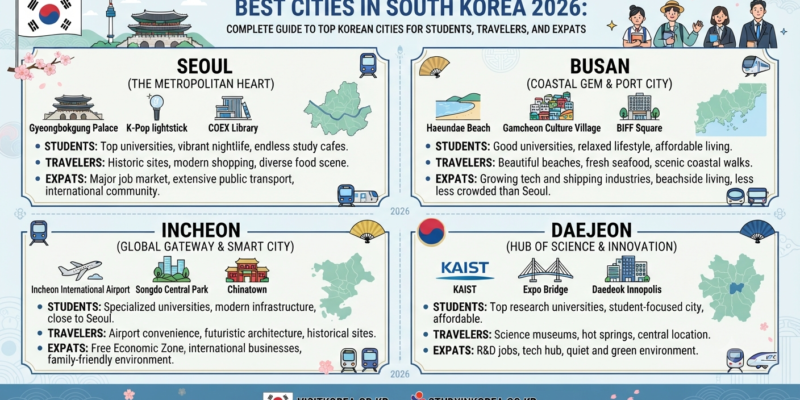
Seoul is the capital of South Korea, the largest city in the country, and one of the great metropolitan centers of the world. With a population of approximately 9.7 million within the city limits and over 25 million in the greater Seoul Capital Area, it is the economic, political, cultural, and educational heart of the nation.
Why Seoul Tops the List of Best Korean Cities
Seoul contains South Korea’s most prestigious universities, including Seoul National University, Yonsei University, and Korea University, which are collectively known as the SKY universities. These institutions rank among the top universities in Asia and attract tens of thousands of international students each year. If you are researching top colleges in Seoul, South Korea, this city offers more options than any other location in the country.
The job market in Seoul is unmatched within South Korea. Major global corporations and nearly all of Korea’s largest conglomerates maintain their headquarters in Seoul or the surrounding Gyeonggi Province. Samsung’s main campus is in Suwon, Hyundai’s global headquarters are in Seoul, and LG, SK, Lotte, and dozens of other major employers are concentrated in this region.
Life in Seoul
Seoul is a city that never sleeps. The Han River runs through the center of the city, with parks, cycling paths, and outdoor spaces along both banks. Neighborhoods like Hongdae attract young people and university students with live music venues, art galleries, independent cafes, and street food markets. Gangnam, made famous worldwide by Psy’s hit song, is Seoul’s affluent commercial and entertainment district. Insadong and Bukchon Hanok Village preserve traditional Korean architecture and culture within the modern city.
Public transport in Seoul is world-class. The metro system covers the entire city and the surrounding region with precise timing, affordable fares, and clean stations. Getting anywhere in Seoul on public transport is fast, reliable, and inexpensive.
The cost of living in Seoul is the highest in South Korea. A single person living comfortably in Seoul should budget between 1,500,000 and 2,000,000 Won per month for rent in a shared apartment, food, transport, and utilities. This is manageable on a Korean salary or student scholarship but requires careful planning.
You can find detailed information about luxury apartments in Seoul and more affordable accommodation options through our complete housing guides.
Busan: The Best Korean City for Beach Lovers and Maritime Culture
Busan is South Korea’s second city, located on the southeastern tip of the Korean Peninsula where it meets the Korea Strait. With a population of approximately 3.4 million, Busan is a major international port, a growing tourist destination, and an increasingly popular choice for international students and expats who want a slower pace of life than Seoul without sacrificing urban amenities.
What Makes Busan One of the Best Cities in South Korea
Busan’s defining characteristic is the seamless integration of urban life with natural scenery. The city sits between mountains and the sea. Haeundae Beach, one of the most famous beaches in Asia, is a full-sized urban beach accessible by metro. Gwangalli Beach offers a different atmosphere, with the sparkling Gwangan Bridge as a backdrop and a vibrant nightlife strip along the waterfront.
Busan is also a city of hills. Gamcheon Culture Village, sometimes compared to a Korean version of Santorini for its colorful hillside houses, has become one of the most photographed spots in the country. The Jagalchi Fish Market, the largest seafood market in South Korea, is both a cultural landmark and a daily working market that sells an extraordinary variety of fresh fish and shellfish.
Busan National University and Pusan National University are major institutions serving the region. The city has a growing international student population and increasingly offers programs in English. For those interested in studying and staying in budget accommodation, Busan offers much more affordable options than Seoul.
The cost of living in Busan is noticeably lower than in Seoul. Rent for a one-room studio apartment runs approximately 300,000 to 500,000 Won per month less than equivalent accommodation in Seoul. Food and entertainment are similarly priced below Seoul levels.
Incheon: The Best Gateway City in South Korea
Incheon is South Korea’s third-largest city with a population of approximately 3 million people. Located on the western coast just 40 kilometers from Seoul, Incheon is connected to the capital by metro line 1 and the Airport Railroad. The two cities effectively function as part of the same metropolitan region.
Why Incheon Deserves a Place Among Korea’s Best Cities
Incheon International Airport is consistently ranked among the best airports in the world. For international students and travelers, arriving in Korea means arriving in Incheon. The airport’s efficiency, cleanliness, services, and transit connections make it a remarkable first impression of Korea. The flights from India to Seoul all land here.
Incheon is also home to Songdo International Business District, one of the world’s most ambitious smart city projects. Built on reclaimed land, Songdo was designed from scratch as a green, technology-integrated urban district with international schools, global companies, and a quality of life that rivals any modern city in Asia. Incheon Global Campus within Songdo hosts branches of several international universities offering degree programs in English.
The port of Incheon connects South Korea to China and other regional trade partners. The city has a historic Chinatown that reflects Korea’s oldest existing Chinatown, dating from the late 19th century. Incheon offers a slightly more affordable cost of living than central Seoul while maintaining excellent connectivity to the capital.
Daegu: The Best Korean City for Traditional Culture and Affordable Living
Daegu is South Korea’s fourth-largest city with approximately 2.4 million residents. Located in the southeastern Gyeongbuk Province, Daegu is sometimes called the fashion city of Korea because of its textile industry and significant number of clothing boutiques and fashion-related businesses.
What Makes Daegu a Top Choice
Daegu offers one of the most affordable costs of living among major Korean cities. Rent, food, and transportation all run noticeably cheaper than in Seoul or Busan. For students on tight budgets, Daegu can stretch a scholarship or part-time income significantly further than life in the capital.
Kyungpook National University, one of South Korea’s top regional universities and a member of the prestigious SKY-adjacent group of national universities, is based in Daegu. Keimyung University and Daegu University also attract international students. The universities in Daegu offer strong programs in engineering, medicine, and the humanities.
Daegu is also famous for apple production, its summer heat (which is the most intense of any major Korean city), and a conservative traditional culture that contrasts with Seoul’s cosmopolitan atmosphere. The city’s downtown area, centered around Dongseongno, is a lively retail and entertainment district.
Gwangju: The Best City in South Korea for Arts and Social History
Gwangju is the largest city in southwestern South Korea with a population of approximately 1.5 million. It is the capital of South Jeolla Province and a city with deep significance in modern Korean political history. The May 18th Democratic Uprising of 1980, in which citizens of Gwangju rose against military dictatorship and were violently suppressed, is a defining moment in South Korea’s path to democracy. The May 18th National Cemetery and the 5.18 Memorial Park are important historical sites.
Why Gwangju Is Worth Considering
Gwangju has reinvented itself as a center of culture and art. The Asia Culture Center, a massive complex housing theaters, galleries, archives, and creative spaces, has transformed Gwangju into a hub for contemporary art in Asia. The Gwangju Biennale, held every two years, is one of the most prestigious contemporary art festivals in the world.
Chonnam National University and Chosun University are the city’s main institutions of higher learning. Gwangju is significantly less expensive than Seoul and offers a genuine Korean urban life without the intensity of the capital. For Indian students who want an authentic Korean experience away from the tourist trail, Gwangju is an excellent and underrated choice.
The city’s food culture is particularly celebrated. The Jeolla region is considered the culinary heartland of Korea, and Gwangju’s restaurants are famous for serving some of the best traditional Korean food available anywhere.
Jeju City: The Best City in South Korea for Nature and Tourism
Jeju City is the capital of Jeju Island, which lies off the southwestern tip of the Korean Peninsula. Jeju is an autonomous special self-governing province and is culturally and geologically distinct from the Korean mainland. The island is home to Hallasan, the highest mountain in South Korea, UNESCO World Heritage lava tube caves, dramatic coastal cliffs, and a subtropical climate unlike anywhere else in Korea.
Jeju City as a Living Destination
Jeju has seen extraordinary growth as both a tourist destination and a residential choice for Koreans seeking a slower pace of life. A significant remote-working community has developed on the island, drawn by its natural beauty, mild climate, and relatively affordable rent compared to Seoul.
The South Korea tour package from Chennai almost always includes Jeju as a key destination. Indian travelers consistently rank Jeju Island among the most beautiful places they visit in Korea. Jeju National University serves the island’s academic community.
Suwon: The Best City in South Korea for Tech and History
Suwon is the capital of Gyeonggi Province and lies approximately 30 kilometers south of Seoul. With a population of about 1.2 million, Suwon is Korea’s largest city after the main metropolitan centers. It is home to Samsung’s primary research and development campus and manufacturing base, making it one of the most economically significant cities outside Seoul.
Suwon Hwaseong Fortress, a UNESCO World Heritage Site built in the late 18th century, winds through the heart of the city and represents one of Korea’s finest examples of traditional military architecture. The combination of high-tech industry and historic preservation makes Suwon a genuinely distinctive place.
Jeonju: The Best Korean City for Food and Heritage
Jeonju is a mid-sized city of approximately 660,000 people in North Jeolla Province. It is famous throughout Korea for two things above all others: bibimbap and the Jeonju Hanok Village.
Jeonju bibimbap is considered the definitive version of one of Korea’s most iconic dishes. Restaurants in Jeonju serve bibimbap with traditional stone bowls, carefully selected seasonal vegetables, and locally sourced gochujang that gives the dish its characteristic color and heat.
Jeonju Hanok Village is one of the best-preserved traditional Korean village areas in the country. Over 700 traditional hanok houses remain intact, creating an atmosphere that transports visitors to the Joseon Dynasty era. Unlike similar districts in Seoul that feel partly commercialized, Jeonju Hanok Village retains a genuine residential character alongside its tourism attractions.
How to Choose the Best City in South Korea for Your Needs
The right city for you depends on your primary purpose for being in Korea.
If you are pursuing academic excellence and career opportunities, Seoul is the clear first choice. Its universities, networking opportunities, and job market are unparalleled within Korea. If you want a balance of beach life, culture, and urban convenience at lower cost, Busan offers an outstanding quality of life. If you want to arrive internationally connected while staying close to Seoul, Incheon makes practical sense. If you are on a tight budget and want a genuine Korean urban experience, Daegu, Gwangju, or Jeonju all offer excellent value.
For those researching must-visit places in South Korea before finalizing their destination, exploring each city even briefly will reveal which atmosphere suits your personality and goals.
Summary: Best Cities in South Korea
South Korea’s cities are diverse, modern, safe, and rich in culture. Seoul leads as the premier destination for education, career, and cosmopolitan living. Busan captivates with its coastal energy. Incheon serves as the gateway to the nation and a rising smart city. Daegu offers affordable living with strong universities. Gwangju combines democratic history with arts and culture. Jeju provides nature and tranquility. Suwon blends technology with heritage. Jeonju celebrates food and traditional architecture.
Explore all these cities and much more through the comprehensive resources at Study in South Korea, where you will find guides to every aspect of Korean life for international students and travelers.