


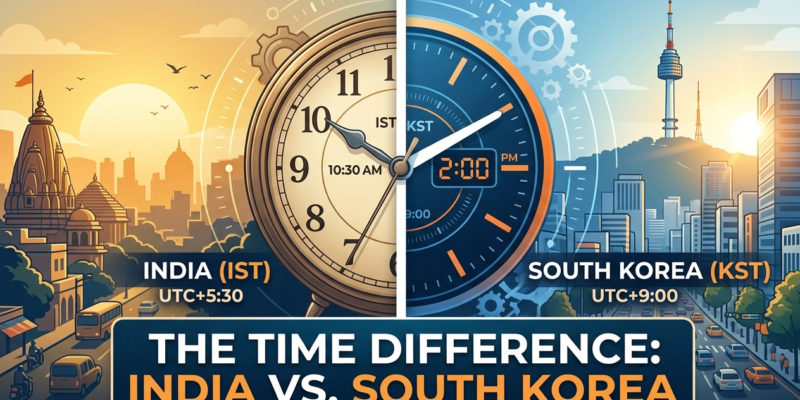
If you are planning to study, work, or travel to South Korea, one of the first practical things you need to understand is the difference between India and South Korea time. Knowing the exact time gap between India and South Korea helps you schedule video calls, plan your arrival, manage your academic schedule, and stay connected with your family back home.
This detailed guide covers everything about the India and South Korea time difference, including how many hours ahead South Korea is from India, how daylight saving affects the gap, and practical tips for Indian students and travelers managing two time zones.
What Is the Current Time Difference Between India and South Korea
The difference between India and South Korea time is 3 hours and 30 minutes. South Korea is always 3 hours and 30 minutes ahead of India Standard Time (IST).
India operates on Indian Standard Time (IST), which is UTC+5:30. South Korea operates on Korea Standard Time (KST), which is UTC+9:00. When you subtract IST from KST, the result is a fixed gap of 3 hours and 30 minutes.
This means:
- When it is 12:00 PM (noon) in India, it is 3:30 PM in South Korea
- When it is 6:00 AM in India, it is 9:30 AM in South Korea
- When it is 9:00 PM in India, it is 12:30 AM (midnight) in South Korea
This time difference does not change throughout the year because neither India nor South Korea observes daylight saving time. This makes the calculation straightforward and consistent for anyone managing schedules across both countries.
India Standard Time vs Korea Standard Time: A Detailed Comparison
Understanding the technical details of each time zone helps you calculate the India and South Korea time difference more accurately.
India Standard Time (IST)
India Standard Time is UTC+5:30. It is one of the few time zones in the world that uses a half-hour offset from UTC. The entire country of India operates on a single time zone, which means there is no regional variation in IST regardless of whether you are in Mumbai, Delhi, Chennai, or Kolkata.
India does not observe daylight saving time. IST remains fixed at UTC+5:30 throughout the year.
Korea Standard Time (KST)
Korea Standard Time is UTC+9:00. It is used across the entire Korean Peninsula, including both North Korea and South Korea, though North Korea has at times made adjustments. South Korea officially follows KST at UTC+9:00.
South Korea also does not observe daylight saving time. KST remains fixed at UTC+9:00 throughout the year, making it predictable for international scheduling.
Because neither country shifts its clocks, the difference between India and South Korea time is always exactly 3 hours and 30 minutes, every day of the year.
India to South Korea Time Conversion Table for Common Hours
The following conversion table helps you quickly calculate South Korea time from India time. This is especially useful for Indian students in South Korea who need to schedule calls with family.
| India Time (IST) | South Korea Time (KST) |
|---|---|
| 12:00 AM (midnight) | 3:30 AM |
| 1:00 AM | 4:30 AM |
| 2:00 AM | 5:30 AM |
| 3:00 AM | 6:30 AM |
| 4:00 AM | 7:30 AM |
| 5:00 AM | 8:30 AM |
| 6:00 AM | 9:30 AM |
| 7:00 AM | 10:30 AM |
| 8:00 AM | 11:30 AM |
| 9:00 AM | 12:30 PM |
| 10:00 AM | 1:30 PM |
| 11:00 AM | 2:30 PM |
| 12:00 PM (noon) | 3:30 PM |
| 1:00 PM | 4:30 PM |
| 2:00 PM | 5:30 PM |
| 3:00 PM | 6:30 PM |
| 4:00 PM | 7:30 PM |
| 5:00 PM | 8:30 PM |
| 6:00 PM | 9:30 PM |
| 7:00 PM | 10:30 PM |
| 8:00 PM | 11:30 PM |
| 9:00 PM | 12:30 AM (next day) |
| 10:00 PM | 1:30 AM (next day) |
| 11:00 PM | 2:30 AM (next day) |
This table is useful for any Indian planning to study in South Korea after 12th or manage cross-country academic or professional schedules.
Does Daylight Saving Time Affect the India and South Korea Time Difference
No. Daylight saving time does not affect the difference between India and South Korea time. This is because neither India nor South Korea observes daylight saving time.
Many countries in North America and Europe shift their clocks forward by one hour in summer and back in winter. However, India abolished daylight saving time in 1945 and has not observed it since. South Korea similarly does not use daylight saving time and has maintained a fixed time zone since 1988.
This means the 3 hours and 30 minutes gap between IST and KST is permanent and does not change in any season. Whether you are planning a trip in January or July, the India to South Korea time difference remains the same.
How the India-South Korea Time Difference Affects Indian Students
For Indian students pursuing higher education in South Korea, the 3 hour 30 minute time gap has significant daily implications. If you are considering universities in South Korea for international students, understanding how time zones affect your lifestyle is essential before you move.
Staying in Touch with Family in India
One of the most common challenges Indian students face in South Korea is finding a suitable window to call home. Since South Korea is ahead of India by 3.5 hours, the best time to call your family in India from South Korea is between 7:00 PM and 9:00 PM KST, which translates to 3:30 PM to 5:30 PM IST. This window works well because it falls outside typical class hours in South Korea and before bedtime in India.
Calling after 10:00 PM in South Korea means it is 6:30 PM in India, which is still a reasonable hour. However, calling very late at night from South Korea (after midnight KST) means it is only early evening in India, so you do have some flexibility.
Online Classes and Remote Learning
Some Indian students enrolled in hybrid or partially online programs may need to attend live sessions conducted from India. Professors based in India who teach online at 10:00 AM IST would expect South Korea-based students to join at 1:30 PM KST, which is usually manageable.
Managing Academic Deadlines
Assignment deadlines issued by South Korean universities are set in KST. Indian students who are still adjusting to the new time zone sometimes miscalculate deadlines if they inadvertently think in IST. It is important to set your phone, laptop, and all academic portals to KST as soon as you arrive.
How the Time Difference Affects Indian Travelers Visiting South Korea
If you are following a South Korea itinerary for 7 days as a first-time visitor from India, jet lag and time zone adjustment are practical concerns you should plan for.
Jet Lag After Flying from India to South Korea
The flight from India to South Korea typically takes between 7 and 9 hours depending on your departure city and whether the flight is direct or has a layover. Combined with the 3.5-hour time difference, your body clock will need time to adjust.
When you land in South Korea, your internal clock still operates on IST. If your flight arrives at 9:00 AM KST, your body believes it is 5:30 AM IST, which means you may feel tired even in the morning. Adjusting to KST typically takes 2 to 3 days.
Practical tips for managing jet lag:
- Stay awake until at least 9:00 PM KST on your first night to reset your sleep cycle
- Avoid heavy meals late at night KST, especially during the first two days
- Set all your devices to KST immediately upon boarding your flight
Booking Tours and Transportation in South Korea
All transportation schedules in South Korea, including KTX trains, city buses, subway systems, and domestic flights, operate on KST. When you book tickets or check schedules, always confirm times in KST to avoid missing departures.
How the India-South Korea Time Difference Affects Business and Work
For Indians working in South Korea or for Indian companies with business partnerships in South Korea, the time zone difference plays an important role in scheduling meetings, calls, and deadlines.
Overlapping Business Hours Between India and South Korea
Standard business hours in India are typically 9:00 AM to 6:00 PM IST. Standard business hours in South Korea are typically 9:00 AM to 6:00 PM KST.
Converting these into a common timeline:
- 9:00 AM KST = 5:30 AM IST (India not yet at work)
- 12:30 PM KST = 9:00 AM IST (both countries now at work)
- 6:00 PM KST = 2:30 PM IST (South Korea closing, India still working)
The overlapping business window between India and South Korea is approximately 12:30 PM to 6:00 PM KST (9:00 AM to 2:30 PM IST). This roughly 5.5-hour window is the most productive time for scheduling joint meetings, calls, and collaborative work between the two countries.
Remote Work Considerations
Indian professionals working remotely for South Korean companies, or vice versa, need to be especially aware of the time gap. A South Korean employer who schedules a morning standup at 9:00 AM KST expects Indian team members to join at 5:30 AM IST. This can be challenging and should be discussed during the hiring process.
South Korea Time vs Other Major Indian Cities
While India operates on a single time zone (IST, UTC+5:30), different cities are at very different geographical longitudes. However, all cities follow the same IST, so the difference between South Korea time and any Indian city is the same: 3 hours and 30 minutes.
| Indian City | India Time (IST) | South Korea Time (KST) |
|---|---|---|
| New Delhi | 10:00 AM | 1:30 PM |
| Mumbai | 10:00 AM | 1:30 PM |
| Bengaluru | 10:00 AM | 1:30 PM |
| Chennai | 10:00 AM | 1:30 PM |
| Kolkata | 10:00 AM | 1:30 PM |
| Hyderabad | 10:00 AM | 1:30 PM |
Whether you are in Surat, Pune, Ahmedabad, or any other Indian city, the time gap to South Korea is always 3 hours and 30 minutes ahead of you.
South Korea Time Compared to Other Asian Countries from India
Understanding how South Korea’s time zone compares to neighboring countries is useful context, especially for students and travelers who may visit multiple countries.
| Country | Time Zone | Difference from India |
|---|---|---|
| India | IST (UTC+5:30) | 0 hours |
| South Korea | KST (UTC+9:00) | +3 hours 30 minutes |
| Japan | JST (UTC+9:00) | +3 hours 30 minutes |
| China | CST (UTC+8:00) | +2 hours 30 minutes |
| Thailand | THA (UTC+7:00) | +1 hour 30 minutes |
| Singapore | SGT (UTC+8:00) | +2 hours 30 minutes |
| Nepal | NPT (UTC+5:45) | +0 hours 15 minutes |
South Korea and Japan share the same time zone (UTC+9:00), both being 3 hours and 30 minutes ahead of India.
How Indian Students Can Manage the India-South Korea Time Difference
Living abroad as an Indian student in South Korea comes with the responsibility of managing two time zones simultaneously. Your academic life runs on KST, while your personal and family communications often run on IST. Here are practical strategies:
Use World Clock Apps
Set up a dual time display on your smartphone. Both Android and iOS allow you to add multiple time zones to your clock app. Set one to KST and one to IST so you can always see both times at a glance without needing to calculate.
Schedule Weekly Family Calls in Advance
Rather than calling spontaneously, schedule a fixed weekly call time that works in both time zones. A good recurring slot is Sunday at 7:00 PM KST, which is 3:30 PM IST, a comfortable afternoon time for family in India.
Inform Your University About Time Zone Challenges
Some South Korean universities are familiar with international students dealing with time zone differences when communicating with home institutions for transcript or document submissions. Do not hesitate to explain time zone constraints if you need extended response times from India-based offices.
Understand the Academic Year Timing in South Korea
South Korea’s academic year begins in March and has a semester break in summer (July-August) and winter (December-February). If you are applying to universities in South Korea from India, application deadlines in KST must be converted carefully to ensure you submit on time from India.
Cultural Understanding of Time in South Korea vs India
Beyond clock time, the cultural attitude toward time differs significantly between India and South Korea, which is worth understanding before you move or visit.
Punctuality in South Korea
South Korean professional and academic culture places an extremely high value on punctuality. Being late to a class, meeting, or appointment, even by a few minutes, is considered disrespectful. If a class starts at 9:00 AM KST, students are expected to be seated before that time.
This is distinct from the more flexible approach to time that can sometimes exist in Indian social contexts, particularly for personal events and informal gatherings.
Business Meeting Etiquette and Time
In South Korean business culture, arriving early to a meeting is the norm rather than the exception. This is part of the broader professional culture you will encounter if you take up jobs in South Korea as an Indian.
Academic Deadlines Are Strict
South Korean universities, which are world-renowned and highly competitive, enforce assignment and exam deadlines strictly. Missing a submission window, even by minutes, may result in a zero grade or academic penalty with no exceptions. This is especially important for Indian students accustomed to more flexible deadline cultures.
Understanding K-manners and Korean etiquette will also help you adapt faster to daily life in South Korea.
Practical Scenarios: Calculating India to South Korea Time in Real Life
Here are a few real-life scenarios to help you apply what you have learned about the India and South Korea time difference:
Scenario 1: Your university in South Korea sends a deadline email at 9:00 PM KST Your family back in India receives a copy of this email. For them in India, the email arrives at 5:30 PM IST. This is a useful reference point if you need to ask them to send any documents before that deadline.
Scenario 2: You want to watch the Indian Premier League (IPL) from South Korea IPL evening matches typically start at 7:30 PM IST. For you in South Korea, this means the match begins at 11:00 PM KST. Late night viewings are common for Indian cricket fans in South Korea.
Scenario 3: A job interview with an Indian company while in South Korea If an Indian recruiter schedules an interview at 11:00 AM IST, you need to be available at 2:30 PM KST. This usually falls within normal afternoon hours in South Korea, making it manageable without disrupting your local schedule.
Scenario 4: A Korean professor sets a 11:59 PM KST deadline for assignment submission This is 8:29 PM IST in India. If your family has access to your student portal or needs to help you submit something while you are traveling, they would need to complete it before 8:29 PM IST.
South Korea Currency and Its Relation to Indian Students Managing Time Zones
When you are studying or working in South Korea, managing financial transactions across two time zones also becomes important. Bank transfers, scholarship disbursements, and tuition payments are all processed in KST business hours.
If you send money from India to South Korea, the transfer initiated during Indian banking hours (10:00 AM to 4:00 PM IST) would arrive in South Korea after 1:30 PM to 7:30 PM KST, often the same business day. Understanding the Indian Rupee to South Korean Won exchange rate is equally important for financial planning.
Frequently Asked Questions About India and South Korea Time Difference
How many hours is South Korea ahead of India?
South Korea is 3 hours and 30 minutes ahead of India. India Standard Time is UTC+5:30 and Korea Standard Time is UTC+9:00, making the difference exactly 3.5 hours.
Does South Korea use daylight saving time?
No. South Korea does not observe daylight saving time. The time difference between India and South Korea remains fixed at 3 hours and 30 minutes throughout the entire year.
What is the best time to call India from South Korea?
The best time to call India from South Korea is between 7:00 PM and 10:00 PM KST, which corresponds to 3:30 PM to 6:30 PM IST. This window ensures that both parties are awake and free from work or academic commitments.
Is South Korea time the same as Japan time?
Yes. South Korea and Japan both use UTC+9:00, which means KST and JST are the same. Both countries are 3 hours and 30 minutes ahead of India.
What time zone does South Korea follow?
South Korea follows Korea Standard Time (KST), which is UTC+9:00. It is a fixed time zone with no daylight saving adjustments.
How do I convert IST to KST quickly?
To convert IST to KST, simply add 3 hours and 30 minutes to the Indian time. For example, if it is 8:00 AM IST, add 3 hours and 30 minutes to get 11:30 AM KST.
Why does India have a half-hour time zone?
India uses UTC+5:30 as a political and practical compromise to cover the entire country under a single time zone. Using UTC+5:30 instead of UTC+5:00 or UTC+6:00 reduces the maximum solar time deviation across the subcontinent.
Summary: Key Facts About India and South Korea Time Difference
- South Korea is 3 hours and 30 minutes ahead of India at all times
- India Standard Time (IST) is UTC+5:30; Korea Standard Time (KST) is UTC+9:00
- Neither country observes daylight saving time, so the gap never changes
- The overlap window for business between India and South Korea is approximately 12:30 PM to 6:00 PM KST (9:00 AM to 2:30 PM IST)
- The best calling window from South Korea to India is 7:00 PM to 10:00 PM KST
- South Korea and Japan share the same time zone (UTC+9:00)
- Indian students in South Korea should set all their devices to KST immediately upon arrival