


Getting a South Korea visa is one of the most important steps for any Indian planning to visit, study, or work in South Korea. The good news for Indian citizens is that South Korea has made significant improvements to its visa application process, including the availability of an electronic visa application system. Understanding how the South Korea e-visa process works for Indians in 2026 will help you prepare a strong application and avoid common mistakes that cause delays or rejections.
This comprehensive guide covers every aspect of the South Korea visa process for Indian passport holders, including visa types, the e-visa system, document checklist, step-by-step application instructions, processing time, fees, and tips from experienced applicants.
Does South Korea Offer an E-Visa for Indians
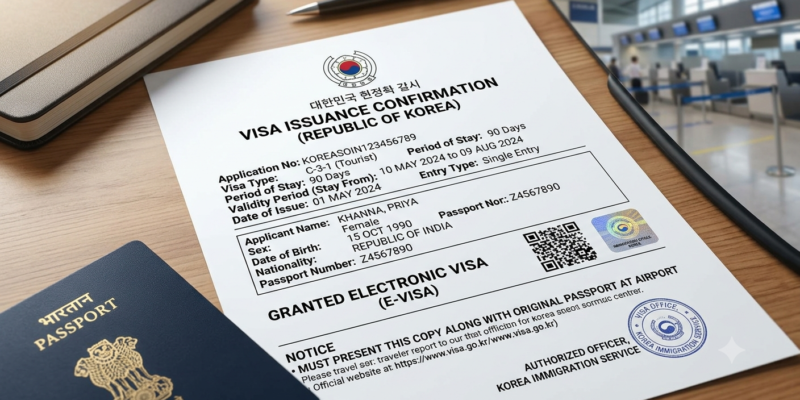
Yes, South Korea offers an online electronic visa application system for Indian citizens through the Korea Visa Application Center (KVAC) and the Hi Korea portal operated by the Korean Immigration Service. This system allows applicants to upload documents, submit applications, and track their visa status online.
However, it is important to understand a key distinction: South Korea’s electronic visa system for Indians is primarily an online application and document submission system, not a full e-visa in the sense that the visa is delivered electronically. For most visa categories applicable to Indian passport holders, the physical visa sticker is affixed in the passport and must be collected in person or via courier from the Korea Visa Application Center.
That said, the process has been significantly streamlined, and applying online is far more convenient than the older paper-based system. Many Indian applicants also use authorized Korea Visa Application Centers in cities like Delhi, Mumbai, Kolkata, and Chennai.
For Indian students specifically, the student visa (D-2) application must be handled carefully with university enrollment documents. Detailed guidance on studying in South Korea as an Indian student is available to help you understand how your visa type connects to your academic program.
Types of South Korea Visas Available for Indian Citizens
Before applying, it is essential to choose the correct visa category. Applying for the wrong visa type is one of the most common reasons for rejection or complications.
C-3: Short-Term Visitor Visa (Tourist Visa)
The C-3 visa is the most common visa category for Indian tourists visiting South Korea. It allows stays of up to 90 days per visit and is intended for tourism, family visits, attending events, and short business meetings. Indians require a visa to visit South Korea, as India and South Korea do not have a visa-free arrangement.
D-2: Student Visa
The D-2 visa is for Indian students enrolled in a degree program at a recognized Korean university. It covers undergraduate (D-2-1), master’s (D-2-2), doctoral (D-2-3), and research student (D-2-4) categories. The university’s admission letter and Certificate of Admission are required documents for this visa. Students admitted to universities in South Korea for international students will receive the necessary paperwork from their institution.
D-4: General Training Visa
The D-4 visa is for Indians enrolled in Korean language programs or vocational training courses at registered institutions. This is often the first step for students who want to learn Korean before enrolling in a degree program.
E-7: Skilled Employment Visa
The E-7 visa is for Indian professionals who have secured employment in South Korea in an occupation requiring specialized skills. This visa requires a job offer letter from a Korean employer and is governed by strict occupation eligibility criteria. More information on working in South Korea as an Indian professional is available in our dedicated employment guide.
F-3: Dependent Family Visa
The F-3 visa allows immediate family members of D-2 or E-7 visa holders to reside in South Korea as dependents.
C-4: Short-Term Employment Visa
This visa is for short-term work assignments, conference participation, or business activities beyond simple meetings. It requires a letter of invitation from a Korean company.
South Korea Visa for Indians: Who Qualifies for Which Category
For most Indian travelers, the C-3 tourist visa is the appropriate category. Students admitted to Korean universities apply for the D-2 student visa. Indian professionals with a confirmed job offer in South Korea apply for the E-7 or relevant work visa.
Choosing the correct category is not just an administrative matter. Misrepresenting your purpose of visit (for example, traveling on a tourist visa with the intention of working or studying) is a serious immigration violation that can result in deportation, blacklisting, and a long-term ban from entering South Korea.
Documents Required for South Korea Tourist Visa (C-3) for Indians
The document checklist for a South Korea C-3 tourist visa for Indian passport holders includes the following items. Always verify the current requirements on the official Korea Visa Application Center website as specific requirements can change.
Core Documents
Your original Indian passport with a minimum validity of six months beyond your intended departure date from South Korea, plus a clear photocopy of the data page. You will also need two recent passport-sized photographs taken against a white background, with specifications generally matching standard visa photo requirements.
The completed Visa Application Form, which can be downloaded from the Hi Korea portal or the Korea Visa Application Center website. This form must be filled accurately in English.
Financial Documents
Bank statements for the past three to six months showing sufficient funds to cover your trip expenses. There is no fixed minimum balance requirement, but the general expectation is that you can demonstrate adequate financial means for accommodation, food, transportation, and return travel. A bank statement showing a consistent balance of at least 50,000 to 100,000 INR or equivalent is generally considered reasonable for a short trip.
Income Tax Returns (ITR) for the past two to three years, if applicable, to demonstrate stable income and financial standing in India.
Salary slips for the past three months if you are employed.
If you are a business owner, audited financial statements or a business registration certificate may be required.
Employment and Identity Documents
An employment certificate from your employer stating your designation, salary, and the approved leave period for the trip. If you are self-employed, a business registration certificate. If you are a student, an enrollment certificate from your Indian institution.
Travel Itinerary Documents
A round-trip flight booking confirmation (note: most embassies accept tentative bookings, not necessarily fully paid tickets). Hotel booking confirmations or an invitation letter from a host in South Korea. A detailed travel itinerary listing planned activities and places to visit during the trip.
Supporting Documents
For married applicants, a marriage certificate. For minor applicants traveling with parents, a birth certificate. If applying for a family visit, an invitation letter from the relative in South Korea along with their Korean Alien Registration Card (ARC) copy.
How to Apply for South Korea Visa Online: Step-by-Step Guide for Indians in 2026
Applying for a South Korea visa from India in 2026 involves the following steps.
Step 1: Create an Account on Hi Korea Portal
Visit the official Hi Korea website at https://www.hikorea.go.kr and create an applicant account using your email address. This is the official Korean Immigration Service portal and is the most reliable source of application forms and information.
Step 2: Fill the Online Application Form
Log into your account and complete the visa application form for the appropriate visa category. Provide accurate personal information, travel details, and purpose of visit. Double-check all entries before saving the form.
Step 3: Gather and Scan All Required Documents
Prepare all required documents as listed in the document checklist above. Scan each document at 300 DPI resolution in color. File sizes and format requirements (typically PDF or JPG) are specified on the portal. Ensure that scans are legible, well-lit, and not blurry.
Step 4: Submit Documents at KVAC or Designated Visa Center
For Indian applicants, the actual submission is typically done in person or through authorized visa application centers. Korea Visa Application Centers (KVAC) are present in major Indian cities. You may also submit through recognized travel agents who handle Korean visa applications.
Alternatively, if applying directly through the Korean Embassy in India (New Delhi) or the Korean Consulates (Mumbai, Kolkata, Chennai), you will submit documents in person during the scheduled appointment.
Step 5: Pay the Visa Fee
Visa fees are paid at the application center at the time of document submission. The fee is non-refundable regardless of visa outcome.
Step 6: Track Your Application Status
After submission, you can track your application status through the Hi Korea portal using your application reference number. Processing times vary by visa category and season.
Step 7: Collect Your Passport
Once your visa is approved, your passport with the visa sticker affixed will be available for collection or courier delivery depending on the submission method you chose.
South Korea Visa Fee for Indian Applicants in 2026
Visa fees for South Korea are charged in USD equivalent and paid in Indian Rupees at the current exchange rate at the time of payment.
For the C-3 single-entry tourist visa, the fee is approximately 40 USD, which is roughly 3,300 INR. For a C-3 multiple-entry visa, the fee is around 65 to 80 USD. For double-entry tourist visas, the fee is approximately 55 USD.
Student visa (D-2) fees are approximately 60 USD. Work visa (E-7) fees vary based on duration.
These fees are subject to change. Always verify the current fee schedule on the KVAC or official Korean Embassy website before submitting your application.
South Korea Visa Processing Time for Indians
The standard processing time for a South Korea tourist visa for Indian applicants is 5 to 7 working days from the date of document submission. During peak travel seasons such as summer holidays, Korean public holidays, and winter school breaks, processing can take up to 10 to 15 working days.
Student visa and work visa applications typically take longer, ranging from 3 to 8 weeks depending on document complexity and embassy workload.
Apply well in advance of your intended travel date. Most travel advisors recommend submitting your visa application at least 4 to 6 weeks before departure for tourist visas and 8 to 12 weeks before your program start date for student visas.
Common Reasons for South Korea Visa Rejection for Indians
Understanding why visas get rejected helps you prepare a stronger application.
Incomplete or Inconsistent Documents
Submitting incomplete document sets or providing information that contradicts details on other submitted documents is a common reason for rejection. For example, if your bank statement shows insufficient funds while your travel itinerary suggests expensive hotel bookings, this inconsistency raises a red flag.
Insufficient Financial Proof
Applicants who cannot demonstrate adequate financial means to cover their trip are likely to face rejection. Ensure your bank balance is at a reasonable level for several months before applying, not just immediately before submission.
Unclear Purpose of Visit
Applications where the purpose of visit is not clearly established or where the consular officer suspects the stated purpose does not match the real intention are often rejected. Include a detailed cover letter explaining your trip purpose, planned activities, and intended return.
Previous Immigration Violations
Any history of overstaying a visa in any country, being deported, or violating immigration laws will significantly affect your chances of obtaining a South Korea visa.
Strong Ties to Home Country
Consular officers look for evidence that you have compelling reasons to return to India, such as employment, property ownership, family dependents, or business commitments. Applicants who appear to have weak ties to India and strong motivation to stay in South Korea raise concern about potential overstays.
Tips for a Successful South Korea Visa Application from India
Prepare your documents systematically and create a checklist to ensure nothing is missing before submission.
Write a clear and detailed cover letter addressed to the Consular Officer explaining your purpose of visit, planned itinerary, accommodation arrangements, financial capacity, and your reasons for returning to India after the trip.
Book refundable or tentative hotel and flight reservations for the application. Avoid paying for non-refundable arrangements before your visa is approved.
If applying for a student visa, work closely with your Korean university’s international student office. They will provide a Certificate of Admission and often a guidance letter for the visa process. Refer to our guide on Korean university admission for international students for detailed support.
Maintain a clean and well-organized travel history. If you have previously visited other countries like Japan, Singapore, USA, UK, or Schengen countries and complied fully with their visa terms, include copies of those visas in your application as evidence of responsible travel behavior.
If you are a student in India, obtain an enrollment certificate from your institution confirming you are currently studying and expect to return for continuation of studies.
South Korea Visa on Arrival: Is It Available for Indians
South Korea does not offer a visa on arrival for Indian passport holders. Indians must obtain a visa before traveling to South Korea. This applies regardless of the purpose of travel, whether tourism, family visit, business, or transit.
It is strongly advised not to attempt entry into South Korea without a valid visa. Doing so will result in denial of boarding by the airline or deportation at the Korean port of entry.
Korea Electronic Travel Authorization (K-ETA) and Indians
South Korea introduced the K-ETA (Korea Electronic Travel Authorization) system for citizens of countries that are eligible for visa-free entry. Indian citizens are not currently eligible for K-ETA because India does not have a visa-free arrangement with South Korea.
However, it is worth monitoring official announcements from the Korean Embassy in India and the Ministry of Foreign Affairs of Korea, as bilateral visa arrangements between India and South Korea have been under discussion at diplomatic levels. Any future changes to visa-free arrangements would represent a major change for Indian travelers.
Where to Apply for South Korea Visa in India
Korean Embassy in New Delhi
The Embassy of the Republic of Korea in New Delhi is the primary diplomatic mission handling visa applications for Indian citizens. It is located in Chanakya Puri, New Delhi.
Korean Consulates
Korean Consulates General are located in Mumbai and Kolkata. These consulates handle applications from applicants in their respective jurisdictions.
Korea Visa Application Centers (KVAC)
KVAC operates authorized application centers in multiple Indian cities including Delhi, Mumbai, Kolkata, Chennai, and Hyderabad. These centers are operated by a contracted service provider and handle document collection, fee payment, and passport return on behalf of the Embassy and Consulates. They do not make visa decisions; that authority rests with the Korean Embassy.
After Getting Your South Korea Visa: What Indians Need to Know
Once your visa is approved and you arrive in South Korea, there are some important next steps, especially for students and long-term visitors.
Students and workers in South Korea on D-2 or E-7 visas are required to register with the local immigration office and obtain an Alien Registration Card (ARC) within 90 days of arrival. The ARC is an essential identity document in South Korea and is required to open a bank account, sign a rental lease, and access healthcare.
Tourists on C-3 visas do not need to apply for an ARC but must ensure they do not overstay their permitted period. Overstaying a Korean visa results in fines, deportation, and a ban from future entry.
Familiarize yourself with Korean social customs and etiquette before arrival to make a positive first impression and integrate smoothly into Korean society.
Conclusion: South Korea E-Visa for Indians Is Accessible With the Right Preparation
The South Korea visa process for Indian citizens is straightforward when approached with thorough preparation, accurate documentation, and a clear understanding of which visa category applies to your purpose of travel. While India and South Korea do not yet have a visa-free arrangement, the application process is efficient, and approval rates are favorable for well-prepared applicants.
Whether you are planning a short tourist visit to explore famous Korean cultural landmarks and experiences, pursuing a degree at a Korean university, or seeking professional employment in one of Asia’s most advanced economies, your visa application is the gateway to that journey.
For complete, up-to-date guidance on studying, living, working, and visiting South Korea as an Indian citizen, explore all our resources at Study in South Korea.