


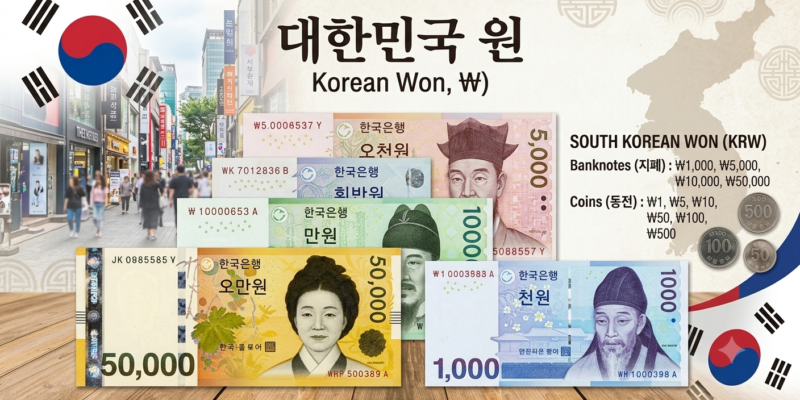
One of the first practical questions anyone asks before visiting or relocating to South Korea is simple but important: what is the South Korea money name? The official currency of South Korea is the Korean Won, written as 원 in Korean script (Hangul) and abbreviated internationally as KRW. The symbol used is ₩.
This guide goes well beyond just naming the currency. It covers the full story of the Korean Won, its historical origins, the denominations currently in circulation, how it compares to the Indian Rupee and other major currencies, and everything international students and travelers need to know to manage money confidently in South Korea.
The Official Name of South Korea’s Currency
The South Korean currency name is the Korean Won. The word “Won” (원) is derived from the Chinese character 圓 (yuan/yen), which originally meant “round” and referred historically to the shape of coins used across East Asia. The same root word is shared with Japan’s Yen and China’s Yuan, reflecting the shared monetary heritage of the region.
When written in English, the currency is spelled “Won” without an accent or umlaut. In Korean, it is pronounced as a single syllable: “wohn” with a flat, level tone. The plural is the same as the singular. You would say “1,000 won” and “1,000,000 won” using the same form.
The ISO 4217 currency code for the South Korean Won is KRW, which you will encounter when exchanging money, making international bank transfers, or checking exchange rate listings online.
This is distinct from the North Korean Won, which uses a different exchange system and is not accepted or exchangeable through standard international financial channels. The differences between North and South Korea extend to virtually every aspect of economic life, including currency systems.
History of the Korean Won
Understanding the Korean money name and history adds valuable context to the modern currency system you will encounter in South Korea today.
Pre-Colonial Period:
Korea historically used a variety of currency forms including cloth, grain, and eventually coin-based systems. The Joseon Dynasty (1392 to 1897) used brass coins called “Sangpyeong Tongbo” that circulated for centuries.
Japanese Colonial Period (1910 to 1945):
During Japanese colonial rule, Korea’s currency was replaced by the Korean Yen, issued by the Bank of Joseon and pegged to the Japanese Yen. This system reflected Japan’s integration of Korea into its imperial economy.
Post-Liberation: The First Won (1945 to 1953):
Following liberation from Japan in 1945, the First Korean Won was established at a ratio of 1 Won to 1 Japanese Yen. The Korean War (1950 to 1953) created severe inflation, with the Won losing most of its value during the conflict.
The Hwan Period (1953 to 1962):
To address hyperinflation, South Korea replaced the Won with the Hwan in 1953, exchanged at 100 Won to 1 Hwan. This was a redenomination intended to stabilize the monetary system during post-war reconstruction.
Return to the Won (1962 to Present):
In 1962, under President Park Chung-hee’s economic modernization program, South Korea reintroduced the Won, this time exchanged at 10 Hwan to 1 Won. This is the currency system that continues today, managed by the Bank of Korea (한국은행), the nation’s central bank established in 1950.
The Bank of Korea has maintained the Won through several economic crises including the devastating 1997 Asian Financial Crisis, during which South Korea required an IMF bailout and the Won lost more than half its value against the US Dollar. The subsequent recovery was remarkably swift, and the Won stabilized to its current broadly managed float exchange rate system.
This history is worth understanding if you are studying in South Korea because it illuminates how far the Korean economy has traveled from post-war poverty to its current status as a high-income nation.
Korean Won Denominations: Banknotes in Circulation
South Korea uses a clean, well-designed set of banknotes featuring prominent historical and cultural figures. Knowing the denominations before you arrive saves confusion at shops, markets, and ATMs.
1,000 Won Note:
The smallest denomination banknote features Yi Hwang (pen name: Toegye), a renowned 16th century Confucian scholar. The reverse side depicts the Dosan Seowon Confucian Academy, a UNESCO World Heritage Site. The note’s primary color is light blue-green.
This denomination is the most used for everyday small purchases: a bottle of water from a convenience store, a piece of street food, or topping up a transit card.
5,000 Won Note:
This purple-toned note features Yi I (pen name: Yulgok), another celebrated 16th century Confucian scholar and the son of the famous artist Shin Saimdang. The reverse depicts the Ojukheon House in Gangneung, where Yi I was born.
The 5,000 Won note covers basic cafe purchases, simple meals at inexpensive restaurants, and short taxi rides.
10,000 Won Note:
The most commonly used mid-value note features King Sejong the Great, the fourth king of the Joseon Dynasty and creator of Hangul, the Korean alphabet. The reverse shows astronomical instruments used during Sejong’s reign. The note is blue in tone.
The 10,000 Won note is the workhorse of everyday Korean commerce, equivalent to roughly 7 to 8 US Dollars or around 600 to 620 Indian Rupees. Most restaurant meals, transit cards, and everyday items fall in the one to several 10,000 Won note range.
For those tracking how the Indian Rupee converts to Korean Won, the 10,000 Won note provides a useful mental anchor for daily budgeting.
50,000 Won Note:
The highest denomination banknote and the newest in circulation (introduced in 2009) features Shin Saimdang, a revered Joseon-era artist, poet, calligrapher, and the mother of Yi I. She is the first historical woman to be depicted on a Korean banknote. The note is yellow-gold in tone.
The 50,000 Won note is the standard note withdrawn from ATMs. Most cash transactions above a simple snack or drink will involve these notes.
There is no 100,000 Won banknote in circulation, which means larger cash transactions require multiple 50,000 Won notes or card payment.
Korean Won Coin Denominations
Coins in South Korea are issued in five denominations. While card and mobile payment usage is extremely high in South Korea, coins still circulate for small transactions and vending machines.
1 Won Coin:
Technically still legal tender, the 1 Won coin is almost never used in practice. Most prices are rounded to the nearest 10 Won at point of sale.
5 Won Coin:
Similarly rare in practice, the 5 Won coin features a turtle ship (Geobukseon), the historically famous armored warship used by Admiral Yi Sun-sin in the 16th century.
10 Won Coin:
The smallest practically used coin, featuring the Dabotap pagoda at Bulguksa Temple, a UNESCO World Heritage Site in Gyeongju. 10 Won coins accumulate quickly but are useful for exact change at traditional markets.
50 Won Coin:
Features a rice stalk design reflecting Korea’s agricultural heritage. Used at vending machines and for exact change purposes.
100 Won Coin:
The most commonly used and practically important coin in daily life. Features Admiral Yi Sun-sin, one of Korea’s most celebrated military heroes. The 100 Won coin is equivalent to approximately 7 to 8 Indian Paise, meaning it takes about 1,650 of them to equal 1 US Dollar. Vending machines, coin laundry facilities, and some transit machines heavily use 100 Won coins.
500 Won Coin:
The largest denomination coin, featuring a Manchurian crane. Worth approximately 38 US cents or 31 Indian Rupees. The 500 Won coin is familiar to visitors because it is roughly the size of a 5 Indian Rupee coin.
Korean Won Exchange Rate in 2026
The exchange rate of the Korean Won fluctuates with global financial conditions, South Korean trade performance, and US Federal Reserve monetary policy. As of mid-2026, approximate exchange rates are:
- 1 USD to KRW: approximately 1,330 to 1,380 Won
- 1 EUR to KRW: approximately 1,440 to 1,490 Won
- 1 GBP to KRW: approximately 1,680 to 1,720 Won
- 1 INR to KRW: approximately 15.8 to 16.4 Won
This means that 1,000 Indian Rupees buys approximately 16,000 Won, and a 10,000 Won note costs roughly 610 to 635 Indian Rupees.
For detailed, up-to-date exchange calculations relevant to Indian students and travelers, the complete 2026 exchange rate guide for Indian students provides specific conversions and practical money management advice.
Where and How to Exchange Money in South Korea
South Korea offers multiple convenient options for exchanging foreign currency into Korean Won:
Banks:
Major Korean banks including KEB Hana Bank, Shinhan Bank, Woori Bank, and KB Kookmin Bank offer currency exchange services at branches. Exchange rates at banks are generally favorable, and the process is straightforward. You will need your passport for currency exchange.
Banks also offer priority exchange services for students enrolled at partner universities, often with reduced or waived fees.
Currency Exchange Booths (Myeongdong and Namdaemun):
The Myeongdong shopping district in Seoul and the Namdaemun Market area are famous for private currency exchange booths that often offer better rates than banks for major currencies like USD and EUR. Rates for less common currencies including INR may be less competitive here.
ATMs:
Global ATMs (marked with “Global” in English) at banks, convenience stores, and airports accept international Visa, Mastercard, and Maestro-linked cards. Withdrawal fees range from 2,000 to 5,000 KRW per transaction. This is often the most convenient option for travelers who maintain a home bank account with low foreign transaction fees.
Airport Exchange:
Incheon International Airport offers currency exchange at both arrival and departure areas. Rates are slightly worse than city-center booths but are convenient for immediate cash needs upon arrival. Exchanging a small amount at the airport and the remainder in the city is a common strategy.
Digital Transfer Platforms:
For Indian students managing money between India and South Korea, platforms like Wise (formerly TransferWise), RemitBee, and KakaoBank’s international transfer service offer competitive exchange rates and lower fees than traditional bank wire transfers.
Mobile and Digital Payments in South Korea
South Korea is one of the most cashless societies in the world. Card and mobile payment infrastructure is so developed that many young Koreans carry minimal to no physical cash.
Major payment systems in South Korea:
KakaoPay is integrated directly into KakaoTalk, South Korea’s dominant messaging application used by virtually the entire population. International students who obtain a Korean bank account can quickly connect to KakaoPay.
Samsung Pay is widely used among Samsung device owners and is accepted at most physical retail locations, restaurants, and transit systems.
Naver Pay integrates with Naver, South Korea’s dominant search engine and digital ecosystem. It is particularly useful for online shopping on Korean platforms.
Credit and debit cards from major Korean banks are accepted virtually everywhere in South Korea. International Visa and Mastercard are accepted at most large retailers, restaurants, and hotels, though some traditional markets and small restaurants remain cash-only.
T-money and Cashbee are prepaid transit cards that also work at convenience stores, allowing seamless payment across public transportation and daily small purchases. These are among the first things international students should acquire upon arriving in Korea, as covered in the student life guide for South Korea.
Opening a Korean Bank Account as a Foreign Student
International students enrolled in South Korean universities can open bank accounts, which is essential for receiving scholarship funds, paying rent, and accessing Korean payment systems.
Required documents typically include:
Alien Registration Card (ARC), which you receive from immigration after arriving in Korea and registering your stay
University enrollment certificate (재학증명서)
Passport
Recommended banks for foreign students:
Shinhan Bank and KEB Hana Bank have English-language service counters at branches near major university campuses. Both banks offer student account products with reduced or waived monthly fees.
IBK (Industrial Bank of Korea) is commonly used by foreign workers and students, with a reputation for relatively accessible account opening procedures for non-Korean nationals.
Kakao Bank, a digital-only bank, has become increasingly popular among international students for its app-based simplicity, though account opening requires an existing Korean phone number.
Understanding Korean Won in the Context of Korean Culture
Currency is not just economic. In South Korea, money carries cultural meaning expressed through traditional practices that remain relevant today.
Sehbae-don (New Year’s Money): During Korean New Year (Seollal), adults give crisp new bills in colorful envelopes to children and younger relatives. The 50,000 Won note is the most common denomination used for this purpose.
Baek-il and Dol gifts: At celebrations marking a baby’s 100th day and first birthday, cash gifts in clean envelopes are the standard form of congratulation. Amounts vary by relationship and social standing.
Wedding cash gifts: Korean weddings typically involve cash gifts rather than wrapped presents. Guests place Won notes in designated envelopes at the entrance. Gift amounts follow understood social norms based on the guest’s relationship to the couple.
Traditional markets and the Won: At traditional markets (재래시장) like Gwangjang Market in Seoul, cash remains king. Visiting these markets, which offer some of South Korea’s most authentic food and shopping experiences related to famous things of South Korea, always requires having Won in hand.
Understanding these cultural dimensions of money helps foreign residents navigate social situations with appropriate awareness and respect.
Tipping Culture and the Korean Won
A critical piece of practical money knowledge: tipping is not standard practice in South Korea. Unlike in the United States or some European countries, Korean service culture incorporates the expectation of excellent service into the base price. Leaving a tip can sometimes cause confusion or even be seen as awkward.
High-end international hotels that cater to foreign business travelers may be exceptions, where bellhop and concierge staff are accustomed to tips. But at Korean restaurants, cafes, salons, and taxis, simply paying the stated price is correct behavior.
This is an important Korean manner to understand before your first interactions in the country, as inadvertent tipping can create social discomfort.
Practical Money Tips for Indian Students in South Korea
Based on common experiences of the Indian student community in South Korea, here are the most practically useful money management tips:
Carry a mix of payment methods. While South Korea is extremely card and mobile-payment friendly, traditional markets, small restaurants near older neighborhoods, and certain cultural sites still prefer cash.
Avoid airport currency exchange for large amounts. The convenience fee embedded in airport exchange rates is significant. Exchange a modest amount for immediate needs and do the bulk of your exchange in the city.
Monitor the INR to KRW exchange rate before major transfers. Exchange rate fluctuations can meaningfully affect the value of remittances from India. Setting rate alerts on apps like Wise or XE can help time transfers advantageously.
Set up a Korean bank account within the first month of arrival. This is essential for receiving scholarship payments, paying housing deposits, and integrating into Korea’s digital payment ecosystem.
Understand the semester scholarship disbursement cycle. Many Korean university scholarships are paid at the start of each semester. Budgeting to stretch this payment across the full semester requires planning, particularly for students from India who may not have a local financial safety net initially.
For more guidance on navigating the financial and cultural dimensions of student life in South Korea, the Study in South Korea resource hub offers comprehensive support for Indian students at every stage of their journey.
Conclusion: The Korean Won and Your Life in South Korea
The South Korea money name, the Korean Won (KRW, ₩), represents one of Asia’s most stable and internationally respected currencies. Its clean denominations, widespread digital payment infrastructure, and globally accessible exchange network make managing money in South Korea straightforward once you understand the basics.
For Indian students and travelers, the key is setting up the right banking infrastructure early, understanding the cultural context of money in Korean society, and using the excellent exchange and transfer tools available to manage funds between India and Korea effectively.
Whether you are managing a monthly budget on a student stipend or planning your salary allocation after landing a job with a Korean company, understanding the Korean Won is your first step toward financial confidence in South Korea.