


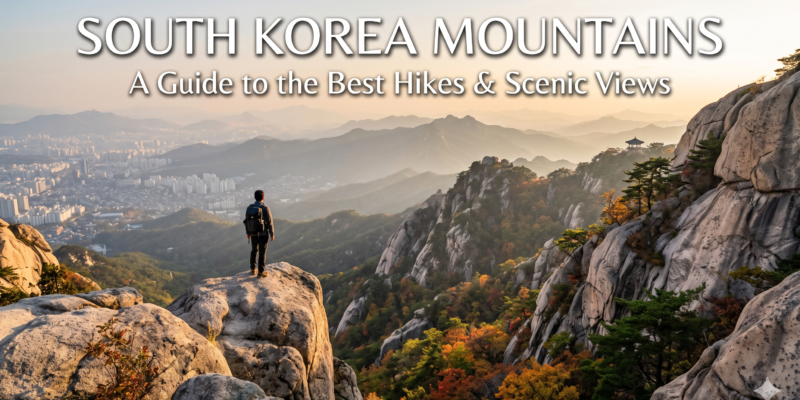
South Korea Mountains: Best Peaks, National Parks and Hiking Trails
Around 70 percent of South Korea’s land is mountainous, and the country counts more than 7,000 named peaks. For a nation this hiking-obsessed, with survey after survey showing most Koreans hit a trail regularly, the mountains are not a side activity, they are a core part of how the country spends its weekends. This guide walks through the peaks worth planning a trip around, what each one demands physically, and when to go.
Why South Korea’s Mountains Are Worth a Trip
Unlike high-altitude ranges elsewhere in Asia, South Korea’s mountains are accessible in a day or a weekend, well marked, and often paired with temples, waterfalls, and granite rock formations that make the hike itself the main attraction rather than just the summit. Four seasons give the same trail a completely different character depending on when you visit, from cherry blossoms in spring to fiery foliage in autumn and snow-capped ridgelines in winter.
Hallasan: South Korea’s Highest Peak
Hallasan sits in the middle of Jeju Island and is South Korea’s tallest mountain at roughly 1,950 metres. It is a dormant shield volcano, and its summit holds Baengnokdam, a crater lake that gives the climb its postcard payoff. Hallasan is considered one of the country’s three sacred spirit mountains, alongside Jirisan and Seoraksan, and many Koreans treat the hike as much as a cultural pilgrimage as a physical challenge.
- Difficulty: Moderate to strenuous, depending on the trail chosen
- Best season: Spring for wildflowers, winter for the snow-covered crater
- Good to know: Permits and set start times apply on the main summit trails, so you need to book your climbing slot in advance rather than just showing up
Seoraksan: Korea’s Most Dramatic Granite Peaks
Seoraksan, in Gangwon-do on the mainland, is consistently ranked the most popular mountain in the country, drawing around three million visitors a year. Its granite spires, deep valleys, and routes like the climb to Ulsanbawi Rock make it the mountain most associated with South Korea’s hiking culture. The trail to Daecheongbong Peak, the highest point in the park, rewards hikers with sweeping views over the Sea of Japan.
- Difficulty: Moderate for shorter routes, hard for the Daecheongbong summit push
- Best season: Autumn, when the park’s foliage is considered among the best in the country
- Good to know: This is a strong first pick if you are also planning time in Seoul, since Sokcho and the park are a manageable bus ride from the capital
Jirisan: The Mainland’s Largest National Park
Jirisan is the giant of South Korea’s mainland mountains and sits inside the country’s largest national park, covering 484 square kilometres. Its ridge trail is one of the oldest and most iconic multi-day routes in Korea, and the park stays scenic through every season rather than peaking only in autumn.
- Difficulty: Strenuous for the full ridge traverse, moderate for shorter day sections
- Best season: Year-round appeal, though many hikers prefer spring and autumn for temperature
- Good to know: If you are built a longer trip around hiking, Jirisan pairs well with the kind of multi-day planning covered in a 7-day South Korea itinerary
Bukhansan: The City Mountain
Bukhansan sits right inside Seoul’s city limits, which makes it the easiest serious hike to fit into a trip that is mostly about the capital. Trails range from short, well-marked loops to rockier scrambles with temple stops along the way, and the summit area gives you a genuinely striking view back over the skyline.
- Difficulty: Easy to moderate, depending on the chosen trail
- Best season: Spring and autumn for comfortable temperatures
- Good to know: A solid choice if your schedule is built around the best cities in South Korea and you only have a free morning or afternoon to spare for a hike
Naejangsan: Korea’s Autumn Favourite
Naejangsan, in the southwest, is smaller than the giants above but consistently ranks among Koreans’ favourite mountains, largely because of its intensely colourful maple and fir foliage. It is a shorter, more relaxed climb, making it a good option if you want the scenery without a full-day trek.
- Difficulty: Easy to moderate
- Best season: Autumn, specifically, this mountain’s reputation is built almost entirely on its fall colours
Planning Your South Korea Hiking Trip
- Pick your season around your priority. Autumn for foliage, spring for mild weather and blossoms, winter for snow scenery on Hallasan, summer only if you are prepared for heat and monsoon rain.
- Check park permit systems. Several national parks, Hallasan included, use timed entry or reservation systems on their most popular trails, especially in peak autumn weekends.
- Pack for temperature swings. Mountain weather in Korea shifts fast, and the winter season in particular can bring ice on trails that look easy in photos.
- Base yourself smartly. Staying near Busan opens up southern trailheads, while Seoul covers Bukhansan and Seoraksan day trips easily.
- Budget for the whole trip. If you are converting rupees for permits, gear, or transport, check the current South Korea currency to Indian Rupee rate before you lock in a budget.
FAQs
What is the highest mountain in South Korea?
Hallasan, on Jeju Island, at approximately 1,950 metres.
Which South Korean mountain is best for beginners?
Bukhansan, since it sits inside Seoul and has shorter, well-marked trails alongside its harder routes.
When is the best time to hike in South Korea?
Autumn, from October to early November, for foliage, and spring, from April to May, for mild weather and lighter crowds.