


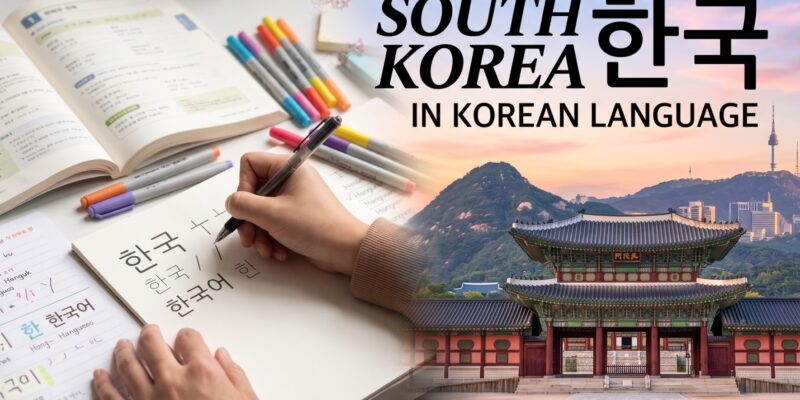
If you are learning Korean or planning to study in South Korea, one of the first things you will notice is that Koreans rarely call their own country “South Korea.” This guide breaks down South Korea in Korean language, the Hangul script behind each name, the correct pronunciation, and why these terms matter for Indian students preparing for life in Korea.
What Is South Korea Called in Korean Language
The short answer to south korea in korean language is 한국 (Hanguk). This is the everyday, informal name South Koreans use when they talk about their own country. The full official name is 대한민국 (Daehanminguk), which is the Korean equivalent of “Republic of Korea.” Both names are used constantly in Korea, on signage, in news broadcasts, and in daily conversation, so understanding the difference matters whether you are a traveler, a Korean language learner, or planning to study in South Korea.
Hanguk (한국): The Everyday Name for South Korea in Korean
Hanguk is the word you will hear most often. It is a shortened form of Daehanminguk and functions the way “Korea” functions in English conversation.
- Hangul: 한국
- Romanization (Revised Romanization): Hanguk
- Literal meaning: “Han nation” or “Han country”
- Used in: daily speech, casual media, K-pop and K-drama dialogue, informal writing
Koreans use Hanguk the same way an Indian might say “India” instead of the full constitutional name “Republic of India.” If you are reading about famous things in South Korea, you will see Hanguk used throughout Korean-language sources.
Daehanminguk (대한민국): The Official Name for South Korea in Korean
Daehanminguk is the formal, official name of the country, equivalent to “Republic of Korea” in English.
- Hangul: 대한민국
- Romanization: Daehanminguk
- Literal meaning: “Great Han People’s Nation” or “Republic of Great Han”
- Used in: the national anthem, government documents, passports, official ceremonies, legal and constitutional contexts
This is the exact term you will find if you check what the country is also known as in formal and diplomatic settings, since Daehanminguk is the name printed on South Korean passports and official state papers.
Hanguk vs Daehanminguk: What Is the Difference
| Term | Hangul | Formality | Where You Hear It |
|---|---|---|---|
| Hanguk | 한국 | Informal, everyday | Conversation, media, casual writing |
| Daehanminguk | 대한민국 | Formal, official | Anthem, passports, government documents |
| Namhan | 남한 | Neutral, geographic | Used mainly in contrast to North Korea (Bukhan) |
A related term, Namhan (남한), literally “South Han,” is used specifically when contrasting South Korea with North Korea, similar to how south korea and north korea differences are usually discussed using Namhan and Bukhan rather than Hanguk.
How to Pronounce South Korea in Korean Language
Getting the pronunciation right matters if you plan to speak with locals once you arrive. Here is a simple phonetic breakdown:
- Hanguk (한국): pronounced “hahn-gook,” with a short, even stress on both syllables
- Daehanminguk (대한민국): pronounced “dae-han-min-gook,” spoken as four even syllables
- Namhan (남한): pronounced “nahm-hahn”
Korean uses the Hangul writing system, created in 1443, which is phonetic rather than symbolic. Each block of Hangul represents a syllable, which is why Hanguk breaks cleanly into two sound blocks (한 + 국) and Daehanminguk into four (대 + 한 + 민 + 국).
Why Koreans Do Not Say “South Korea” at Home
Within the country, the division between North and South is understood by context, so Koreans do not need to specify “South” the way international media does. Hanguk alone is enough, because to a South Korean, Hanguk simply means “my country.” This is part of a broader naming history connected to the national identity shaped around the Republic of Korea, which was formally established in 1948.
North Korea, by contrast, calls itself Joseon (조선) and refers to South Korea as Namjoseon (남조선), a naming split that reflects the political history of the peninsula after 1945.
Other Korean Names and Terms Related to South Korea
- 조선 (Joseon): the historical name of Korea before division, still used today by North Korea for itself
- 코리아 (Koria): the Korean transliteration of the English word “Korea,” used mainly in international or sports contexts
- 대한 (Daehan): a shortened form of Daehanminguk, often seen in brand names and sports team names
- 민국 (Minguk): meaning “republic” or “people’s nation,” the second half of Daehanminguk
If you are researching how South Korea’s government and institutions operate, you will frequently see Daehanminguk used in official titles and legal language.
Why This Matters for Students Planning to Study in Korea
Knowing how South Korea refers to itself in its own language is more than trivia. It helps with:
- Reading Korean university names and documents correctly, since most carry Daehanminguk or Hanguk in formal titles
- Understanding visa and immigration paperwork, which uses Daehanminguk as the official state name
- Settling into life in South Korea faster, since locals will say Hanguk constantly in daily conversation
- Avoiding confusion when reading Korean news, social media, or K-content, where Hanguk is the default term
For Indian students preparing their study in South Korea journey, learning these basic terms before arrival makes the transition smoother, from reading campus signage to understanding official admission letters.
Frequently Asked Questions
What is South Korea called in Korean language?
South Korea is called Hanguk (한국) in everyday Korean and Daehanminguk (대한민국) in its official, formal name, which translates to “Republic of Korea.”
What does Hanguk mean?
Hanguk means “Han nation” or “Han country,” referring to the Han ethnic and cultural identity that forms the basis of Korean nationhood.
What does Daehanminguk mean?
Daehanminguk translates to “Republic of Great Han” or “Great Han People’s Nation” and is the full official name of South Korea, equivalent to “Republic of Korea” in English.
Is Hanguk the same as Korea?
Hanguk specifically refers to South Korea. North Korea calls itself Joseon (조선), so Hanguk and Joseon are two different self-referential names used by the two Koreas.
How do you write South Korea in Hangul?
South Korea is written as 한국 (Hanguk) in everyday Hangul, or 대한민국 (Daehanminguk) in its full official form.