


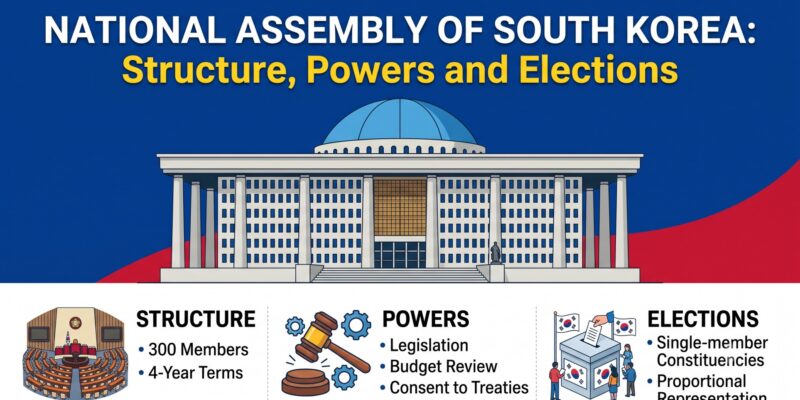
The National Assembly of South Korea is the single lawmaking body of the country, known in Korean as Gukhoe. Anyone researching Korean government, planning to study political science in Korea, or simply trying to understand how the country runs eventually lands on this institution. This guide breaks down what the National Assembly does, how it is elected, where it sits in Seoul, and why it matters to students, travelers and professionals tracking South Korea.
What Is the National Assembly of South Korea
The National Assembly of the Republic of Korea is the unicameral national legislature of South Korea, meaning it has only one chamber rather than two. It is the body responsible for passing every law in the country, approving the national budget, and holding the executive branch accountable. The current term is the 22nd National Assembly, which began its four year term on 30 May 2024.
Because South Korea has a single legislative chamber, every bill, budget decision and treaty ratification passes through this one body. That makes it the central point of contact for anyone trying to understand South Korean government structure beyond the presidency.
Seat Structure and How Members Are Elected
The National Assembly has 300 seats. Of these, 254 members are elected directly from local constituencies and 46 are allocated through proportional representation. Proportional seats exist so that people with specific professional or policy expertise, who may not win a direct constituency race, can still enter the assembly.
Key election facts:
- Elections are held every four years
- The most recent general election took place on 10 April 2024
- The next election is expected by 12 April 2028
- Candidates must be at least 30 years old to run for a seat
- Members receive a salary of roughly US 128,610 dollars a year
The mixed system of constituency and proportional seats is designed to balance local representation with broader policy representation, a structure that has evolved through several amendments since the assembly’s founding.
Leadership: Speaker and Deputy Speakers
Under the constitution, the National Assembly is presided over by one Speaker and two Deputy Speakers. The Speaker manages plenary sessions, represents the assembly externally, and casts a deciding vote only in specific tie situations. Deputy Speakers step in to run sessions when the Speaker is unavailable and typically come from different political blocs to balance representation.
Leadership changes with each new assembly term, and the ruling and opposition party balance shifts based on election results, which directly affects how easily bills move through committees.
Powers and Responsibilities
The National Assembly’s core powers include:
- Lawmaking: drafting, debating and passing all national legislation
- Budget approval: reviewing and approving the government’s annual budget and settling accounts
- Oversight: questioning ministers, conducting audits (the “National Assembly Audit”), and investigating government agencies
- Treaty ratification: approving international agreements before they take effect
- Confirmation hearings: vetting nominees for senior government and judicial posts
This oversight role is one reason the National Assembly is often compared with legislatures elsewhere when people study South Korea’s democratic system, since it acts as the main check on presidential power.
Political Parties in the Current Assembly
The 22nd National Assembly’s composition reflects a Democratic Party led opposition bloc and a People Power Party led government bloc, with a small number of unclassified or independent seats. Party composition shifts every election cycle and shapes which bills can realistically pass, since Korea’s system regularly produces situations where the president’s party does not hold a majority.
Anyone tracking Korean politics for research or reporting should treat these numbers as a snapshot rather than fixed, since floor crossings and by elections can shift the balance between elections.
National Assembly Building: Location and Visiting Information
The National Assembly Building sits in Yeouido, an island district in Seoul on the Han River. The building is recognizable by its green dome and is a common stop for visitors interested in Korean civic life, alongside more typical tourist routes covered in a general Seoul travel guide.
Visiting details:
- Guided tours run Monday to Friday, roughly 9 a.m. to 5 p.m.
- No public tours on weekends, though the Visitors Center and Memorial Hall stay open 9 a.m. to 5 p.m.
- Closed on national holidays and on the second and fourth Sunday of each month
- Advance booking is recommended for guided tours
- The complex includes a Memorial Hall documenting the assembly’s history since 1948
A Short History of the National Assembly
The first National Assembly convened on 31 May 1948, shortly after Korea’s liberation and before the formal founding of the Republic of Korea. Since then the assembly has been reshaped many times, moving from an original seat count in the low 200s to today’s 300 seats. Studying this history alongside how the country transitioned to full democracy is useful background for students comparing economic growth and democratisation in South Korea.
Why This Matters for Students and Foreign Residents
For Indian students and professionals moving to Korea, the National Assembly is not just an abstract civics topic. It sets immigration law, education policy and labor regulations that directly affect study visas and daily life as a foreigner in Korea. Understanding how a bill becomes law here also helps explain why visa rules, minimum wage figures, and university funding can change from one year to the next.
Frequently Asked Questions
How many members does the National Assembly of South Korea have?
The National Assembly has 300 members: 254 elected from local constituencies and 46 chosen through proportional representation.
How often are National Assembly elections held?
Elections are held every four years. The most recent election was on 10 April 2024, with the next expected by 12 April 2028.
Is South Korea’s National Assembly unicameral or bicameral?
It is unicameral, meaning it has a single legislative chamber rather than separate upper and lower houses.
Where is the National Assembly Building located?
It is located in Yeouido, an island district in Seoul on the Han River, easily reached from most parts of the city.
Can the public visit the National Assembly Building?
Yes. Guided tours run on weekdays only, and advance booking is recommended since there are no tours on weekends or national holidays.
What is the minimum age to become a member of the National Assembly?
Candidates must be at least 30 years old to run for a seat.