


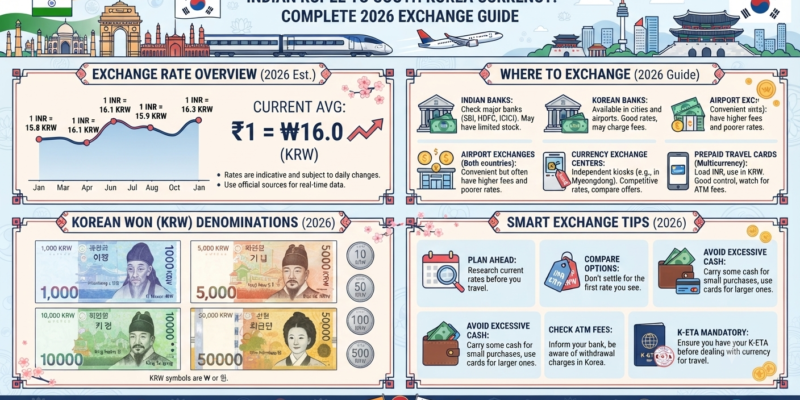
Understanding how the Indian Rupee converts to South Korean Won is one of the most important parts of planning a trip, whether you are traveling for tourism, business or long term study. Exchange rates directly affect your tuition payments, monthly budget and day to day spending in Korea. This guide explains everything you need to know about Indian Rupee to South Korea currency conversion in 2026.
Understanding the Korean Won
South Korea’s official currency is the Korean Won, represented by the symbol KRW. Unlike the Rupee, the Won operates on a larger numerical scale, meaning that a single Rupee converts into a noticeably higher number of Won. This can feel confusing for first time travelers, since everyday prices in Korea are often listed in figures that look much larger than what you are used to seeing in India.
For a full breakdown of denominations, coins, notes and how the currency system works in daily life, this guide on the South Korea money name and Korean Won explains the basics clearly, which is especially helpful before your first trip.
Current Exchange Rate Trends
Exchange rates between the Indian Rupee and Korean Won fluctuate regularly based on global economic conditions, interest rates and trade relations between the two countries. It is important to check live rates close to your travel date rather than relying on outdated figures, since even small daily fluctuations can affect your total budget when converting larger amounts for tuition or rent.
For an updated conversion guide and rate trend explanation, refer to this detailed resource on South Korea currency compared to Indian currency, which is regularly relevant for anyone budgeting a Korea trip from India.
There is also a more focused explainer specifically on Korean Won to Indian Rupee conversion, which walks through practical conversion examples that make budgeting easier for students and travelers alike.
For those who want a simplified reference point, this guide on one Indian Rupee in South Korean currency breaks down the smallest unit conversion, which is a helpful starting point before scaling up to your full budget calculations.
Best Ways to Exchange Money Before Traveling
There are several ways to convert Indian Rupees into Korean Won, and choosing the right method can save you a meaningful amount over the course of your stay. Options include exchanging cash at authorized forex dealers in India before departure, withdrawing Won directly from ATMs after landing in Korea, using prepaid multi currency travel cards, or exchanging through banks that offer competitive rates for larger transfers.
For students planning a long term stay, wire transfers directly to a Korean bank account are often more cost effective than repeated small exchanges, particularly for tuition payments and rent. It is worth comparing transfer fees across a few banks or remittance services before committing to one option, since fees and exchange margins can vary noticeably.
Budgeting Your Monthly Expenses in Korea
Once you understand the conversion rate, the next step is planning your actual monthly budget in Korea. This includes accommodation, food, transport, mobile recharge, health insurance and personal expenses, all of which will be paid in Won.
This detailed guide on the cost of living in South Korea per month gives a realistic monthly breakdown that pairs well with your currency conversion planning, helping you estimate exactly how many Rupees you will need to transfer or carry each month.
If you are staying in a guesthouse rather than a dormitory, budgeting also needs to account for rent variations across cities. This guide to affordable guesthouses in Korea is a useful companion resource when calculating your monthly Won requirement.
Currency Considerations for Flight and Travel Costs
Beyond daily expenses, currency conversion also matters when comparing flight ticket prices, especially if you are booking through platforms that display fares in Won or US Dollars rather than Rupees. Converting these figures accurately helps you compare deals honestly instead of misjudging a fare because of currency confusion.
If you are still finalizing your travel plans, this guide on India to South Korea ticket prices pairs well with your currency research, since both figures together give you a complete picture of your total trip cost.
Common Mistakes to Avoid When Exchanging Currency
Many first time travelers exchange large sums of cash at airport counters, which typically offer the least favorable rates due to higher margins and service charges. It is generally better to exchange a small amount for immediate needs at the airport and handle the bulk of your currency needs through banks, authorized dealers or ATMs after arrival.
Another common mistake is not accounting for currency conversion fees on international debit or credit cards, which can quietly add up over a semester of regular transactions. Checking your bank’s foreign transaction fee policy before you travel can help you avoid unnecessary charges.
Planning Ahead for Tuition and Living Cost Transfers
If you are a student, your university will typically specify how tuition fees should be paid, often through a direct bank transfer in Won. Coordinating with your bank in India ahead of time, understanding transfer limits and confirming processing times will help you avoid delays that could affect your enrollment or visa compliance.
It is a good idea to keep a small buffer amount converted in advance for your first few weeks, covering accommodation deposits, transport cards and basic groceries, while you set up a local bank account for ongoing expenses.
Final Thoughts
Understanding how the Indian Rupee converts to South Korean Won, and planning your currency exchange strategy in advance, makes a significant difference to your overall budget as a student or traveler. Track exchange rate trends regularly, compare exchange methods for the best rates, and always budget slightly more than your estimated monthly cost to account for fluctuations.
For more guidance on budgeting, banking and financial planning while studying in South Korea.