


Planning a trip, a study program, or a business visit to South Korea from India often begins with one simple question. How much is the Indian Rupee worth in South Korean currency, and how should you carry or exchange your money once you land. This guide breaks down the Indian Rupee to South Korea currency relationship in detail, covering the current exchange rate, historical trends, the best ways to convert your money, and practical tips for Indian students and travelers heading to Korea.
If you are exploring study options in Korea, our study in South Korea guide helps Indian students plan their finances, visas, and admissions from start to finish.
Understanding the South Korean Currency
South Korea uses the Korean Won as its official currency, represented by the symbol KRW and often written simply as Won. Unlike the Indian Rupee, which uses paise as its subunit, the Korean Won does not commonly use a smaller denomination in daily transactions because of its historically lower per-unit value. This is why one Indian Rupee converts into a much larger number of Won.
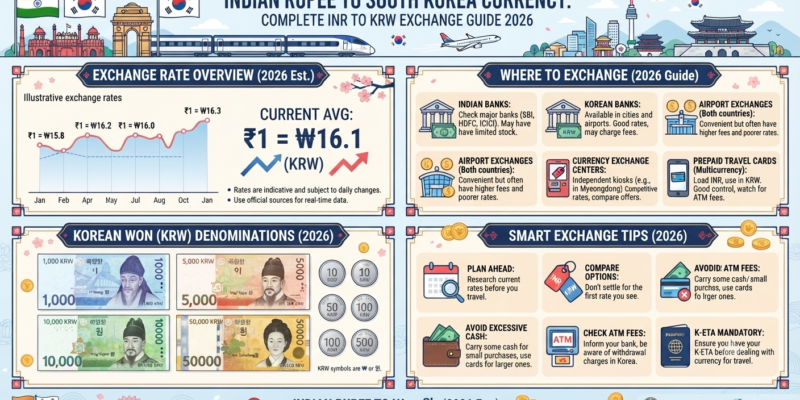
The Bank of Korea is the central authority responsible for issuing and regulating the currency, and Won notes are available in denominations of 1,000, 5,000, 10,000, and 50,000, while coins are used for smaller amounts such as 10, 50, 100, and 500 Won.
Current Indian Rupee to South Korea Currency Exchange Rate
As of 2026, the general exchange rate for Indian Rupee to South Korean Won hovers around 1 INR equals approximately 16 to 17 KRW, though this figure moves daily based on global currency markets, inflation data, and monetary policy decisions from both the Reserve Bank of India and the Bank of Korea.
This means that if you are carrying 10,000 Indian Rupees for your trip, you could expect to receive somewhere between 160,000 and 170,000 Korean Won after conversion, minus any service charges applied by your exchange provider.
Because exchange rates are never fixed and shift throughout the day, it is always wise to check a live currency converter or your bank’s official rate before making any large transaction. Rates quoted at airports, especially at the last minute, tend to be less favorable than those available through banks or authorized forex dealers in advance.
Why the Exchange Rate Fluctuates
Several factors influence how many Won you get for your Rupee at any given time.
Inflation and interest rates: When Korea’s inflation rate rises faster than India’s, the Won typically weakens against other currencies, changing the conversion ratio.
Trade balance: South Korea is a major exporter of electronics, automobiles, and shipbuilding products. Strong export performance tends to strengthen the Won.
Global market sentiment: Since neither currency is a primary global reserve currency, both the Rupee and Won are sensitive to movements in the US Dollar, which acts as the benchmark for most currency pairs.
Government policy: Central bank interventions, interest rate hikes, or capital control measures in either country can shift the exchange rate within days.
If you want a broader view of how the Won compares against the Rupee historically, our detailed piece on South Korea currency versus Indian currency trends covers long term movement patterns.
How to Convert Indian Rupees to South Korean Won
There are multiple ways to convert your Rupees into Won before or during your trip to Korea, and each option comes with its own costs and convenience level.
1. Authorized Forex Dealers in India
Licensed money changers and forex companies in major Indian cities allow you to convert Rupees into Won before you travel. This is often the safest option since you can compare rates across providers and avoid last-minute airport charges.
2. Bank Transfers and Forex Cards
Many Indian banks issue multi-currency forex cards preloaded with Won, which can be used for ATM withdrawals and card payments across Korea. This is a convenient option for students who need to manage a fixed monthly budget without carrying large amounts of cash.
3. Currency Exchange Counters in Korea
Once you land in South Korea, currency exchange counters are available at Incheon International Airport, as well as in major shopping districts like Myeongdong in Seoul, which is known for offering some of the most competitive rates in the country.
4. ATMs and Card Payments
South Korea has a highly developed digital payment infrastructure, and most international debit and credit cards work at ATMs and retail counters. However, transaction fees and conversion markups vary by bank, so it is worth checking with your card issuer beforehand.
Best Places to Exchange Currency in South Korea
If you are an Indian student or traveler looking for the best rates once you arrive, Myeongdong in Seoul remains the most popular destination for currency exchange, with dozens of licensed money changers competing for better rates than banks typically offer.
Other reliable options include exchange counters inside major hotels, though these often charge a premium, and bank branches, which are safe but sometimes slower due to documentation requirements.
If your travel plans include booking accommodation in Korea, our guide on booking hotels across South Korea can help you budget your stay alongside your currency planning.
Currency Tips for Indian Students Studying in South Korea
For Indian students moving to Korea for higher education, understanding the Won and managing monthly expenses in a new currency can feel overwhelming at first. Here are some practical tips.
Open a local bank account early: Most universities help international students open a Korean bank account within the first few weeks, which makes managing rent, groceries, and transport payments far easier than relying on cash.
Track the exchange rate before transfers: If your family sends money from India regularly, keeping an eye on the Rupee to Won rate can help you time transfers for the best value.
Use student discounts and transport cards: Korea’s T-money card system allows for discounted fares on buses and subways, which helps reduce daily costs significantly.
Budget for seasonal price changes: Certain goods, especially fresh produce, can be more expensive in Korea than in India, so building a slightly higher monthly buffer is wise.
If you are still finalizing your study plans, our comprehensive guide to the student visa process for Indian applicants walks through the documentation and financial proof requirements in detail.
Cost of Living Impact on Currency Planning
Understanding the exchange rate is only half the picture. Knowing how far your converted Won will stretch in daily life is equally important. Seoul and other major cities have higher living costs compared to smaller towns, and rent, food, and transportation form the bulk of monthly expenses for most students and workers.
For a full month by month breakdown of typical expenses, our detailed resource on the monthly cost of living for international students in Korea is a useful companion to this currency guide.
Salary expectations also matter if you plan to work part time during your studies or full time after graduation. Our article on average salaries and earning potential in Korea gives a realistic picture of what to expect financially once you start working.
Common Mistakes to Avoid When Exchanging Currency
Many first-time travelers and students make avoidable mistakes when converting Indian Rupees to Korean Won.
Exchanging large amounts at the airport: Airport counters often charge higher fees due to convenience pricing. It is better to convert a small amount for immediate use and handle the rest through banks or city exchange counters.
Ignoring hidden service charges: Some providers advertise attractive rates but add service fees or commissions that reduce the actual amount you receive.
Not comparing multiple providers: Rates can vary meaningfully between banks, private money changers, and online platforms, so a quick comparison before a large transaction can save a significant amount.
Carrying only cash: Relying solely on cash is risky. A combination of a forex card, a small amount of cash, and a linked international debit card offers better security and flexibility.
Digital Payment Trends in South Korea
South Korea is one of the most digitally advanced economies in the world, and cash usage has been steadily declining in favor of card payments and mobile wallets. Popular local payment apps and QR-based systems are widely used, even at small retail stores and street food stalls.
For Indian travelers and students, this means carrying a card that supports international transactions, or setting up a local payment app once you have a Korean bank account, will make daily transactions far smoother than depending on physical Won notes alone.
Historical Trend of Rupee to Won Conversion
Over the past decade, the Indian Rupee has generally depreciated against most major currencies, including the Korean Won, largely due to differences in economic growth trajectories and trade balances. While short term fluctuations occur due to global events, the long term trend has seen Indians needing to spend more Rupees to acquire the same amount of Won compared to previous years.
This is an important consideration for students planning multi-year study programs in Korea, as tuition and living costs calculated in Won may effectively become more expensive in Rupee terms over time if the currency trend continues.
For related context on how Korea’s broader currency system works, our guide on the official currency code and Won symbol explained offers useful background.
Frequently Asked Questions
What is the current value of 1 Indian Rupee in South Korean Won? The rate fluctuates daily, but as of 2026, 1 Indian Rupee typically converts to approximately 16 to 17 South Korean Won. Always check a live rate before making transactions.
Is it better to exchange money in India or in South Korea? Both options work, but comparing rates at Indian forex dealers against those in Myeongdong or Korean bank branches before travel usually gives the best overall value.
Can I use Indian debit or credit cards in South Korea? Yes, most international cards work at Korean ATMs and retail stores, though it is advisable to inform your bank before traveling and check for foreign transaction fees.
Do Korean universities accept tuition payment in Won only? Most Korean universities require tuition payment in Won through a local or international bank transfer, so understanding the conversion rate in advance helps with accurate financial planning.
How much cash should I carry when traveling from India to South Korea? It is generally recommended to carry a small amount of cash for immediate expenses and rely on a forex card or international debit card for larger transactions during your stay.
Final Thoughts
Understanding the Indian Rupee to South Korea currency relationship is essential whether you are planning a short vacation, a long-term study program, or a business trip. Exchange rates shift daily, but knowing how the system works, where to get the best rates, and how to manage your money once you land in Korea can save both time and money.
For students planning their journey to Korea, our study in South Korea guide offers complete guidance on visas, university admissions, accommodation, and financial planning to make your transition smoother.