


Understanding the South Korea median income is essential for anyone planning to study, work, or relocate to one of Asia’s most economically advanced nations. Whether you are an Indian student evaluating the financial landscape before enrolling in a Korean university or a professional exploring career opportunities, knowing how income works in South Korea sets realistic expectations and helps you plan effectively.
This comprehensive guide covers everything from average monthly wages and industry-specific salaries to how cost of living measures up against what Koreans actually earn.
What Is the South Korea Median Income in 2026
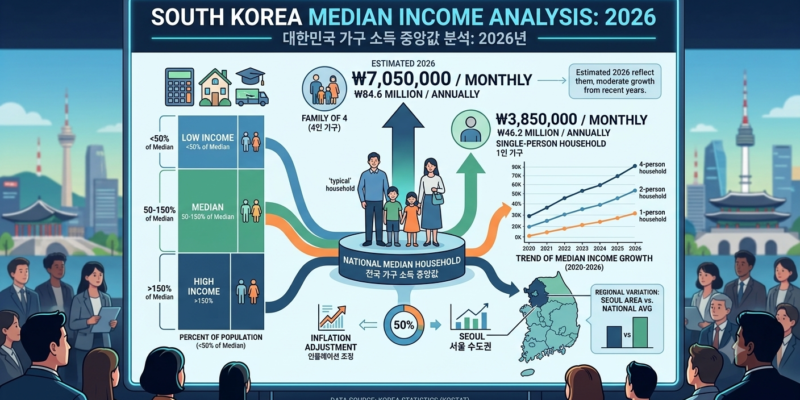
The median income in South Korea refers to the midpoint of all individual earnings in the country, where half the population earns above and half earns below that figure. As of 2026, the median monthly income in South Korea stands at approximately 2.8 million Korean Won (KRW), which translates to roughly 2,100 USD per month or around 175,000 Indian Rupees.
The average gross salary in South Korea is slightly higher than the median, sitting near 3.5 to 4 million KRW per month, because high earners in sectors like technology, finance, and pharmaceuticals pull the average upward.
These figures are critical context for Indian students studying in South Korea who may work part-time during their studies or consider full-time employment after graduation.
South Korea Minimum Wage vs Median Income
South Korea has a legally mandated minimum wage system enforced by the Ministry of Employment and Labor. In 2026, the minimum wage in South Korea is set at 10,030 KRW per hour, which amounts to approximately 2.09 million KRW per month for a full-time worker logging 209 hours.
Comparing minimum wage to median income reveals a notable gap of nearly 700,000 KRW per month, indicating that a significant portion of Korean workers earn incomes above the legal floor. This gap is particularly important for understanding opportunities available to foreign workers and graduates from universities in South Korea for international students.
Key wage benchmarks in 2026:
- Minimum monthly wage: 2.09 million KRW
- Median monthly income: 2.8 million KRW
- Average monthly salary: 3.5 to 4 million KRW
- Top 10 percent earner threshold: above 7 million KRW
Average Salary by Industry in South Korea
Industry plays a massive role in determining where an individual falls relative to the South Korean median income. Certain sectors consistently pay well above median while others cluster near or below it.
High-income sectors above median:
Finance and banking employees in South Korea earn an average of 5.5 to 7 million KRW monthly. Professionals working at major institutions like KB Kookmin Bank, Hana Bank, and Korea Investment Corporation command premium salaries that far exceed national median figures.
Technology and semiconductor industries are anchored by giants like Samsung Electronics, SK Hynix, and LG Electronics. Software engineers and hardware specialists in these companies typically earn between 5 and 8 million KRW monthly, with senior engineers exceeding 10 million KRW.
Pharmaceutical and biotech professionals have seen rapid wage growth in South Korea, with median salaries in this sector reaching 4.5 to 6 million KRW, driven by post-pandemic investment in life sciences.
Legal and medical professionals represent the highest individual earning potential in the country, with experienced attorneys and specialists at major hospitals earning 8 to 15 million KRW or more per month.
Sectors near or below the national median:
Retail and hospitality workers in South Korea typically earn between 2 and 2.5 million KRW monthly, often near or slightly above minimum wage levels. This is a common employment category for international students working part-time.
Education sector workers including hagwon (private tutoring academy) instructors earn between 2.2 and 3.5 million KRW depending on location and subject specialization. English-language instruction remains a relatively accessible entry point for foreign nationals with appropriate qualifications.
Manufacturing and factory workers earn between 2.5 and 3.5 million KRW, which places them near the national median with added benefits in many large conglomerates.
South Korea Median Income by Region
Geography significantly influences earnings across South Korea. The income hierarchy is concentrated in the capital region and gradually decreases in provincial areas.
Seoul and the Capital Region (Gyeonggi Province):
Seoul consistently reports the highest median income in the country, with average salaries running 15 to 25 percent above the national median. Workers in Seoul benefit from proximity to major corporate headquarters, financial institutions, and multinational companies. The Seoul metropolitan area accounts for nearly half of South Korea’s total economic output.
Incheon, home to Korea’s main international airport and a growing free economic zone, offers salaries close to Seoul levels with slightly lower cost of living.
Busan:
South Korea’s second-largest city and primary port has a strong shipping, logistics, and manufacturing base. Median income here runs approximately 10 to 15 percent below Seoul, though living costs are proportionally lower.
Daejeon and Daegu:
These mid-sized cities are regional economic hubs with strong manufacturing and research sectors. Median incomes are roughly 15 to 20 percent below Seoul figures.
Rural and smaller cities:
Agricultural regions and smaller cities outside major metropolitan zones report median incomes that can be 25 to 35 percent below the national average, though cost of living is substantially lower in these areas.
For Indian students and workers in South Korea, understanding regional income variation is essential when evaluating job offers and comparing post-graduation employment prospects.
South Korea Income Compared to Other Asian Nations
Placing South Korean earnings in regional context helps international observers appreciate the country’s economic development:
South Korea’s median income surpasses most of Southeast Asia, including countries like Thailand, Vietnam, and the Philippines by a factor of three to five. It also exceeds India’s median income by approximately ten times when expressed in purchasing power terms.
Compared to Japan, South Korea’s median income is now roughly comparable, with South Korea having overtaken Japan in nominal median wage metrics in recent years. This is a remarkable achievement given that Japan was significantly wealthier than Korea just two decades ago.
When compared to the United States and Western Europe, South Korea’s median income remains below these regions, though the gap has narrowed substantially. The country’s GDP per capita in 2026 places it firmly in the upper tier of global economies.
Income Growth Trends in South Korea
The trajectory of South Korean wages over the past decade shows sustained upward movement driven by policy, productivity gains, and demographic shifts:
Minimum wage increases have been consistent and politically prominent in South Korea, with the government committing to regular annual adjustments. Between 2017 and 2026, the minimum wage has increased by over 70 percent, significantly lifting incomes at the bottom of the distribution.
Population aging is reshaping income dynamics. As South Korea faces one of the world’s most severe demographic contractions, labor shortages are pushing wages upward, particularly in skilled trades, healthcare, and technology. This creates long-term opportunity for foreign nationals who can fill these gaps.
Government policy has also prioritized narrowing the income gap between large corporations (chaebols) and smaller companies. Historically, Samsung or Hyundai employees earned significantly more than workers at small and medium enterprises for equivalent roles. Policy efforts are gradually reducing this differential.
How South Korea Median Income Affects Cost of Living
Understanding income is meaningless without comparing it to what life actually costs in South Korea. The good news for those earning at or above the median is that South Korea offers excellent value relative to other developed economies.
Housing costs:
Monthly rent for a studio apartment (called an “offictel” or “one-room”) in Seoul typically ranges from 600,000 to 900,000 KRW outside the city center, and 900,000 to 1.3 million KRW in central districts. This represents a manageable 25 to 35 percent of the median monthly income.
Unique to South Korea is the “jeonse” (deposit lease) system, where tenants pay a large upfront deposit (typically 50 to 70 percent of property value) in exchange for rent-free occupation. This system has become more difficult for lower and median earners to access as property prices have risen.
Food and daily expenses:
South Korea offers a remarkably affordable food culture when eating locally. A meal at a standard Korean restaurant costs 8,000 to 12,000 KRW. Convenience stores provide filling meals for 4,000 to 7,000 KRW. Monthly grocery spending for a single person averages 200,000 to 350,000 KRW.
Transportation:
Seoul’s public transportation system is one of the best in the world and extremely affordable. A single subway ride costs 1,400 to 1,600 KRW, and a monthly commuter pass runs around 55,000 KRW. This is a small fraction of median income and represents exceptional value.
Healthcare:
South Korea’s national health insurance system (NHIS) covers all residents including enrolled foreign students. Copayments are modest, and access to quality medical care is broadly available. This significantly reduces the financial burden of healthcare compared to countries without universal coverage.
For those who want to understand the currency context behind these figures, the 1 Indian Rupee in South Korea currency exchange guide provides a detailed breakdown relevant to Indian nationals planning their finances.
Part-Time Income Opportunities for International Students
International students in South Korea are legally permitted to work up to 20 hours per week during the academic semester and full-time during official vacation periods (summer and winter breaks). This creates meaningful supplementary income potential.
Part-time roles commonly available to foreign students include:
Convenience store and cafe work pays at or slightly above minimum wage, roughly 10,000 to 12,000 KRW per hour. Working 15 to 20 hours weekly yields approximately 600,000 to 900,000 KRW monthly.
English tutoring, particularly for children, pays 20,000 to 40,000 KRW per hour for native or near-native speakers. This represents one of the most financially rewarding part-time options for foreign students from English-speaking backgrounds.
Campus jobs at universities, including library work, laboratory assistance, and administrative support, often pay slightly above minimum wage but offer scheduling flexibility and language practice opportunities.
Restaurant and food service roles in areas popular with international visitors can pay 12,000 to 15,000 KRW per hour. Knowledge of Korean improves both tip potential and job accessibility.
Students considering k-culture related career paths including translation, content creation, and cultural liaison roles can find growing demand among companies expanding into global markets.
Post-Graduation Income for Foreign Graduates in South Korea
Foreign nationals who complete a degree at a South Korean university and secure employment face a distinct income trajectory compared to Korean nationals. Several factors influence this:
Korean language proficiency is the single largest determinant of salary for foreign graduates. Those reaching TOPIK Level 4 or above unlock a significantly wider job market and command salaries closer to Korean peers. TOPIK Level 5 or 6 holders in technical fields can compete directly with local candidates.
STEM and technical degrees offer the most direct pathway to above-median income. Engineering, computer science, and pharmaceutical graduates from reputable Korean universities often receive starting offers of 3 to 3.5 million KRW monthly, which places them right at or above the national median immediately upon graduation.
Business and humanities graduates typically start at 2.4 to 2.8 million KRW monthly and advance more slowly unless they join Korean companies with international expansion needs or enter roles requiring their native language skills.
The student life experience at Korean universities often includes internship programs that serve as direct pathways to full-time employment, making university choice and academic engagement critical factors in post-graduation income potential.
Tax System and Net Income in South Korea
Gross income figures only tell part of the story. Understanding what South Korean workers actually take home after deductions is essential for financial planning.
South Korea operates a progressive income tax system with rates ranging from 6 percent on the lowest income bracket to 45 percent on earnings above 1 billion KRW. For median earners, the effective tax rate typically falls between 6 and 15 percent of gross income.
In addition to income tax, employees contribute to:
National Pension (NPS): 4.5 percent of gross salary, with the employer matching this contribution
National Health Insurance (NHI): approximately 3.5 percent of salary
Employment Insurance: 0.9 percent of salary
Industrial Accident Compensation Insurance: fully employer-paid
For a median earner bringing in 2.8 million KRW gross monthly, total deductions typically amount to 250,000 to 400,000 KRW, leaving net take-home pay of approximately 2.4 to 2.55 million KRW. This net figure is what actually funds daily life and savings.
Income Inequality and the Wage Gap in South Korea
South Korea faces a notable income inequality challenge despite its overall prosperity. Several structural factors contribute to this:
The chaebol-SME divide: Employees at large conglomerates like Samsung, LG, Hyundai, and SK earn significantly more than counterparts in smaller companies performing equivalent work. This wage gap, sometimes as large as 50 to 70 percent for similar roles, drives intense competition for chaebol positions among Korean graduates.
Gender income gap: Despite progress, South Korean women earn approximately 31 percent less than men on average, one of the widest gender pay gaps among OECD nations. Policy reforms are gradually addressing this, but meaningful change remains a long-term project.
Age and seniority systems: Traditional Korean corporate culture has valued seniority, with pay increasing substantially with years of service rather than purely on performance. Younger workers, including recent foreign graduates, may find entry-level wages lower than they expected despite strong qualifications.
Non-regular vs regular employment: A significant portion of the Korean workforce is employed on non-regular (contract or temporary) basis, earning 30 to 40 percent less than regular employees in comparable roles. Foreign nationals are more frequently placed in non-regular positions initially, making negotiation of employment terms especially important.
Financial Planning Advice for India to South Korea Movers
For Indian nationals specifically, the cultural and practical differences between North and South Korea provide useful context, but the financial planning considerations are quite practical.
When converting a South Korean median salary of 2.8 million KRW to Indian Rupees at current exchange rates, this equates to approximately 175,000 to 185,000 INR monthly. For reference, this exceeds the median professional salary in India’s major metropolitan areas, which means South Korea offers a significant earning uplift for qualified Indian professionals.
Remittance options from South Korea to India are well-developed. Banks like Woori, Shinhan, and KEB Hana offer international transfer services, and fintech platforms provide competitive exchange rates. Understanding the currency dynamics covered in resources about Indian Rupee to Korean Won exchange helps in timing remittances effectively.
Conclusion: Is South Korea’s Income Level Attractive for International Residents
The South Korea median income in 2026 represents a compelling economic proposition for foreign nationals with the right qualifications and language skills. At approximately 2.8 million KRW monthly, the median sits in a comfortable range relative to living costs, particularly outside central Seoul.
For Indian students who have invested in a Korean university education, the path to above-median income is accessible within three to five years of entering the workforce, particularly in technology, engineering, finance, and fields connected to k-culture industries that continue growing globally.
South Korea’s economy continues to diversify, wages continue to rise, and the country’s openness to skilled international talent is increasing. Those who combine Korean language fluency, a strong academic foundation, and an understanding of Korean workplace norms are well-positioned to earn significantly above the national median within a decade of starting their careers.
For a deeper look at study and career pathways, explore the Study in South Korea resources covering everything from university admissions to life after graduation.