


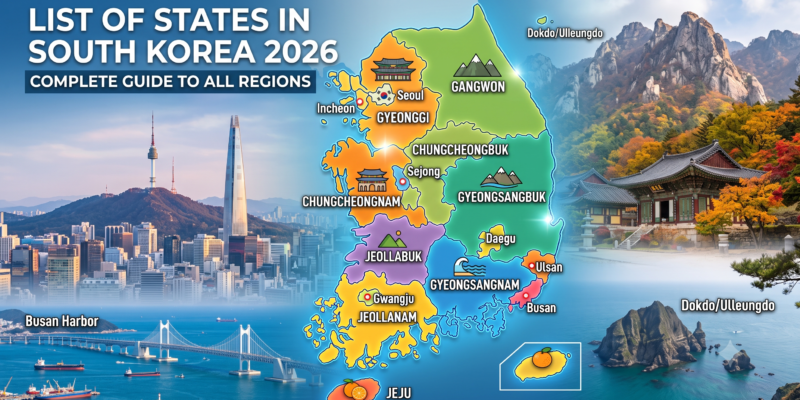
List of States in South Korea 2026: Complete Guide to All Regions
South Korea is not divided into “states” the way the United States or India are, but the question comes up constantly among students, travelers, and anyone researching the country for the first time. This guide gives you the complete, current list of states in South Korea for 2026: every province, every special city, and every metropolitan city, along with what changed this year and why it matters if you are planning to study, work, or travel here.
If you already know South Korea is small on a map but packed with regional variety, this article breaks that variety down province by province, city by city, so you know exactly where each region sits and what makes it worth knowing about.
What Does “State” Mean in the Context of South Korea
South Korea does not use the word “state” in its own administrative language. What people usually mean when they search for “states in South Korea” is the country’s first-tier administrative divisions, called provinces, or “do” (도) in Korean. This is the same root word used in North Korea’s provincial system, since both countries share the same historical framework that dates back to the late 19th century.
Alongside provinces, South Korea also has special cities, a special metropolitan city, metropolitan cities, and a special self-governing city. All of these sit at the same top administrative level as a province, even though they are called cities rather than provinces. So when someone asks how many states are in South Korea, the honest answer covers all of these categories together, not just the eight provinces.
This matters for practical reasons too. University applications, visa paperwork, and even shipping addresses in South Korea usually reference the province or city name at this top level first, so getting comfortable with the terminology early on will save confusion later, whether you are filling out an admission form or simply telling a taxi driver which region you are headed to.
Three provinces have gone a step further and adopted the English label “State” in their own official branding, distinct from ordinary provinces. Gangwon State and Jeonbuk State both use this term to emphasize their autonomy, while Jeju uses “Special Self-Governing Province” instead. This naming quirk is one of the most common sources of confusion for first-time researchers, and it is worth understanding before you look at the full list.
How Many States Are There in South Korea in 2026
As of 2026, South Korea has 16 first-tier administrative divisions. This is a change from the 17 divisions most guides still quote, because on 1 July 2026 the South Jeolla province (Jeollanam-do) formally merged with the city of Gwangju to form a single new administrative unit called Jeonnam-Gwangju Special Metropolitan City. This was the country’s first major regional integration of its kind, and it reduced the national count from 17 to 16.
The current 16 divisions break down into three broad groups: 8 provinces (including three that carry the “State” or “Special Self-Governing Province” label), 5 ordinary metropolitan cities, and 3 special-status cities, which are Seoul, Sejong, and the newly formed Jeonnam-Gwangju. If you read older material, including most blog posts published before mid-2026, you will still see the outdated figure of 17 divisions and nine provinces. Anyone researching South Korea’s administrative system for study, business, or travel planning in 2026 should treat that older figure as out of date.
Complete List of Provinces (Do) in South Korea
Provinces are the largest and most rural of South Korea’s administrative divisions, generally covering multiple cities and counties under one provincial government. Here is the complete, current list.
| Province | Official English Name | Capital | Notable For |
|---|---|---|---|
| 경기도 | Gyeonggi Province | Suwon | Most populous province, surrounds Seoul |
| 강원특별자치도 | Gangwon State | Chuncheon | Mountains, beaches, Winter Olympics legacy |
| 충청북도 | North Chungcheong Province | Cheongju | Inland province, tech and logistics hubs |
| 충청남도 | South Chungcheong Province | Hongseong County | Coastal industry, close to Sejong |
| 전북특별자치도 | Jeonbuk State | Jeonju | Food culture, Jeonju hanok village |
| 경상북도 | North Gyeongsang Province | Andong, Pohang | Largest province by land area, heritage sites |
| 경상남도 | South Gyeongsang Province | Changwon, Jinju | Shipbuilding and heavy industry |
| 제주특별자치도 | Jeju Special Self-Governing Province | Jeju City | Island province, tourism and volcanic landscape |
Gyeonggi Province deserves special mention since it is by far the most populous province in the country, home to over 13.5 million people, largely because it wraps around Seoul and hosts much of the capital region’s commuter population. If you are researching where to live near Seoul without living inside the capital itself, Gyeonggi is usually the first name that comes up, and our guide on the best cities in South Korea covers several Gyeonggi cities worth knowing.
At the other end of the scale, North Gyeongsang Province is the largest by land area at just over 19,000 square kilometers, while Jeju is the smallest province, covering under 1,900 square kilometers despite being one of the most visited regions in the country.
Special Cities and Metropolitan Cities in South Korea
Cities with metropolitan or special status function like provinces in South Korea’s administrative structure, meaning they answer directly to the national government rather than sitting inside a province. This group includes the capital, the country’s newest merged region, and five other major urban centers.
| City | Status | Population (approx.) | Notable For |
|---|---|---|---|
| Seoul | Special City | 9.7 million | Capital, largest city, financial and cultural center |
| Jeonnam-Gwangju | Special Metropolitan City | 3.3 million | Newly merged region (2026), art and food culture |
| Busan | Metropolitan City | 3.3 million | Second-largest city, major port, beaches |
| Daegu | Metropolitan City | 2.4 million | Textile industry, traditional medicine market |
| Incheon | Metropolitan City | 2.9 million | Main international airport, port city |
| Daejeon | Metropolitan City | 1.5 million | Science and research hub |
| Ulsan | Metropolitan City | 1.1 million | Automotive and shipbuilding industry |
| Sejong | Special Self-Governing City | 356,000 | Administrative capital, government ministries |
Seoul remains the country’s political, economic, and cultural anchor, and it is very often the first stop for students and travelers alike. If you are planning a trip or want a neighborhood-by-neighborhood breakdown, our Seoul travel guide walks through the city’s best areas and practical tips.
Busan, the second-largest city, sits on the southeastern coast and functions as the country’s main port, while Incheon hosts Incheon International Airport, the arrival point for the large majority of international visitors and students flying in from India.
The 2026 Jeonnam-Gwangju Merger Explained
The formation of Jeonnam-Gwangju Special Metropolitan City on 1 July 2026 is the most significant change to South Korea’s map in decades, and it is why so many “list of states” articles online are currently out of date. The merger combined South Jeolla province with the city of Gwangju, which had previously operated as a separate metropolitan city surrounded by, but administratively independent from, the province around it.
The new combined region has a population of roughly 3.3 million people and covers an area of more than 12,000 square kilometers, making it South Korea’s first large-scale regional integration between a province and a metropolitan city. The government’s stated goal was to reduce administrative duplication, pool infrastructure budgets, and give the wider Jeolla region a stronger, unified voice at the national level.
For anyone comparing South Korea’s regions for research, business planning, or relocation, this single change is worth noting since it directly affects population rankings, regional GDP tables, and the total division count that older sources still get wrong.
South Korea’s Special Self-Governing Provinces
Three of South Korea’s eight provinces hold “special self-governing” status: Jeju, Gangwon, and Jeonbuk. This designation gives them greater administrative and fiscal independence from the central government compared to ordinary provinces, covering areas like tourism policy, land use, and certain local taxes.
Jeju was the first to receive this status back in 2006, largely to support its tourism-driven economy and its unique island geography. Gangwon followed in 2023, adopting the English name “Gangwon State” to reflect its new independence, and Jeonbuk became the third special self-governing province in 2024, branding itself “Jeonbuk State” for the same reason. This is also the reason two provinces use “State” in English while Jeju uses “Special Self-Governing Province” instead. Both wordings describe the same underlying legal status; the difference is purely a branding choice made by each provincial government.
Administrative Levels Below the Province and City Level
Provinces and special cities are only the top tier of South Korea’s administrative system. Below them sit several smaller layers that matter if you are researching a specific address, applying to a university, or trying to understand a rental listing. Cities (si) and counties (gun) sit directly beneath provinces, and within cities larger than 500,000 people, districts (gu) take over many local government functions, similar to boroughs in other countries.
Below districts and counties, the system narrows further into towns (eup), townships (myeon), and neighborhoods (dong), which is the level most people actually encounter day to day, since Korean addresses are typically written down to the dong or a specific building. A single province can contain dozens of cities and counties, each with its own mayor or county head, while a metropolitan city like Busan or Incheon is subdivided into districts rather than counties in most cases.
This layered structure explains why South Korea can feel administratively dense despite being geographically compact. A country roughly the size of Portugal packs in over 200 cities and counties beneath its 16 top-level divisions, along with thousands of neighborhoods and villages, each with defined boundaries and its own local office.
States of South Korea by Population and Area
Understanding the relative size of each region helps put South Korea’s compact geography into perspective. The table below ranks the country’s largest divisions by population and by land area.
| Division | Population | Area (km²) | Rank |
|---|---|---|---|
| Gyeonggi Province | 13.5 million | 10,184 | Most populous |
| Seoul | 9.7 million | 605 | Most densely populated |
| Jeonnam-Gwangju | 3.3 million | 12,748 | Second-largest by area |
| Gyeongsangnam-do | 3.3 million | 10,533 | – |
| North Gyeongsang Province | 2.6 million | 19,030 | Largest by land area |
| Jeju Province | 671,000 | 1,849 | Smallest by land area |
For a broader sense of how South Korea’s total size compares internationally, our guide on how big South Korea actually is breaks down total land area, population density, and how the country stacks up against India and its neighbors.
Which State or Province Should International Students Consider
For Indian students planning to study in South Korea, the province or city you choose affects almost everything: tuition costs, cost of living, part-time job availability, and how easy it is to find a community of fellow international students.
Seoul and Gyeonggi Province host the largest concentration of top-ranked universities and the widest range of English-taught programs, making them the default choice for most applicants. Our guide to universities in South Korea for international students and our list of top colleges in Seoul both go deeper into program-level options.
Busan and Daegu are worth considering if you want lower living costs than Seoul while staying close to a major urban center, and Daejeon is a strong option specifically for STEM and research-focused students given its concentration of science institutes. Whichever region you choose, budgeting matters just as much as ranking. Our cost of living guide breaks down monthly expenses by city, and if you are still deciding whether to apply straight after school, our guide on studying in South Korea after 12th walks through the process step by step.
How South Korea’s States Compare to Indian States
It is natural for Indian readers to compare South Korea’s provincial system to India’s 28 states and 8 union territories, but the comparison only goes so far. India’s states are large, populous, and historically rooted in language and culture, while South Korea’s provinces are far smaller in both area and population, and the distinction between a “province” and a “special city” carries administrative weight that does not really have an Indian equivalent.
What the two systems do share is a layered structure: both countries divide governance into a top tier of large regions and a lower tier of cities, districts, and smaller local units. If you are researching South Korea specifically in the context of Indian ties, our guide on South Korea and India’s relationship covers the cultural and diplomatic connections between the two countries in more depth.
Frequently Asked Questions About States in South Korea
How many states does South Korea have in 2026? South Korea has 16 first-tier administrative divisions as of 2026: 8 provinces and 8 special or metropolitan cities. This is down from 17 following the July 2026 merger of South Jeolla province and Gwangju city into Jeonnam-Gwangju Special Metropolitan City.
Does South Korea use the word “state” officially? No. South Korea’s official term is “do” (province). Two provinces, Gangwon and Jeonbuk, use “State” in their English branding to signal their special self-governing status, but the underlying Korean term is still “do.”
What is the capital of South Korea? Seoul has been the capital since the division of Korea in 1945, although some government ministries relocated to Sejong in the years after 1997 to reduce pressure on the greater Seoul area.
What is the largest province in South Korea by area? North Gyeongsang Province is the largest by land area, covering just over 19,000 square kilometers.
What is the most populous province in South Korea? Gyeonggi Province is the most populous, with more than 13.5 million residents, largely due to its position surrounding Seoul.
Why did Gwangju merge with South Jeolla province? The South Korean government merged the two in July 2026 to reduce administrative duplication and combine budgets, creating a single, stronger regional government for the wider Jeolla area.
Which province is best for international students? There is no single best answer, but Seoul and Gyeonggi Province host the largest number of universities and English-taught programs, while Busan, Daegu, and Daejeon offer lower living costs with strong academic options of their own.
Final Thoughts
South Korea’s provincial and city structure is smaller and simpler than it first appears, but it does shift over time, and the 2026 Jeonnam-Gwangju merger is proof of that. Whether you are researching the country for a study application, a trip, or general curiosity, working from the current 16-division structure rather than an outdated 17-division list will keep your understanding accurate.
If you are exploring South Korea specifically as a study destination, browse our full set of guides on the or check out our breakdown of available courses in South Korea to see what fits your goals.