


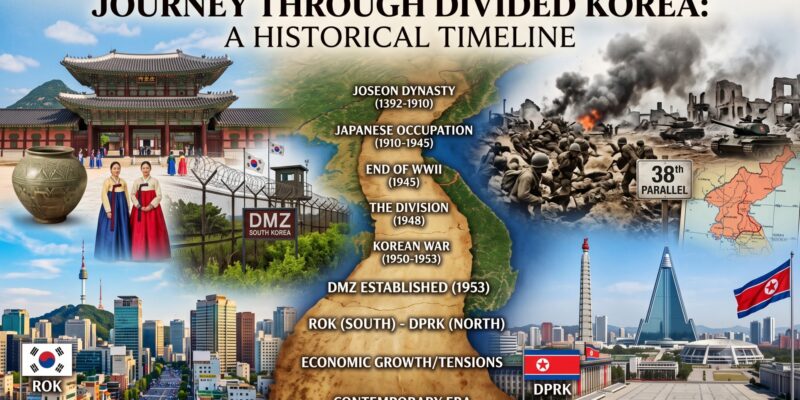
North and South Korea History: How One Nation Became Two
Few stories in modern history are as dramatic as the split of the Korean Peninsula. For over a thousand years, Korea existed as a single, unified nation. Today, it is two countries with opposite political systems, separated by one of the most heavily guarded borders on earth. This guide walks through the full history of North and South Korea, from the ancient kingdoms that came before the divide to the Korean War, the DMZ, and the ongoing question of reunification.
If you are researching Korea before planning a trip, an exchange program, or a degree in South Korea, understanding this history also gives useful context for daily life and culture once you arrive. You can read more about that side of modern Korea on our K-Culture page.
Korea Before the Division: One Nation for Over a Thousand Years
Long before anyone spoke of north and south Korea history as two separate stories, the Korean Peninsula was governed as a single kingdom for centuries. The most recent of these was the Joseon dynasty, which ruled a unified Korea from 1392 until the early twentieth century and shaped the language, customs, and identity that both modern Koreas still share.
That unity ended with foreign occupation. Japan annexed Korea in 1910 after the Russo-Japanese War and ruled the peninsula as a colony for 35 years. Japanese colonial rule suppressed Korean language and culture and left deep scars that still influence how both Koreas view their national identity today. This period is essential background for understanding why the division that followed felt like such a rupture to Korean society.
Section word count target: ~220 words Structural notes: Short historical narrative section, no table needed Internal link: anchor text “K-Culture” links to https://studyinsouthkorea.in/k-culture/
Why Is Korea Divided? The 38th Parallel Explained
The question “why is Korea divided” traces back to August 1945, the final days of World War II. When Japan surrendered, the United States and the Soviet Union needed a quick way to accept the Japanese surrender across the peninsula. The two powers agreed, almost overnight, to split administrative control at the 38th parallel, a line of latitude with no real basis in Korean geography, dialect, or history.
The Soviet Union occupied the north, and the United States occupied the south. What both sides intended as a temporary wartime arrangement hardened into a permanent border as Cold War tensions between Washington and Moscow deepened. Attempts at a UN-supervised vote to reunify the peninsula under one government collapsed when the north refused to take part, and by 1948 the temporary line had become a real political boundary.
For a full breakdown of how this line still separates the two countries today, see our complete DMZ guide.
Section word count target: ~200 words Structural notes: Could include a simple timeline callout (1945 surrender, 1945 parallel agreed, 1948 two governments) Internal link: anchor text “complete DMZ guide” links to https://studyinsouthkorea.in/uncategorized/north-korea-south-korea-border-name-complete-2026-dmz-guide/
1948: Two Governments, Two Koreas
By 1948, the temporary occupation zones became two separate states. In the south, Syngman Rhee led the formation of the Republic of Korea, headquartered in Seoul, with a government modeled on Western-style democratic institutions and backed by the United States. In the north, the Soviet Union installed Kim Il Sung, a former guerrilla fighter, as leader of the Democratic People’s Republic of Korea, based in Pyongyang.
From this point, north and south korea history diverges sharply. The south began building a capitalist, US-aligned state. The north adopted a centralized, Soviet-backed communist model under the Kim family, a leadership dynasty that continues to rule North Korea today. Each side claimed to be the legitimate government of the entire peninsula, setting the stage for direct conflict.
To understand how South Korea’s political system evolved from here into the democracy it is today, read our guide on is South Korea a democracy.
Section word count target: ~200 words Structural notes: Plain narrative, consider a small two-column comparison of the two founding leaders and capitals Internal link: anchor text “is South Korea a democracy” links to https://studyinsouthkorea.in/uncategorized/is-south-korea-a-democracy-complete-2026-political-system-guide/
The Korean War (1950-1953)
Tensions between the two governments erupted into open war on June 25, 1950, when North Korean forces crossed the 38th parallel into the south. The United States and a United Nations coalition entered on the side of South Korea, while China later intervened to support North Korea, turning a civil conflict into a proxy battle within the wider Cold War.
Three years of fighting caused enormous loss of life on both sides and devastated cities across the peninsula. The war ended not with a peace treaty but with an armistice agreement signed on July 27, 1953. Because no formal peace treaty was ever signed, North and South Korea remain technically at war to this day, a fact that still shapes tensions along the border.
Section word count target: ~180 words Structural notes: Straightforward narrative, keep factual and non-graphic Internal link: none needed here, no genuinely relevant sitemap URL for war specifics
The DMZ: A Border Frozen in Time
The armistice created the Korean Demilitarized Zone, a buffer roughly 2.5 miles wide that runs along the original front line rather than the old 38th parallel exactly. Despite its name, the DMZ is one of the most heavily fortified borders on the planet, lined with troops, fencing, and surveillance on both sides.
The DMZ is more than a military line. It is the clearest physical symbol of the division discussed throughout this piece on north and south korea history, and it remains a major point of interest for visitors and students studying Korean geopolitics.
For the full story of how this border came to be and what it looks like today, see our detailed guide: north korea south korea border name and DMZ history.
Section word count target: ~150 words Structural notes: Short section, strong internal link opportunity Internal link: anchor text “north korea south korea border name and DMZ history” links to https://studyinsouthkorea.in/uncategorized/north-korea-south-korea-border-name-complete-2026-dmz-guide/
Two Nations, Two Paths: How North and South Korea Diverged
After the armistice, the two Koreas took radically different paths. South Korea moved through military rule in the 1960s and 1970s before transitioning into a full democracy, and its National Assembly today is central to that system. Alongside political change, South Korea built one of the fastest-growing economies in modern history, becoming a global leader in technology, shipbuilding, and popular culture.
North Korea, by contrast, doubled down on a closed, centrally planned economy under continuous rule by the Kim family. Decades of isolation, sanctions, and limited trade have left North Korea’s economy far behind its southern neighbor, even though both nations share the same language and pre-division history.
To see exactly how the two systems differ side by side today, read our full comparison of the differences between North and South Korea. For more on how South Korea’s government functions, see our guide to the National Assembly of South Korea.
Section word count target: ~220 words Structural notes: Good candidate for a simple two-column comparison table (Government / Economy / Global Role) Internal links: anchor text “full comparison of the differences between North and South Korea” links to https://studyinsouthkorea.in/uncategorized/10-differences-between-north-and-south-korea-a-complete-2026-guide-to-understanding-the-korean-peninsula/; anchor text “National Assembly of South Korea” links to https://studyinsouthkorea.in/uncategorized/national-assembly-south-korea/
Reunification Efforts: Will Korea Ever Be One Again?
Despite decades of division, reunification has never fully left the conversation. The June 15th North-South Joint Declaration in 2000 marked the first summit between the two Koreas’ leaders since the division. This was followed by the October 4th Declaration in 2007 and the Panmunjom Declaration in April 2018, each aiming to ease tensions and open the door to eventual reunification.
Progress has been slow and repeatedly interrupted by renewed tension, missile tests, and shifting international politics. Still, many Koreans on both sides continue to see reunification as an eventual, if distant, goal rooted in the shared history covered throughout this guide.
Section word count target: ~150 words Structural notes: Short closing-context section, simple bullet timeline works well Internal link: none needed, no directly relevant sitemap page
FAQs About North and South Korea History
When did North and South Korea split?
The peninsula was divided at the 38th parallel in August 1945, and two separate governments were formally established in 1948.
Why did Korea split into two countries?
Korea was divided as a temporary wartime measure between the Soviet Union and the United States after Japan’s surrender in 1945. Cold War rivalry turned that temporary line into a permanent border.
Are North and South Korea still at war?
Technically, yes. The Korean War ended with an armistice in 1953, not a formal peace treaty, so the two nations remain in a state of war on paper.
What was Korea like before the division?
Korea was a single, unified kingdom for centuries, most recently under the Joseon dynasty, before Japan colonized the peninsula in 1910 and the division followed after World War II.