


South Korea has emerged as one of the most visited countries in Asia, and a significant part of its growing tourism numbers comes from its liberal visa-free travel policies. Whether you are a traveler, a student planning to explore Korean culture before enrolling in a university, or a professional attending a conference, understanding which countries enjoy visa-free access to South Korea is essential for smooth travel planning.
This complete guide covers every aspect of the South Korea visa-free entry system, including the list of eligible countries, conditions of entry, duration of permitted stay, and what travelers from non-eligible countries like India need to know before visiting.
What Is the South Korea Visa-Free Policy and How Does It Work
South Korea grants visa-free entry to citizens of select countries under bilateral agreements and unilateral policies. This means travelers from these countries do not need to apply for a tourist visa in advance and can arrive at any South Korean port of entry with just a valid passport and onward travel documents.
However, visa-free entry does not mean unrestricted entry. Travelers still need to meet health and immigration requirements, carry sufficient funds for their stay, hold a return ticket, and be prepared for questioning at immigration. Some nationalities also need to obtain a K-ETA (Korea Electronic Travel Authorization) even if they are visa-exempt.
If you are planning to study in South Korea, the visa-free policy applies only to short-term tourism and business visits. Students must apply for a D-2 or D-4 student visa regardless of their nationality.
Full List of South Korea Visa Free Countries in 2026
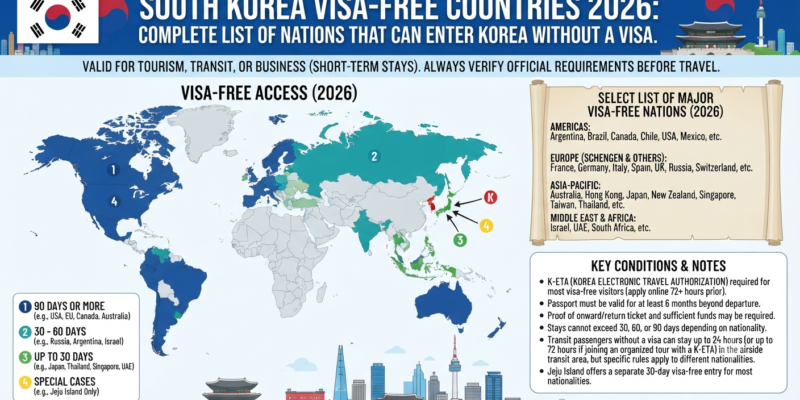
South Korea maintains visa-free agreements with over 100 countries. The duration of permitted stay varies depending on the bilateral arrangement between South Korea and the respective country.
Countries Allowed 90 Days Visa-Free Stay
Citizens of the following countries can stay in South Korea for up to 90 days without a visa:
Germany, France, Italy, Spain, Netherlands, Belgium, Sweden, Denmark, Norway, Finland, Austria, Switzerland, Luxembourg, Portugal, Greece, Ireland, Poland, Czech Republic, Hungary, Slovakia, Slovenia, Croatia, Estonia, Latvia, Lithuania, Romania, Bulgaria, Cyprus, Malta, Iceland, Liechtenstein, Monaco, San Marino, Andorra, Vatican City, United Kingdom, United States of America, Canada, Australia, New Zealand, Japan, Singapore, Mexico, Brazil, Argentina, Chile, Colombia, Peru, Costa Rica, Panama, Dominican Republic, El Salvador, Guatemala, Honduras, Nicaragua, Ecuador, Bolivia, Paraguay, Uruguay, Venezuela, Morocco, Tunisia, Bahrain, Oman, Kuwait, Qatar, United Arab Emirates, Israel, Turkey, and several other nations.
Countries Allowed 60 Days Visa-Free Stay
Citizens of countries such as the Bahamas, Barbados, Dominica, Grenada, Saint Kitts and Nevis, Saint Lucia, Saint Vincent and the Grenadines, Antigua and Barbuda, Trinidad and Tobago, and Suriname enjoy 60-day visa-free stays.
Countries Allowed 30 Days Visa-Free Stay
Several Southeast Asian nations including Thailand, Malaysia, Philippines, Indonesia, and Vietnam have 30-day or 15-day visa-free arrangements with South Korea, though some of these conditions are subject to periodic revision and bilateral updates.
Countries Requiring K-ETA Despite Visa Exemption
Many visa-exempt countries including the United States, United Kingdom, Canada, Australia, and most European Union nations are required to obtain a K-ETA before departure. The K-ETA is an online travel authorization that is not a visa but a mandatory pre-clearance for eligible visa-exempt travelers.
The K-ETA application is submitted online, costs a nominal fee, and is generally approved within 72 hours. It is valid for multiple entries over a two-year period.
Is India on the South Korea Visa-Free List
India is not on the South Korea visa-free countries list for regular tourist or business travel. Indian citizens must apply for a South Korean visa through the Korean Embassy or Consulate before traveling.
However, Indian students and professionals have access to several visa categories depending on their purpose of travel. Indian students who wish to pursue higher education can apply for a South Korea student visa which allows them to live and study in Korea legally for the duration of their academic program.
For short tourism trips, Indians can also apply for a South Korea e-visa which simplifies the application process significantly compared to the earlier paper-based process.
Indian citizens visiting South Korea for tourism should also track their South Korea visa application status to ensure timely approval before booking flights.
South Korea K-ETA: What It Is and Who Needs It
The Korea Electronic Travel Authorization system was introduced to enhance border security while maintaining streamlined entry for visa-exempt travelers. It functions similarly to the US ESTA or Australia’s ETA systems.
As of 2026, K-ETA requirements apply to nationals of countries including but not limited to the United States, United Kingdom, Canada, Australia, New Zealand, Japan, and most European Union member states.
To apply for K-ETA, travelers need to visit the official K-ETA website and submit a form with personal details, passport information, travel plans, and answer a few health and security screening questions. The K-ETA is linked electronically to the passport and does not require a physical stamp or sticker.
Travelers who obtain K-ETA are allowed multiple entries within the validity period of two years, as long as each individual stay does not exceed the permitted duration for their nationality.
Entry Requirements for Visa-Free Travelers Visiting South Korea
Even if your country is on the visa-free list, you must meet all immigration requirements at the port of entry. Immigration officers in South Korea have the authority to deny entry to travelers who cannot satisfy these conditions.
You must carry a valid passport with at least six months validity beyond your intended stay. You must also have a confirmed return or onward ticket to prove you intend to leave South Korea before your permitted stay expires. Immigration may ask for proof of sufficient funds to cover your expenses during your stay, which is typically assessed as a minimum daily budget per person.
You should also be able to provide accommodation details, such as a hotel booking confirmation or an invitation letter from a host in South Korea. Travelers who have previously violated Korean immigration laws or have a criminal record may be denied entry regardless of their visa-free status.
Visa-Free Transit Through South Korea
South Korea also offers a special visa-free transit arrangement called the Transit Without Visa (TWOV) facility. Under this arrangement, travelers transiting through Incheon International Airport who are connecting to a third country do not require a South Korean visa if their transit time is within a specified window.
This facility is available to nationals of several countries that are not otherwise on the visa-free entry list. The TWOV allows transit passengers to stay within the international transit zone without passing through immigration.
Additionally, South Korea offers a special city tour program for certain transit passengers, allowing them to leave the airport and explore Seoul or Incheon for a limited number of hours before their connecting flight. This is a unique offering among Asian transit hubs and is especially useful for travelers with long layovers.
Working Holiday Visa Arrangements That Complement Visa-Free Access
Beyond simple visa-free tourism, South Korea has working holiday visa agreements with several countries. These agreements allow young people aged 18 to 30 (in some cases up to 35) to live and work in South Korea for up to one year.
Countries with working holiday visa arrangements with South Korea include Australia, New Zealand, Canada, Ireland, France, Germany, the United Kingdom, Japan, Taiwan, Hong Kong, Denmark, Sweden, and several others. Citizens of these countries can combine their initial visa-free entry with an application for a working holiday visa if they wish to extend their stay and work legally.
This is particularly relevant for young travelers who want to experience Korean life more deeply while also earning income. It is important to note that a working holiday visa is separate from a work visa and does not lead to permanent residency.
What Visa-Free Travelers Can and Cannot Do in South Korea
Visa-free entry permits tourism, leisure, visiting family and friends, and in some cases short-term business meetings or conferences. However, there are several activities that are not permitted under visa-free entry.
Visa-free travelers cannot take up paid employment in South Korea. They cannot enroll in formal degree-granting academic programs. They cannot conduct business transactions that generate income within South Korea. And they cannot stay beyond the permitted visa-free duration without applying for an extension through the Korea Immigration Service.
For anyone considering longer stays, formal employment, or academic enrollment, the correct course of action is to apply for the appropriate visa category before traveling. Students from countries like India who wish to pursue universities in South Korea for international students must obtain a student visa before arrival.
How South Korea’s Visa-Free Policy Compares With Other Asian Countries
Among major Asian destinations, South Korea offers one of the most generous visa-free access policies. Japan, Singapore, and South Korea are often compared in terms of their openness to international visitors.
Japan has its own extensive visa-free network but requires K-ETA equivalent documentation from many nationalities. Singapore operates a similarly open policy, especially for short tourism visits. South Korea distinguishes itself through its active promotion of tourism combined with the cultural wave driven by K-pop, K-drama, and Korean cuisine.
For Indian travelers who want to tour Seoul, the visa requirement adds an extra planning step but does not significantly limit access, given how streamlined the e-visa process has become in recent years.
Recent Updates to South Korea’s Visa-Free Policy in 2026
South Korea periodically reviews and updates its visa-free arrangements based on diplomatic relations, immigration compliance rates, and bilateral negotiations. In 2026, there have been several noteworthy developments.
South Korea extended its K-ETA exemption for certain nationalities during peak tourism periods as part of a campaign to boost international visitor numbers following the global recovery in tourism. The government has also been in discussions with several South Asian nations about easing visa access for students and skilled professionals, reflecting the country’s growing need for international talent across sectors including technology, healthcare, education, and manufacturing.
For Indian students and professionals, life in South Korea continues to improve in terms of legal protections, community support, and integration opportunities, even if full visa-free access has not yet been extended to Indian passport holders.
Planning Your South Korea Trip Based on Visa Status
If you are from a visa-free country, the planning process is relatively straightforward. Choose your travel dates, book flights to Incheon International Airport or Gimpo Airport, apply for K-ETA if required, arrange accommodation, and ensure your passport is valid for the required period.
If you are from a country that requires a visa, begin the process at least four to six weeks before your intended travel date. Gather all necessary documents including bank statements, employment letters, accommodation proof, and travel itinerary. Submit your application through the official Korean Embassy website or in person at the consulate.
For those planning to fly from India, flight tickets from India to Seoul are available year-round on multiple airlines, and booking in advance typically yields significantly lower fares.
Frequently Asked Questions About South Korea Visa-Free Entry
Can Indians visit South Korea without a visa? No, Indian passport holders require a visa to enter South Korea. They can apply for an e-visa online or submit a paper application at the Korean Embassy.
How long can Americans stay in South Korea without a visa? US citizens can stay in South Korea for up to 90 days without a visa, provided they hold a valid K-ETA prior to departure.
Do visa-free travelers need travel insurance for South Korea? Travel insurance is not mandatory for visa-free entry but is strongly recommended. South Korean healthcare is excellent but can be expensive for uninsured foreign visitors.
Can I work in South Korea on a visa-free visit? No. Working for pay in South Korea requires a proper work visa regardless of whether you entered visa-free.
Is K-ETA required for all visa-exempt countries? No, K-ETA requirements vary by nationality. Some countries are fully exempt while others must obtain K-ETA before travel. Always verify the latest requirements on the official Korean government portal.
Conclusion
South Korea’s visa-free policy is one of the most expansive in Asia and reflects the country’s commitment to being an open, welcoming destination for global travelers. With over 100 countries enjoying some form of visa-free or simplified entry access, South Korea remains highly accessible for tourism, business, and cultural exchange.
For those from countries not on the visa-free list, particularly Indian students and travelers, the visa application process has been made easier through online systems and clear documentation guidelines. Whether you are planning a short trip or a long-term academic journey, understanding your visa options is the first and most important step.
Visit Study in South Korea for the most up-to-date guidance on visas, student life, accommodation, and everything you need to build a successful future in Korea.