


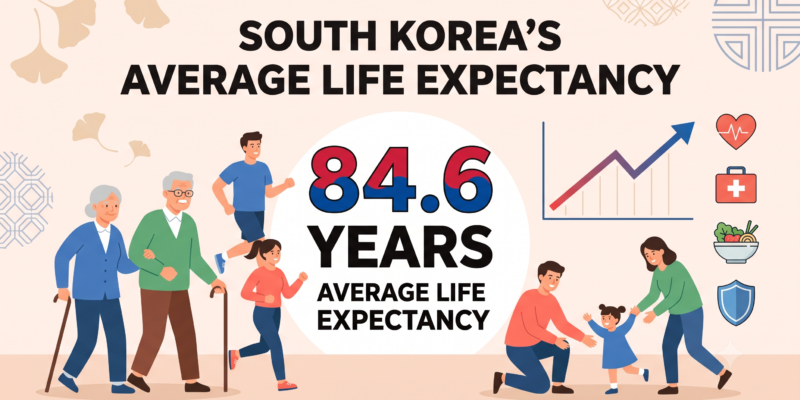
The South Korea average life expectancy is one of the highest in the world. A baby born in the country today can expect to live to roughly 83 to 84 years, and women often pass 86 or 87. That is more than a decade longer than a baby born in South Korea in the early 1970s, and well above the global average of about 74 years.
If you are an Indian student, a working professional, or a parent thinking about life in Korea, this number matters. It says something about healthcare quality, food, safety, and the daily environment you would live in. This guide explains the latest life expectancy in South Korea, compares men and women, shows how the figure changed over time, and covers the real challenges behind the headline.
What Is the Average Life Expectancy in South Korea?
Life expectancy at birth is the number of years a newborn is expected to live if today’s death rates stayed the same throughout their life. It is not a promise for any one person. It is a snapshot of how healthy a society is.
For 2024, national life table data from Statistics Korea (published through KOSIS) puts male life expectancy at about 80.8 years. Overall, the national figure sits at roughly 83.6 years, with women at about 86.6 years. United Nations estimates are slightly higher, at about 84.4 years for both sexes combined. The two sets differ because of method and revision schedules, which we explain later in this guide.
In plain terms, the average life expectancy in South Korea in 2026 is best described as “between 83.5 and 84.5 years, depending on the source.” Most global rankings place South Korea in the top five or six countries worldwide.
South Korea Life Expectancy by Gender: Men vs Women
Women live longer than men in nearly every country, and South Korea is no exception. The gap here is about six years.
| Measure (2024) | Men | Women | Both sexes |
|---|---|---|---|
| Statistics Korea (KOSIS) life table | 80.8 | about 86.6 | about 83.6 |
| UN World Population Prospects 2024 | 81.3 | 87.3 | 84.4 |
South Korea ranks among the top four countries globally for female life expectancy. Several reasons are often cited: lower smoking rates among women, high participation in health screening programmes, and the long-standing social habit of regular medical checkups. Korean men, meanwhile, still face higher rates of smoking, heavy drinking, and work-related stress, which narrows their advantage.
For an Indian family comparing destinations, the key point is that both men and women in Korea enjoy a long expected lifespan, supported by a modern health system.
How Life Expectancy in South Korea Has Changed Since 1960
The speed of improvement is what makes the Korean story remarkable. In 1960, life expectancy was only around 54 years. Within about six decades, it climbed by nearly 30 years.
| Year | Life expectancy, both sexes (UN estimate) |
|---|---|
| 1960 | about 54 |
| 2015 | 82.5 |
| 2019 | 83.7 |
| 2022 | 82.7 |
| 2024 | 84.4 |
Notice the dip in 2022. That year, COVID-19 deaths raised overall mortality, and life expectancy fell temporarily before recovering in 2023 and 2024. The long-term direction remains upward.
This rise tracks the country’s economic rise. Better sanitation, vaccination, nutrition, and hospital access all arrived within a single generation. If you want to see how that economic growth translates into everyday income and living standards, read our breakdown of whether South Korea is a rich country and our explainer on whether South Korea is developed or developing.
Why Do Koreans Live So Long?
No single factor explains it. Researchers usually point to a combination of healthcare, food, and lifestyle.
Universal Health Insurance
South Korea has a national health insurance system that covers almost the entire population. Hospital visits, specialist consultations, and diagnostic tests are affordable compared with many countries. Immunisation coverage for childhood vaccines such as DPT, hepatitis B, and measles is around 97 percent, which keeps preventable childhood deaths very low.
Foreign residents also join the system after a short stay. If you plan to work or study in Korea, it helps to understand how contributions work, including the National Pension Service for foreigners.
A Diet Built Around Vegetables and Fermented Foods
Traditional Korean meals revolve around rice, vegetables, soups, fish, and fermented foods such as kimchi. Portions of red meat and sugar have historically been lower than in Western diets, and obesity rates remain among the lowest in the developed world. Even though fast food and sweets are growing in popularity, the base diet still leans healthy. You can explore more of this food culture in our guide to famous things in South Korea.
An Active, Walkable, Safe Environment
Seoul and other big cities have dense public transport, so people walk far more than car-dependent societies. Hiking is a national pastime, and neighbourhood parks and gyms are everywhere. Low crime also means people feel comfortable moving around, even late at night. For a deeper look at this angle, see our guide on whether South Korea is safe for Indians.
Education, Income, and Health Awareness
High education levels and steady incomes mean most households can afford regular checkups, nutritious food, and quality housing. National screening programmes for cancers, blood pressure, and diabetes encourage early detection, which improves survival.
Healthy Life Expectancy in South Korea
Living long is one thing. Living long in good health is another. The World Health Organization’s healthy life expectancy figure for South Korea is about 72.5 years. That means people can expect roughly a decade of life with some health limitations at the end.
This gap is the new target for Korean policy makers. The focus is shifting from adding years to life toward adding health to years. Programmes for elderly exercise, dementia care, and community clinics are expanding every year.
South Korea vs India and Other Countries
For Indian readers, comparison helps. India’s life expectancy is around 72 years, which is nearly 12 years below South Korea. The table below puts the numbers side by side using recent UN-based figures.
| Country | Life expectancy at birth (about 2024) |
|---|---|
| South Korea | 84.4 |
| United Kingdom | 81.4 |
| United States | 79.5 |
| World average | about 73.9 |
| India | about 72 |
South Korea sits at the top of this list. Compared with the United States, Koreans live almost five years longer on average, even though Korea spends less per person on healthcare. That efficiency is one reason health researchers study the Korean model so closely.
The Challenges Behind the Numbers
A high life expectancy is good news, but it brings real pressure.
A rapidly ageing society. With people living longer and births falling, the country is ageing faster than almost any other. The fertility rate was only about 0.75 births per woman in 2024, among the lowest anywhere. Our population pyramid of South Korea guide shows exactly how the age structure is changing.
Elderly poverty. Many older Koreans did not benefit from the pension system for long enough, and a significant share of seniors live on low incomes. This is a major policy debate.
Mental health and work pressure. Long working hours and academic competition create stress for younger and middle-aged adults. The government and civil groups are expanding counselling and support services.
Rising chronic disease. As the population ages, conditions such as diabetes, heart disease, and dementia are increasing. Diabetes prevalence is already close to 10 percent.
These challenges are one reason Korea welcomes international students and skilled workers. If you are weighing a move, see our guides on how to study in South Korea and jobs in Korea for Indians.
What a Long Life Expectancy Means for Indian Students and Workers
You are not moving to Korea to live to 100. But life expectancy numbers hint at the quality of services around you:
- Healthcare access: Clinics and hospitals are modern, widespread, and efficient.
- Public health: Clean water, food safety standards, and strong disease control.
- Daily life: Reliable transport, safe streets, and a culture of preventive care.
- Cost planning: Health insurance is a regular part of your monthly budget, so check our cost of living in South Korea per month breakdown before you move.
To get a fuller picture of what daily life looks like, read life in South Korea for Indians and students and our student life section.
Why Life Expectancy Figures Differ Between Sources
If you search for South Korea life expectancy 2026, you may see 83.5 on one site and 84.4 on another. This is normal. National statistics offices publish complete life tables with a delay and revise them. The UN publishes modelled estimates that harmonise methods across countries. Rankings websites then mix and repackage these numbers.
When you cite the figure in an essay, a report, or a blog, always name the source and year. For official numbers, use Statistics Korea’s KOSIS portal or the UN World Population Prospects.
Human Development and Life Expectancy
Life expectancy is one of three pillars of the Human Development Index, alongside education and income. Korea scores very high on all three. For a full analysis, read our guide to the Human Development Index of South Korea.
Frequently Asked Questions
What is the average life expectancy in South Korea? It is roughly 83.6 years at birth based on national 2024 data, and about 84.4 years in UN estimates. Men average about 81 years and women about 87 years.
Is South Korea’s life expectancy higher than India’s? Yes. South Korea’s figure is around 84 years, while India’s is around 72 years, a gap of about 12 years.
Which gender lives longer in South Korea? Women live longer, by about six years on average.
Why is life expectancy so high in South Korea? Universal health insurance, widespread vaccination, a vegetable and fish based diet, regular health screening, safe cities, and high education and income levels all contribute.
What is healthy life expectancy in South Korea? The WHO estimate is about 72.5 years, meaning people typically spend several years of later life with some health limitations.
Will South Korea’s life expectancy keep rising? Most projections say yes, though the pace depends on how well the country handles ageing, chronic disease, and mental health.
Does a higher life expectancy make Korea a better place to live? It signals a strong health system and safe living conditions, but you should also consider cost of living, language, and work culture before deciding.
Conclusion
The South Korea average life expectancy of about 83 to 84 years reflects decades of investment in healthcare, nutrition, and public safety. Women live to around 87, men to around 81, and the country consistently ranks among the world’s longest-lived populations. Behind the success sit real challenges: an ageing society, a very low birth rate, and mental health pressure.
If you are considering study or work in Korea, these numbers are a reassuring sign of a stable, modern living environment. Explore our k-courses page to start planning, or contact our team for guidance on your next step.