


Is South Korea a Rich Country? Complete 2026 Guide to GDP, Income and Living Standards
So, is South Korea a rich country? In short, yes — South Korea is officially classed as a high-income, developed economy, with a GDP per capita well above the global average and a standard of living that rivals most of Western Europe. But the full answer is more layered than a single yes or no, and if you’re weighing studying in South Korea after 12th, planning a move, or just curious about how Korea built its wealth, it helps to look at the actual numbers behind the headline.
This guide breaks down where South Korea sits on global GDP rankings, how its per-capita income compares to India and other nations, the history behind its rapid economic rise, and the inequality that complicates the “rich country” label. By the end, you’ll have a complete, data-backed picture of exactly how wealthy South Korea is in 2026 — and what that wealth actually looks like on the ground.
Is South Korea a Rich Country? The Quick Answer
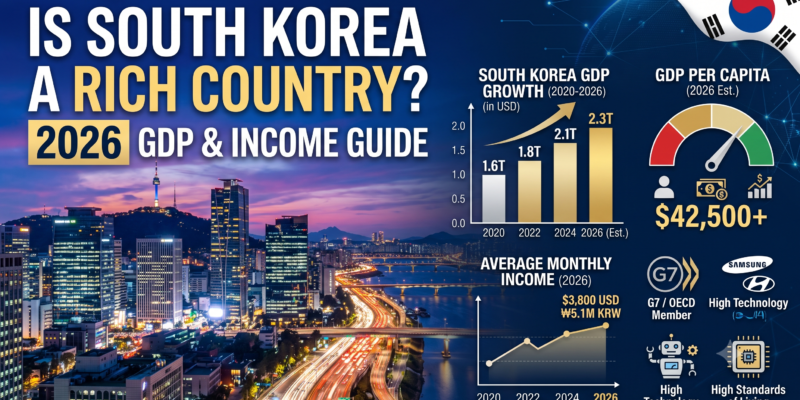
Yes. South Korea is recognised by the IMF, World Bank, and OECD as a high-income, advanced economy. It has been an OECD member since 1996, ranks among the world’s top 15 economies by nominal GDP, and posts a GDP per capita above USD 36,000 — nearly three times the global average. Seoul is a global financial and technology hub, and Korean brands like Samsung, Hyundai, and LG rank among the most valuable companies on earth.
That said, “rich” isn’t the same as “evenly wealthy.” South Korea also has one of the highest relative poverty rates among OECD nations and a widening wealth gap, so the country’s prosperity is real but unevenly distributed. The sections below unpack both sides.
South Korea’s GDP and Global Economic Ranking in 2026
South Korea’s nominal GDP sits at roughly USD 1.9 trillion, placing it among the world’s 13th to 15th largest economies depending on the year and measurement source. On a purchasing power parity (PPP) basis — which adjusts for the real cost of goods and services in a country — Korea’s economy is even larger, reflecting how far its income actually stretches domestically.
| Metric | South Korea (2026 est.) | Global Standing |
|---|---|---|
| Nominal GDP | ~USD 1.9 trillion | 13th–15th largest economy |
| GDP Per Capita (Nominal) | ~USD 36,000–37,000 | Top 25–30 worldwide |
| GDP Per Capita (PPP) | ~USD 55,000–61,000 | Top 30 worldwide |
| OECD Membership | Since 1996 | High-income economy |
| Population | ~51.8 million | 28th largest |
This scale of output didn’t happen by accident. South Korea’s economy is built on a small number of export-heavy sectors — semiconductors, shipbuilding, automobiles, and consumer electronics — that punch far above what the country’s land area or natural resources would suggest. Korea has almost no oil or major mineral reserves, which makes its wealth almost entirely a product of manufacturing, technology, and human capital rather than resource extraction.
South Korea GDP Per Capita: How Rich Is the Average Korean?
GDP per capita is usually the more honest measure of “how rich” a country feels to live in, since total GDP can be inflated simply by population size. South Korea’s GDP per capita has climbed from under a hundred dollars in the 1960s to well over USD 36,000 today, and it’s projected to edge closer to USD 37,000 by the end of 2026.
For context, that figure is roughly 2.8 to 3 times the world average. On a purchasing power parity basis, where the number accounts for local prices rather than raw currency conversion, the figure rises even further, which is one reason cost of living conversations — like our breakdown of cost of living in South Korea per month — matter as much as the raw income figure when judging affordability.
If you’re comparing this to take-home pay rather than macro statistics, our guide to average salary in South Korea per month and the separate look at South Korea’s median income and earning potential go deeper into what a “rich” economy actually pays real workers by industry and experience level.
From One of Asia’s Poorest Nations to a Global Economic Power
South Korea’s wealth is a genuinely remarkable turnaround story, often called the “Miracle on the Han River.” At the end of the Korean War in the early 1950s, South Korea was one of the poorest countries on the planet — poorer, by some estimates, than several Sub-Saharan African nations at the time. Roughly half of its manufacturing base and most of its railway infrastructure had been destroyed.
What followed was decades of aggressive industrial policy: state-directed investment into steel, shipbuilding, electronics, and automobiles; heavy investment in universal education; and export-focused conglomerates known as chaebols (Samsung, Hyundai, LG, SK) that grew into global giants. By the 1990s, South Korea had joined the ranks of the “Asian Tigers,” and it crossed the USD 1 trillion GDP mark in 2004.
- 1960s: Among the poorest nations globally, with per-capita income under USD 100
- 1970s–1980s: Rapid industrialisation driven by state-backed manufacturing and exports
- 1997–1998: Asian financial crisis tests the economy, followed by reform and recovery
- 1996: South Korea joins the OECD, formally recognised as a high-income economy
- 2004: GDP crosses the USD 1 trillion mark for the first time
- 2020s: Consolidates position among the world’s top 15 economies, led by semiconductors and technology exports
This growth trajectory is closely tied to the question of whether South Korea is a developed or developing country — by every standard economic classification, it firmly crossed that line decades ago.
What Makes South Korea Rich: The Industries Behind the Wealth
South Korea’s prosperity rests on a concentrated set of high-value export industries rather than broad-based resource wealth. Understanding these sectors explains why the country’s wealth is both large and, at times, fragile.
Semiconductors and Technology
Samsung and SK Hynix together control a dominant share of the global memory chip market, making semiconductors South Korea’s single largest export category and a critical piece of the global electronics supply chain.
Automobiles and Shipbuilding
Hyundai-Kia is one of the world’s largest automakers, and Korean shipyards build a significant share of the planet’s large commercial vessels, from container ships to LNG carriers.
Cultural Exports (Hallyu)
K-pop, Korean film and television, and Korean beauty products have become a genuine soft-power export industry, adding billions in revenue and, just as importantly, global brand value that supports tourism, education demand, and consumer exports.
Education and Human Capital
Korea invests heavily in education, producing one of the most credentialed workforces in the world. This is part of why the country climbed the value chain from cheap manufacturing to high-end technology within a single generation.
South Korea vs Other Wealthy Nations: How Does It Compare?
Placing South Korea alongside other recognised high-income economies helps put its wealth in perspective. It isn’t at the very top of the global rich list, but it comfortably clears the bar most economists use to define a rich, developed nation.
| Country | GDP Per Capita (approx., PPP) | Classification |
|---|---|---|
| United States | ~USD 85,000 | High-income / developed |
| United Kingdom | ~USD 58,000 | High-income / developed |
| South Korea | ~USD 55,000–61,000 | High-income / developed |
| Italy | ~USD 58,000 | High-income / developed |
| India | ~USD 11,000 | Developing / emerging |
Korea’s per-capita income has, on several measures, overtaken countries like Italy and sits close to the United Kingdom. For readers comparing this to home currency value directly, our South Korea vs Indian currency exchange guide breaks down exactly how far the Korean won stretches against the Indian rupee.
The Other Side: Inequality Behind South Korea’s Wealth
A country can be statistically rich while a large share of its population doesn’t feel wealthy, and South Korea is a clear example of this tension. Despite its high average income, South Korea has recorded one of the highest relative poverty rates among OECD member states in recent years, with a notable share of the population — particularly older citizens — living below the relative poverty line.
Wealth is also geographically concentrated. Property values and income are disproportionately clustered in Seoul and districts like Gangnam, while rural and post-industrial regions have grown more slowly. Real estate prices in the capital have pushed home ownership out of reach for many younger Koreans, feeding into what’s sometimes referred to locally as “Hell Joseon” — a phrase capturing frustration with rigid corporate hierarchies, intense competition, and limited social mobility despite the country’s overall wealth.
South Korea’s fertility rate, among the lowest in the world, is frequently linked by economists and sociologists to exactly this pressure: high living costs, demanding work culture, and economic anxiety even within a wealthy economy.
So while the numbers say South Korea is unambiguously rich on paper, day-to-day life in South Korea can feel considerably more competitive and cost-sensitive than the GDP headline suggests, especially in Seoul.
Human Development and Living Standards
GDP alone doesn’t capture quality of life, which is why organisations like the UN also track the Human Development Index (HDI), combining income with education and life expectancy. South Korea consistently scores in the “very high human development” category, reflecting strong healthcare access, near-universal literacy, and long life expectancy alongside its income figures. Our detailed look at the Human Development Index of South Korea breaks these components down individually.
In practical terms, this means South Korea combines high income with strong public infrastructure: extensive high-speed rail, near-universal broadband and mobile connectivity, a well-regarded public healthcare system, and one of the highest tertiary education enrolment rates in the world.
How Global Institutions Classify a “Rich” Country
Economists don’t rely on a single number to decide whether a country is rich. The World Bank uses Gross National Income (GNI) per capita bands to sort countries into low-income, lower-middle-income, upper-middle-income, and high-income categories, with high-income status currently starting above roughly USD 14,000 GNI per capita. South Korea’s GNI per capita sits well above that threshold, comfortably inside the high-income bracket alongside Western Europe, North America, Japan, and Australia.
The IMF and OECD apply similar logic through their “advanced economy” classification, which weighs not just income but also market development, financial infrastructure, and integration into global trade. South Korea meets all three criteria: it has deep, liquid capital markets, a highly globalised export sector, and manufacturing and technology industries that are deeply embedded in international supply chains. This is why, unlike some high-GDP oil-exporting nations that fail the “advanced economy” test, South Korea passes every major definition of what it means to be a rich country.
Savings, Reserves and Financial Strength
A country’s wealth isn’t only measured by income — its financial resilience matters too. South Korea holds one of the largest stockpiles of foreign exchange reserves in the world, a cushion built up partly in response to the lessons of the 1997–1998 Asian financial crisis, when a shortage of foreign currency reserves nearly crippled the economy. Korea also has one of the highest gross national savings rates among OECD countries, meaning households and businesses set aside an unusually large share of income rather than spending it immediately.
This combination of strong reserves, high savings, and a current account that runs in surplus most years gives South Korea’s economy a level of stability that pure GDP figures don’t fully capture. It’s one of the quieter reasons credit rating agencies consistently rate Korean sovereign debt highly, even during periods of global financial stress.
Consumer Wealth: What Rich Actually Looks Like Day to Day
Beyond macroeconomic statistics, South Korea’s wealth is visible in everyday consumer infrastructure. The country has some of the fastest average internet speeds in the world, near-universal smartphone penetration, and a high-speed rail network (KTX) connecting major cities in a fraction of the time equivalent trips would take elsewhere. Retail and dining scenes in cities like Seoul and Busan rival any major global capital, and 24-hour convenience culture, extensive public transit, and widespread digital payment adoption are all hallmarks of a genuinely high-income consumer economy rather than just a high-income statistic.
At the same time, this consumer wealth sits alongside genuinely high living costs. Housing in Seoul in particular has become one of the more expensive property markets in Asia relative to income, which is a major reason the inequality conversation above matters just as much as the GDP figures when judging what “rich” really means for an ordinary resident.
Is South Korea Rich Enough to Be Worth Moving to or Studying In?
For Indian students and professionals specifically, the relevant question usually isn’t “is Korea rich” in the abstract, but whether that wealth translates into opportunity. It generally does: Korea’s high-income economy funds well-resourced universities, strong scholarship programmes, and demand for skilled foreign talent in technology, engineering, and research. If you’re exploring this path, see our guides on universities in South Korea for international students and how to study in South Korea as an Indian student for the practical side of turning Korea’s economic strength into a personal opportunity.
Frequently Asked Questions
Is South Korea richer than India?
Yes, by a wide margin on a per-capita basis. South Korea’s GDP per capita (PPP) is roughly five times higher than India’s, reflecting decades of industrialisation and export-led growth. India’s total economy is larger due to its much bigger population, but average income per person is far higher in Korea.
Is South Korea a developed or developing country?
South Korea is classified as a developed, high-income country by the IMF, World Bank, and OECD, of which it has been a member since 1996.
What is South Korea’s GDP per capita in 2026?
South Korea’s nominal GDP per capita is approximately USD 36,000–37,000, rising to roughly USD 55,000–61,000 when adjusted for purchasing power parity.
Why is South Korea rich despite having few natural resources?
South Korea’s wealth comes almost entirely from manufacturing, technology exports, and human capital rather than natural resources. Decades of investment in education, export-focused industrial policy, and globally competitive companies in semiconductors, shipbuilding, and automobiles built the economy from the ground up.
Is South Korea a rich or poor country today?
South Korea is a rich country by every standard macroeconomic measure, though it also has notable income inequality and a high relative poverty rate among older citizens, so wealth is not evenly distributed across the population.
Conclusion: So, Is South Korea a Rich Country?
On every major economic benchmark — GDP size, GDP per capita, OECD membership, and human development indicators — South Korea is a rich, developed nation, and one of the most striking economic growth stories of the past century. It transformed from post-war poverty into a global technology and manufacturing powerhouse in roughly two generations.
At the same time, that wealth isn’t shared evenly, and cost of living, housing prices, and inequality remain real challenges within the country. Understanding both sides — the macro numbers and the lived experience — gives the fullest, most accurate answer to whether South Korea is truly rich.