


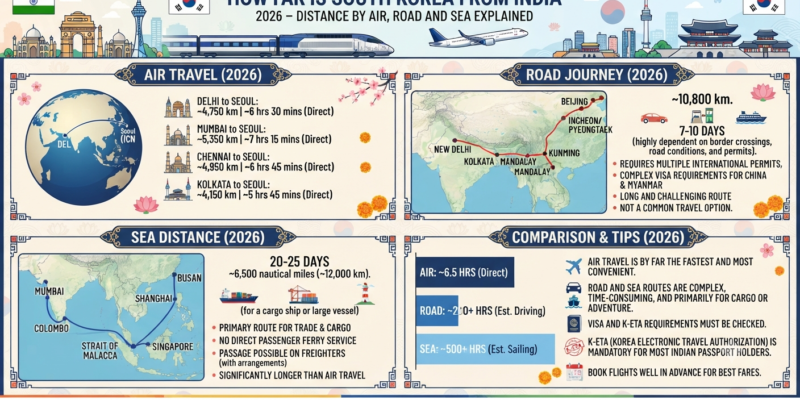
Understanding how far South Korea is from India is one of the first questions that comes to mind when planning travel, studies, or business trips to this East Asian nation. The distance between the two countries is significant, and knowing it helps you plan your flight schedules, transit times, budget, and overall travel itinerary. This detailed guide breaks down the distance from India to South Korea by air, sea, and overland geography, along with flight duration from major Indian cities and everything else you need to know as an Indian traveller.
Geographic Overview of India and South Korea
India is located in South Asia, bordered by the Indian Ocean to the south, the Arabian Sea to the southwest, and the Bay of Bengal to the southeast. It shares land borders with Pakistan, China, Nepal, Bhutan, Bangladesh, and Myanmar.
South Korea, officially known as the Republic of Korea, is located in East Asia on the southern half of the Korean Peninsula. It shares a land border with North Korea to the north and is surrounded by the Yellow Sea to the west and the East Sea (Sea of Japan) to the east. Japan lies to the southeast of South Korea across the Korea Strait.
The two countries sit on different continental subregions of Asia, separated by a vast geographical span that includes parts of Southeast Asia or Central Asia depending on the route taken.
Straight-Line Aerial Distance from India to South Korea
The straight-line distance, also called the crow-flies or aerial distance, from India to South Korea varies depending on which city in India you are measuring from. Here are the approximate straight-line distances from major Indian cities to Seoul, the capital of South Korea:
New Delhi to Seoul: approximately 5,080 kilometres
Mumbai to Seoul: approximately 6,200 kilometres
Hyderabad to Seoul: approximately 5,750 kilometres
Bangalore to Seoul: approximately 5,940 kilometres
Chennai to Seoul: approximately 5,690 kilometres
Kolkata to Seoul: approximately 4,680 kilometres
Ahmedabad to Seoul: approximately 5,900 kilometres
Pune to Seoul: approximately 6,100 kilometres
Among all major Indian cities, Kolkata is geographically the closest to Seoul, South Korea, owing to its northeastern location in India. Delhi follows as the next closest major departure city from a straight-line perspective.
If you are specifically planning travel from Bangalore, you may also find useful information in our detailed guide on Bangalore to South Korea distance and flight time.
Flight Distance and Travel Time from India to South Korea
While the straight-line distance gives a sense of geography, the actual flight path is slightly longer due to air traffic corridors, routing adjustments, and the fact that aircraft do not fly in a perfectly straight line between two points. Here are the approximate flight distances and travel durations from major Indian cities to Seoul Incheon International Airport:
Delhi to Seoul Flight Distance and Duration
Flight distance: approximately 5,600 kilometres
Direct flight time: approximately 7 hours 30 minutes to 8 hours
Airlines like Air India and Korean Air operate direct flights from Indira Gandhi International Airport in Delhi to Seoul Incheon. This is the only direct nonstop route from India to South Korea currently available, making Delhi the most convenient departure city for the quickest journey.
Mumbai to Seoul Flight Duration
Flight distance: approximately 6,700 kilometres via direct or connecting routing
Connecting flight total time: approximately 10 to 14 hours including layover
There are no direct flights from Mumbai to Seoul. Passengers connect through hubs like Singapore, Dubai, Hong Kong, or Bangkok.
Hyderabad to Seoul Flight Duration
Flight distance: approximately 6,200 kilometres via transit routing
Connecting flight total time: approximately 10 to 16 hours depending on the transit hub
Refer to our complete guide on flights from Hyderabad to South Korea for a full breakdown of routes and airlines.
Chennai to Seoul Flight Duration
Flight distance: approximately 6,100 kilometres via transit routing
Connecting flight total time: approximately 10 to 15 hours
Bangalore to Seoul Flight Duration
Flight distance: approximately 6,400 kilometres via transit routing
Connecting flight total time: approximately 11 to 15 hours
Kolkata to Seoul Flight Duration
Flight distance: approximately 5,000 kilometres via transit routing
Connecting flight total time: approximately 8 to 13 hours
Kolkata offers a geographic advantage with shorter straight-line distance, and connecting flights through Bangkok or Singapore can result in faster overall journeys compared to other Indian cities.
Is There a Land Route from India to South Korea?
A direct land route from India to South Korea is not possible for several key geographical reasons:
South Korea is located on a peninsula that is only connected to mainland Asia via North Korea to the north. North Korea maintains one of the most heavily restricted borders in the world, essentially making land passage from South Asia to South Korea impossible for civilian travellers.
Even if overland travel through China and North Korea were theoretically possible, the distance from India to South Korea by land would exceed 7,000 to 8,000 kilometres depending on the route, and the journey would cross through multiple countries with complex entry requirements.
For all practical purposes, the only viable way to travel from India to South Korea is by air.
Sea Distance from India to South Korea
A sea route from India to South Korea is technically possible but is not a practical option for travellers. Commercial passenger shipping between India and South Korea does not operate regularly. Cargo ships make the journey, but travel time would be several weeks.
The approximate sea distance from a major Indian port such as Chennai or Mumbai to Busan, South Korea’s largest port city, is roughly 7,000 to 8,500 nautical miles. Cargo shipping routes typically pass through the Strait of Malacca, past Singapore, and up through the South China Sea before reaching South Korean ports.
For those interested in what South Korea’s port city of Busan is like, it is a vibrant coastal metropolis with beaches, mountains, and a thriving cultural scene.
India to South Korea Time Difference
Another important aspect of understanding how far India is from South Korea relates to the time zone difference. South Korea Standard Time (KST) is UTC plus 9:00, while India Standard Time (IST) is UTC plus 5:30. This means South Korea is 3 hours and 30 minutes ahead of India.
When it is noon in Delhi or Mumbai, it is 3:30 PM in Seoul. This time difference is relevant for scheduling phone calls, business meetings, and coordinating with South Korean universities or employers. For a detailed explanation, see our guide on India to South Korea time difference.
Countries and Regions That Lie Between India and South Korea
When travelling from India to South Korea, depending on your flight route, you pass over several countries and regions:
Via Southeast Asia (Singapore/Bangkok route): The flight path crosses the Bay of Bengal, the Malay Peninsula or Indochina (Thailand, Myanmar, Vietnam), and then northward across the South China Sea toward the Korean Peninsula.
Via the Middle East (Dubai route): The flight heads northwest to Dubai, then arcs eastward across Central and South Asia before reaching East Asia.
Via East Asia (Hong Kong route): The flight crosses South Asia, Southeast Asia, and parts of the South China Sea before arriving at the Korean Peninsula.
The most geographically logical route is through Southeast Asia, as it keeps travel distance shorter than the Middle East option.
What South Korea Looks Like Geographically
For Indian travellers who have not visited South Korea before, the country covers an area of approximately 100,210 square kilometres, making it smaller than the state of Gujarat. Despite its relatively compact size, South Korea is densely populated with over 51 million people. Seoul, the capital, is home to roughly half the country’s population when including the greater metropolitan area.
The country is mostly mountainous, with fertile plains in the west and southwest. The southern and western coasts have numerous islands. South Korea shares a heavily militarised border with North Korea known as the Demilitarised Zone (DMZ). Read more about the North Korea South Korea border to understand the geopolitical context.
How Far Is Incheon Airport from Seoul City Centre
Once you land at Incheon International Airport, which is located on Yeongjong Island off the coast of Incheon city, you still need to travel approximately 50 to 70 kilometres to reach central Seoul depending on your destination. Transport options include:
AREX Express Train: Takes approximately 43 minutes to Seoul Station. This is the fastest and most reliable option.
Airport Limousine Bus: Connects Incheon Airport to various parts of Seoul and takes approximately 60 to 90 minutes depending on traffic.
Taxi: Private taxis and KakaoTaxi are available outside arrivals. Journey time varies based on traffic and can take 60 to 80 minutes.
Private Transfer: Pre-booked airport transfers are convenient for students arriving with heavy luggage.
Understanding the full travel journey from your city in India all the way to your accommodation in Seoul helps in planning a stress-free arrival.
Distance from Specific Indian States to South Korea
Tamil Nadu to South Korea: Chennai, the capital of Tamil Nadu, is approximately 5,690 kilometres from Seoul by air. The South Korea tour package from Chennai is a popular option for travellers from this region.
Telangana to South Korea: Hyderabad, capital of Telangana, is approximately 5,750 kilometres from Seoul. Multiple connecting flights are available through Singapore, Dubai, and Bangkok.
Maharashtra to South Korea: Mumbai, the capital of Maharashtra, sits approximately 6,200 kilometres from Seoul. Connecting routes through Singapore and Dubai are the most popular.
West Bengal to South Korea: Kolkata has the shortest distance advantage among major Indian cities at approximately 4,680 kilometres from Seoul. Connecting flights through Bangkok or Singapore are common from Kolkata.
Why Knowing the Distance Matters for Planning Your South Korea Trip
Understanding the distance from India to South Korea has several practical implications for your travel planning:
Flight Budget Planning: Longer flight distances mean higher fuel surcharges and generally higher base fares. Knowing the approximate distance helps you benchmark whether a quoted fare is reasonable.
Jet Lag Management: A time zone difference of 3.5 hours combined with a long flight means you will likely experience some jet lag upon arrival in Seoul. Planning your first day in Seoul to be light on activities helps you adjust.
Baggage Strategy: Long-haul flights allow for more checked baggage in many cases, but budget airline connections may restrict this. Understanding the journey length helps you decide how to pack.
Visa and Documentation Timing: Knowing you are travelling a significant intercontinental distance means your travel documents need to be in order well in advance. Read our guide on how to get a South Korea visa from India to ensure your paperwork is ready before your travel date.
Summary
South Korea is located approximately 5,000 to 6,200 kilometres from major Indian cities when measured in straight-line aerial distance. The closest major Indian city to Seoul is Kolkata at approximately 4,680 kilometres, while Mumbai is the farthest at approximately 6,200 kilometres. There are no land or sea passenger routes between India and South Korea. The only practical travel option is by air.
Flight times range from approximately 7.5 hours for a direct Delhi to Seoul flight to 16 hours for connecting flights from southern Indian cities. South Korea is 3 hours and 30 minutes ahead of India Standard Time, which is important for coordinating communication and scheduling.
Whether you are planning a holiday, a study program, or a business visit, knowing the distance and travel logistics helps you prepare fully. For more detailed guidance on travelling to South Korea from India, visit Study in South Korea for comprehensive resources tailored to Indian students and travellers.