


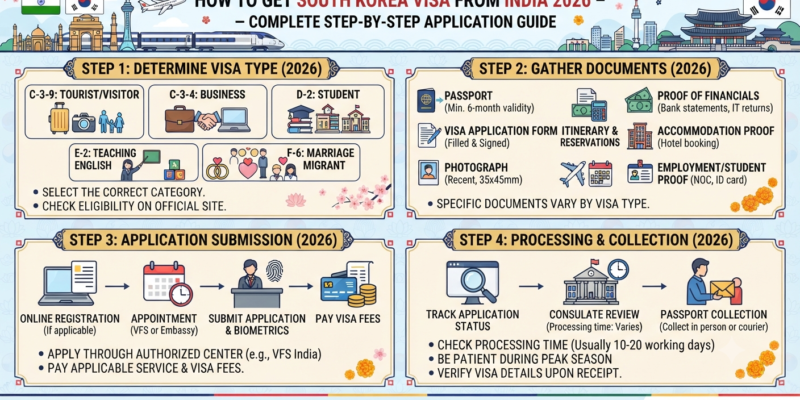
Getting a South Korea visa from India is a structured process that requires careful preparation of documents, timely application, and attention to detail. South Korea is one of Asia’s most sought-after travel and study destinations for Indian nationals, and the Korean Embassy in India processes thousands of visa applications from Indian passport holders every year. This comprehensive guide walks you through every step of the South Korea visa application process from India, covering all major visa categories, required documents, fees, processing timelines, and practical tips to maximise your chances of approval.
Understanding South Korea Visa Requirements for Indian Nationals
Indian passport holders are not eligible for visa-free entry into South Korea. This means you must apply for a visa before travelling to South Korea, regardless of the purpose of your visit. The type of visa you apply for depends on the nature of your trip, whether it is tourism, business, education, or employment.
The Republic of Korea operates a well-organised visa system managed through the Korean Embassy in New Delhi and the Korean Consulate General in Mumbai, Chennai, and Kolkata. In addition, South Korea now offers an electronic visa (e-Visa) system for eligible applicants, which allows online application without visiting the embassy in person.
You can also track your application status online once submitted. For a step-by-step tracking guide, read our article on South Korea visa application tracking for 2026.
Types of South Korea Visas Available for Indian Applicants
Tourist Visa (C-3)
The C-3 short-term tourist visa is the most commonly applied visa by Indian travellers planning leisure trips to South Korea. It allows a stay of up to 90 days and covers general tourism, visiting family, attending cultural events, and short-term business meetings.
Business Visa (C-3-4)
The C-3-4 visa is issued to individuals travelling to South Korea for business purposes such as meetings, conferences, trade fairs, or business negotiations. It falls under the short-term visa category and typically allows a stay of up to 90 days.
Student Visa (D-2)
The D-2 student visa is issued to individuals admitted to accredited universities or higher education institutions in South Korea. It is one of the most important visas for Indian students planning to pursue undergraduate, postgraduate, or doctoral programs. Read our complete breakdown of the South Korea student visa for Indian students for detailed eligibility and application information.
Study Visa (D-4)
The D-4 study visa is for those attending language institutes, vocational training programs, or preparatory courses. If you are planning to attend a Korean language program before joining a university, the D-4 visa is what you will need. Our detailed guide on South Korea study visa 2026 covers this visa type comprehensively.
Work Visa (E Series)
South Korea offers multiple work visa categories depending on your profession. Common categories include E-1 (professors), E-2 (English teachers), E-3 (researchers), E-4 (technology transfer), E-5 (professionals), E-6 (arts and entertainment), and E-7 (specially designated activities). Each category has its own eligibility and documentation requirements.
Electronic Visa (e-Visa)
South Korea’s e-Visa system allows eligible Indian nationals to apply for certain visa categories online through the Korea Hi Korea portal without visiting a Korean diplomatic mission. Currently, the e-Visa is primarily available for the C-3 tourist visa and certain business visa categories. Read our guide on South Korea e-Visa for Indians to see if you qualify for online application.
Where to Apply for a South Korea Visa from India
Indian applicants can submit their South Korea visa applications at the following Korean diplomatic missions:
Embassy of the Republic of Korea – New Delhi Address: 9, Chandragupta Marg, Chanakyapuri, New Delhi 110021 This is the primary mission for applicants from northern, central, and western India.
Consulate General of the Republic of Korea – Mumbai Address: Namit House, 5th Floor, Altamount Road, Mumbai 400026 This consulate serves applicants from Maharashtra, Gujarat, Goa, Madhya Pradesh, Chhattisgarh, and Rajasthan.
Consulate General of the Republic of Korea – Chennai Address: 9th Floor, SIDCO Corporate Building, Chennai 600032 Serves applicants from Tamil Nadu, Kerala, Karnataka, Andhra Pradesh, and Telangana.
Consulate General of the Republic of Korea – Kolkata Address: 6, Ho Chi Minh Sarani, Kolkata 700071 Serves applicants from West Bengal, Odisha, Bihar, Jharkhand, and the northeastern states.
If you are in Hyderabad, you would typically apply at the Chennai Consulate General, as Telangana falls under its jurisdiction.
Documents Required for South Korea Tourist Visa from India
The following documents are required for a standard C-3 tourist visa application. Requirements may vary slightly based on the consulate and specific visa category.
Passport: Valid Indian passport with a minimum of 6 months validity beyond your intended stay in South Korea. Your passport should have at least two blank pages.
Visa Application Form: Completed and signed visa application form available on the official Korea Visa Portal or at the consulate.
Passport-Sized Photographs: Two recent passport-sized colour photographs on a white background taken within the last 6 months. Photo size is typically 3.5 cm x 4.5 cm.
Proof of Financial Means: Bank statements from the last 3 to 6 months showing sufficient funds to support your stay in South Korea. The minimum required balance is generally around INR 1,00,000 to INR 2,00,000 depending on the duration of your visit.
Proof of Employment or Income: A letter from your employer confirming your designation, salary, and approved leave dates. If self-employed, provide business registration documents and income tax returns.
Income Tax Returns: ITR filings from the past 1 to 2 years demonstrating financial stability.
Flight Itinerary: A confirmed or tentative flight booking for entry and exit from South Korea. A travel agent can issue a confirmed itinerary that does not require immediate payment.
Hotel Booking or Accommodation Proof: Confirmed hotel reservations for the duration of your stay, or a letter from a host if staying with family or friends in South Korea.
Travel Insurance: Travel insurance covering medical emergencies and repatriation for the duration of your South Korea stay is recommended and sometimes required.
Cover Letter: A personal cover letter addressed to the Korean Consul briefly explaining the purpose of your visit, intended activities, and your intention to return to India.
Previous Travel History: Copies of visa stamps in your passport from countries like the USA, UK, Australia, Schengen area countries, or Japan can strengthen your application and demonstrate travel history.
Documents Required for South Korea Student Visa from India
Students applying for the D-2 student visa need the following in addition to the standard documents:
Admission Letter: Official letter of admission from an accredited South Korean university or institution confirming your enrollment.
Proof of Scholarship or Financial Sponsorship: Evidence that you have funds or a scholarship to cover tuition and living expenses. This can be a bank statement showing sufficient balance or a scholarship award letter.
Academic Records: High school or undergraduate transcripts, marksheets, and certificates as applicable.
No-Objection Certificate: NOC from your school, college, or current employer (if applicable) confirming you are leaving your current position to study.
TOPIK Score Card (if applicable): Some universities require proof of Korean language proficiency. Check with your institution.
For a complete breakdown of the student visa process, refer to our guide on South Korea study visa requirements for Indian students and parents.
Step-by-Step South Korea Visa Application Process from India
Step 1 – Determine Your Visa Category Identify whether you need a tourist, business, student, or work visa based on your purpose of visit. Applying for the wrong visa category leads to rejection and delays.
Step 2 – Gather All Required Documents Collect all documents listed for your specific visa category. Ensure all bank statements, employment letters, and financial proofs are recent and accurate.
Step 3 – Complete the Visa Application Form Download and fill in the Korea Visa Application Form from the official Korea Visa Portal. Fill in all fields clearly in English or Korean. Do not leave any mandatory fields blank.
Step 4 – Book Your Consulate Appointment Most Korean consulates in India require prior appointment scheduling. Visit the official consulate or embassy website to book your appointment online. Walk-in applications are generally not accepted.
Step 5 – Submit Your Application Visit the Korean consulate or embassy on your scheduled appointment date. Bring all original documents along with self-attested photocopies. Pay the applicable visa fee at the time of submission.
Step 6 – Biometrics (if required) Some visa categories may require fingerprint and photograph capture at the consulate. This is typically done on the same day as your document submission.
Step 7 – Wait for Processing South Korea tourist visa processing typically takes 5 to 7 working days. Student visas and work visas may take 3 to 4 weeks. Do not book non-refundable travel tickets until your visa is approved.
Step 8 – Collect Your Passport Once your visa is approved, you can collect your passport in person at the consulate or have it sent by courier (if the consulate offers this option). Check that the visa details, validity, and number of permitted entries are correct before leaving the consulate.
South Korea Visa Fees for Indian Applicants in 2026
Visa fees for South Korea applications from India are collected in Indian Rupees at the applicable exchange rate at the time of application. Here are the approximate fees:
Single Entry Tourist Visa (C-3): approximately INR 3,500 to INR 4,500
Multiple Entry Tourist Visa (C-3): approximately INR 8,000 to INR 10,000
Student Visa (D-2): approximately INR 6,000 to INR 8,000
Work Visa (E series): varies by category, typically INR 6,000 to INR 10,000
These fees are non-refundable regardless of whether your visa is approved or rejected. Always confirm current fees on the official Korean Embassy or Consulate website before applying, as rates are subject to change.
South Korea Visa Processing Time from India
Standard Tourist Visa (C-3): 5 to 7 working days
Business Visa: 5 to 10 working days
Student Visa (D-2 or D-4): 2 to 4 weeks
Work Visa: 3 to 6 weeks depending on category and documentation completeness
Processing times may be longer during peak travel seasons (spring and autumn) or around Korean national holidays. Always apply well in advance of your planned travel date.
Common Reasons for South Korea Visa Rejection
Understanding why visas get rejected helps you avoid the same mistakes:
Insufficient Financial Proof: If your bank balance is low or inconsistent, the consulate may question your ability to fund your trip. Maintain a healthy bank balance well before applying.
Incomplete Documents: Missing any required document is one of the most common reasons for rejection. Double-check the document checklist for your specific visa category.
Inconsistent Information: Discrepancies between your application form and supporting documents raise red flags.
No Previous Travel History: First-time international travellers with no prior visa history may face additional scrutiny. A strong financial profile and clear travel purpose can offset this.
Vague Travel Purpose: A poorly written cover letter or an itinerary that lacks detail can lead to rejection. Be specific about your plans in South Korea.
Previous Visa Overstay: If you have overstayed a visa in any country, this will negatively impact your South Korea visa application.
Tips to Increase Your South Korea Visa Approval Chances
Maintain a Stable Bank Balance: Keep your savings account balance healthy for at least 3 to 6 months before applying. Sudden large deposits just before the application date can raise suspicion.
Write a Clear and Honest Cover Letter: Your cover letter should clearly state your purpose of visit, planned activities, travel dates, and reasons why you will return to India at the end of your stay.
Show Strong Ties to India: Demonstrating ties to India such as employment, family responsibilities, property ownership, or ongoing education strengthens your application by showing you intend to return.
Provide a Detailed Itinerary: A day-by-day travel plan with hotel bookings, places you plan to visit, and transportation arrangements shows the consulate that your trip is well-planned and genuine.
Submit Original Documents Wherever Possible: Do not rely entirely on photocopies. Originals are more credible and demonstrate you are a genuine applicant.
For additional context on diplomatic procedures, read our guide on the Ministry of Foreign Affairs South Korea and how it manages international visitor policies.
South Korea e-Visa for Indian Nationals
South Korea’s e-Visa system, accessible through the Korea Hi Korea official portal, allows eligible applicants to apply for certain short-term visas online. The system is available for C-3 tourist visas and some business visa types.
Advantages of the e-Visa system include:
No need to visit the consulate in person for eligible visa categories
Online document upload and fee payment
Faster processing in many cases
Ability to track application status online
However, the e-Visa system is not available for all applicants or all visa categories. Students applying for D-2 or D-4 visas and applicants for long-term work visas must apply through the Korean embassy or consulate directly.
After Your Visa Is Approved – What to Do Next
Once your South Korea visa is stamped in your passport, your preparation for travel begins in earnest. Here are some next steps:
Book Your Flights: With your visa in hand, you can proceed to book confirmed flights from your nearest Indian airport to Seoul. Read about India to South Korea flight tickets for Indians to find the best deals.
Arrange Accommodation: Whether you are staying in a hotel, guesthouse, or university dormitory, confirm your accommodation before departure. Our guide on South Korea hotel booking for 2026 covers your options in detail.
Sort Out Currency: Exchange some Indian Rupees for Korean Won before departure or plan to use ATMs at Incheon Airport. Read about the South Korea currency versus Indian Rupee exchange rate to plan your budget.
Understand Korean Culture: Reading about Korean culture, etiquette, and local customs will help you integrate better and show respect for local traditions. Explore our K-Culture section for a rich overview of Korean life.
Summary
Getting a South Korea visa from India in 2026 requires identifying the correct visa type, preparing a thorough documentation package, scheduling an appointment at the correct Korean diplomatic mission, and submitting your application within the required processing timeframe. Tourist visas typically take 5 to 7 working days to process, while student and work visas take longer.
The key to a successful application lies in financial stability, a well-crafted cover letter, complete documentation, and consistency across all submitted materials. For students, having a confirmed university admission letter and scholarship or funding proof significantly strengthens the application.
For more guides on studying, living, and travelling in South Korea as an Indian national, visit Study in South Korea for resources covering every aspect of your Korean journey.