


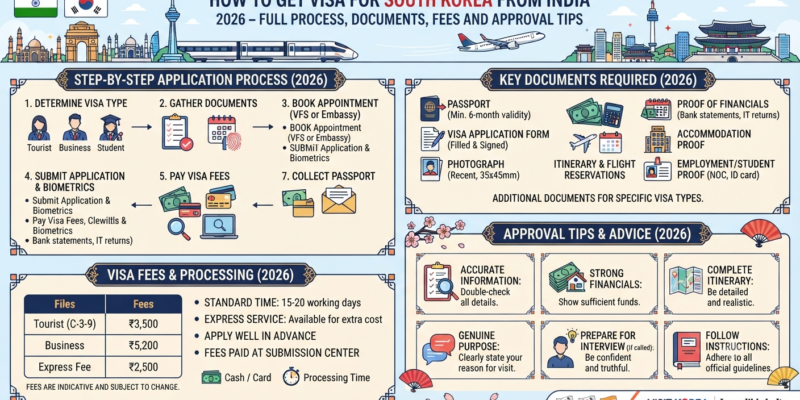
South Korea has emerged as one of the most attractive destinations for Indian travellers, students, and working professionals in recent years. Whether you are drawn by its world-class universities, thriving technology and entertainment industries, stunning natural landscapes, or vibrant urban culture, the first step is securing the right visa. This detailed guide provides a complete roadmap on how to get a visa for South Korea from India in 2026, covering the process from start to finish with expert tips to help you navigate it confidently.
Why South Korea Is a Top Destination for Indian Travellers and Students
South Korea attracts millions of international visitors annually and has a rapidly growing population of Indian students and professionals. Its universities consistently rank among Asia’s best, its cities are safe, modern, and well-connected, and its culture has achieved global recognition through K-pop, K-drama, Korean cuisine, and Korean beauty trends.
From an Indian perspective, South Korea also offers an increasingly supportive environment for international students. The South Korea student visa process has been streamlined over the years, and the Korean government actively recruits international students through scholarship programs like the Global Korea Scholarship (GKS).
Understanding how to get a visa for South Korea from India is therefore an essential skill for anyone planning to make this journey, whether for a two-week holiday or a four-year degree program.
Does India Have a Visa-Free Agreement with South Korea?
No. As of 2026, Indian passport holders do not enjoy visa-free access to South Korea. A valid visa must be obtained before entering South Korea for any purpose, whether tourism, education, business, or employment. There is no visa-on-arrival facility available for Indian nationals at South Korean ports of entry.
India and South Korea do enjoy strong bilateral relations. Read about India and South Korea’s friendship and cooperation to understand the depth of the relationship between both nations across trade, culture, and diplomacy. However, visa liberalisation for Indian nationals is not yet in place.
Overview of South Korea Visa Categories for Indian Nationals
South Korea’s visa system is broadly divided into short-term visas (C series), long-term sojourn visas (D, E, F, H series), and special purpose visas. Here is a quick overview of the categories most relevant to Indian applicants:
C-3 Short-Term General Visa: For tourism, transit, visiting family and friends, attending short-term conferences or cultural events. Stay up to 90 days.
C-3-4 Short-Term Business Visa: For business meetings, negotiations, attending trade fairs, or signing contracts. Stay up to 90 days.
D-2 Academic Student Visa: For students enrolled in degree programs at South Korean universities. This is the primary visa for Indian students studying in South Korea.
D-4 General Training Visa: For language institute students, vocational trainees, and preparatory course students.
E-1 Professor Visa: For individuals invited to teach at South Korean universities.
E-2 Foreign Language Teacher Visa: For individuals contracted to teach a foreign language (primarily English) at South Korean language schools or educational institutions.
E-7 Special Occupation Visa: For professionals in specific designated roles in South Korean companies.
F-4 Overseas Korean Visa: For individuals of Korean descent holding foreign nationality.
H-1 Working Holiday Visa: For eligible young adults who wish to travel and work in South Korea temporarily. India is not yet listed among eligible countries for this visa, so most Indians apply for the C-3 or D-2.
Korean Diplomatic Missions in India – Where to Apply
Your choice of consulate depends on your state of residence in India:
Embassy of the Republic of Korea in New Delhi Jurisdiction: Delhi, Uttar Pradesh, Haryana, Punjab, Himachal Pradesh, Uttarakhand, Jammu and Kashmir, Ladakh, Rajasthan, Madhya Pradesh, Bihar, Chhattisgarh, Jharkhand
Consulate General in Mumbai Jurisdiction: Maharashtra, Gujarat, Goa, Dadra and Nagar Haveli, Daman and Diu
Consulate General in Chennai Jurisdiction: Tamil Nadu, Kerala, Karnataka, Andhra Pradesh, Telangana, Puducherry, Lakshadweep
Consulate General in Kolkata Jurisdiction: West Bengal, Odisha, Assam, Meghalaya, Tripura, Manipur, Nagaland, Mizoram, Arunachal Pradesh, Sikkim, Andaman and Nicobar Islands
Always verify the current jurisdictional boundaries on the official Korean Embassy or Consulate website before scheduling your appointment, as these may be updated periodically.
Step-by-Step Process to Get a Visa for South Korea from India
Step 1 – Identify the Correct Visa Type
Begin by clearly defining the purpose of your visit. Are you going for a holiday? Apply for C-3. Are you attending a university? Apply for D-2. Are you meeting business partners? Apply for C-3-4. Choosing the wrong visa category is a primary reason for rejection.
Step 2 – Visit the Official Korean Visa Portal
Go to the official Korea Visa Portal (Hi Korea) at hikorea.go.kr. This portal provides the latest information on visa categories, required documents, and application forms. It also allows you to apply for e-Visas where eligible.
Step 3 – Download and Complete the Application Form
Download the Korean Visa Application Form from the portal or collect it from your local consulate. Fill in all fields in capital letters in English or Korean. Pay particular attention to:
Personal information matching exactly as it appears on your passport
Employment and educational details
Travel history details for the past 5 years
Accommodation address in South Korea
Contact details of persons you will be visiting (if applicable)
Step 4 – Prepare Your Document Package
Compile all required documents based on your visa category. Do not leave any document out. Incomplete applications are returned and may delay your travel plans significantly. Use the document checklist provided in this guide as a reference.
Step 5 – Schedule Your Consulate Appointment
Book your appointment through the official appointment scheduling system for your respective consulate. Appointment slots at Korean consulates in India can fill up quickly, especially during spring and autumn travel seasons. Book your slot at least 3 to 4 weeks before your intended travel date.
Step 6 – Attend Your Appointment
On your appointment day, arrive at the consulate 15 minutes before your scheduled time. Bring:
All original documents plus self-attested photocopies
Your appointment confirmation email or print
Valid Indian passport
Visa fee payment (cash or demand draft as specified by the consulate)
Step 7 – Pay the Visa Fee
Visa fees are to be paid at the time of application submission. Confirm the accepted payment mode with the consulate before your appointment, as some accept only demand drafts and others accept cash.
Step 8 – Await Processing and Collect Your Visa
After submission, the consulate will process your application. Standard tourist visa processing takes 5 to 7 working days. Student and work visas take longer. Once approved, collect your passport in person or via courier (if offered by the consulate). Verify all visa details are correct upon receipt.
Detailed Document Checklist for C-3 Tourist Visa
Valid Passport: Minimum 6 months validity remaining beyond your South Korea travel dates. At least 2 blank pages.
Completed Visa Application Form: Signed and dated by the applicant. For minors, signed by a parent or guardian.
Passport-Sized Photographs: Two colour photographs on a white background, 3.5 cm x 4.5 cm. Photographs must be taken within the past 6 months. No spectacles, head coverings (unless for religious reasons), or expressions.
Personal Bank Statements: Statements from your primary savings or current account covering the last 3 to 6 months. Statements must show your name, account number, and transaction history.
Proof of Employment: Employment certificate on company letterhead stating your designation, length of service, monthly salary, and approved leave period. Alternatively, for government employees, a no-objection certificate from the department.
Income Tax Returns: Last 1 to 2 years of ITR acknowledgement showing your annual income.
Flight Booking: Confirmed or tentative round-trip flight booking showing your departure and return dates. A travel agent-issued itinerary is acceptable even without full payment at this stage.
Hotel or Accommodation Proof: Printout of hotel reservations for all nights of your stay. If staying with contacts in South Korea, provide their invitation letter along with a copy of their residence permit or Korean identity documents.
Detailed Travel Itinerary: A planned day-by-day itinerary for your South Korea trip. Include places to visit, day trips planned, and cultural or leisure activities.
Travel Insurance: Valid travel insurance policy covering your entire stay in South Korea for a minimum sum of USD 50,000 for medical emergencies and repatriation.
Cover Letter: Addressed to the Korean Consul, explaining your purpose of visit, planned activities, and your intent to return to India before your visa expires.
Previous Visa Copies: Copies of any valid or recently expired visas to the USA, UK, Schengen countries, Japan, or Australia if applicable. Previous international travel history strengthens your profile.
Detailed Document Checklist for D-2 Student Visa
In addition to the documents listed for the tourist visa above, student visa applicants need:
Admission Letter from a Korean University: Official acceptance letter from an accredited Korean higher education institution detailing your program, start date, and student ID.
Certificate of Standard Admission: Issued by the Korean university, this document confirms your formal enrollment status.
Financial Sponsorship Documents: Bank statements showing minimum balance as required by your university (typically KRW 9,000,000 to KRW 20,000,000 equivalent). Scholarship award letters from Korean institutions or the Korean government can substitute or supplement personal financial documents.
Academic Transcripts and Certificates: Copies of your 10th, 12th, and undergraduate mark sheets and certificates as applicable to your level of admission.
TOPIK Score Card (if required): Test of Proficiency in Korean score, if your university program is conducted in Korean.
Health Certificate: Some universities require a basic medical fitness certificate.
For a comprehensive breakdown of the Korean student visa, see our article on South Korea study visa requirements 2026.
South Korea Visa Fee Structure for Indian Applicants in 2026
Visa fees are payable at the time of application. The following are approximate fees in Indian Rupees based on current USD to INR conversion rates:
C-3 Single Entry (90 days or less): INR 3,500 to INR 4,500
C-3 Multiple Entry (up to 1 year): INR 7,000 to INR 9,000
C-3 Multiple Entry (up to 5 years): INR 14,000 to INR 16,000
D-2 Student Visa (single entry): INR 6,000 to INR 8,000
D-2 Student Visa (multiple entry): INR 9,000 to INR 12,000
E-Series Work Visas: INR 6,000 to INR 12,000 depending on category
All fees are non-refundable. Even if your visa is rejected, the fee will not be returned. This makes thorough document preparation all the more important before submission.
South Korea e-Visa Application Process for Indians
The South Korea e-Visa allows eligible Indian applicants to apply for short-term visas online without visiting a consulate. Here is how the e-Visa process works:
Visit the Official e-Visa Portal: Go to evisa.go.kr, the official Korean e-Visa portal, to begin your application.
Register and Create an Account: Create a user account using your email address. Verify your account via the email confirmation link.
Select Your Visa Type: Choose the visa type appropriate for your visit from the available e-Visa categories.
Fill in the Online Application Form: Complete the application form with personal, passport, travel, and financial details. Upload a digital passport-sized photograph.
Upload Required Documents: Scan and upload all required supporting documents in the specified file formats and sizes.
Pay the e-Visa Fee Online: Pay the applicable fee using a credit card or online payment gateway accepted on the portal.
Submit and Wait: After submission, you will receive an application reference number. Processing time for e-Visas is typically 3 to 5 working days.
Download and Print Your e-Visa: Once approved, log in to the portal to download and print your e-Visa. You must carry a printed copy to present at South Korean immigration along with your passport.
For a detailed walkthrough of the online process, read our full article on South Korea e-Visa for Indians 2026.
Common Reasons Visa Applications for South Korea Are Rejected
Lack of Financial Proof: Bank statements that do not show adequate funds or show irregular deposits just before the application date are a red flag.
Employment Instability: Frequent job changes or a recent resignation without a new job may suggest you are unlikely to return to India.
Weak Cover Letter: An unconvincing or vague cover letter fails to explain the genuine purpose of visit.
Overstay History: Any previous overstay on visas in any country, including India, significantly impacts your South Korea visa prospects.
Incomplete Documents: Leaving out required documents is one of the most easily avoidable reasons for rejection.
Discrepant Information: Differences between what is stated in the application form and what is shown in supporting documents lead to automatic suspicion.
No Ties to India: If the consulate believes you may not return to India, they may reject your application. Demonstrating clear ties such as employment, family, property, or ongoing education in India is essential.
Travelling to South Korea After Getting Your Visa
Once your South Korea visa is in hand, your next steps involve booking flights, arranging accommodation, and preparing for arrival. Here is a quick roadmap:
Book Your Flights: Check options for flights connecting India to South Korea. Read our guide on India to South Korea flight ticket options and prices.
Understand the Cost of Living: Before departure, familiarise yourself with monthly living costs in South Korea for international students and expats.
Currency Planning: Know the current Korean Won to Indian Rupee conversion rate and plan your foreign exchange accordingly. Read our article on South Korea and India currency exchange rates.
Learn Basic Korean Phrases: While English is widely spoken in Seoul, knowing a few Korean words will go a long way in daily life. Explore our K-Manners section for cultural and language etiquette.
Set Up Your Student or Tourist Essentials: Students should know about Alien Registration Cards (ARC), SIM cards, bank account setup, and campus registration procedures upon arrival.
South Korea Visa Renewal and Extension from India
If you are already in South Korea and wish to extend your stay, visa extensions must be processed at the local Immigration Office (Hiiminwon) in South Korea. You cannot extend your South Korea visa from India.
For student visa holders, your university’s international student office will typically guide you through the visa renewal process at the end of each academic year.
Tourists who wish to stay longer than permitted on their initial visa must exit South Korea and reapply at the Korean Consulate in India or another country where a Korean diplomatic mission is located.
Frequently Asked Questions About Getting a South Korea Visa from India
How long does it take to get a South Korea tourist visa from India?
Standard processing time is 5 to 7 working days from the date of application submission. Allow extra time during busy travel seasons.
Can I apply for a South Korea visa without a confirmed flight booking?
A tentative flight itinerary issued by a travel agent is acceptable for application purposes. You do not need a fully paid ticket at the time of application.
Is a bank balance of INR 1 lakh sufficient for a South Korea tourist visa?
A balance of INR 1,00,000 to INR 2,00,000 is generally considered the minimum for a short trip. For longer stays, a higher balance is expected.
Can I apply for a multiple-entry South Korea visa on my first application?
Yes, you can apply for a multiple-entry visa on your first application, though approval is more likely if you have prior travel history and a strong financial profile.
Is South Korea safe for Indian travellers?
South Korea is one of the safest countries in the world for tourists and international students. Read our guide on life in South Korea for Indians for a detailed look at safety, daily life, and community.
Summary
Getting a visa for South Korea from India in 2026 is a manageable process when approached with preparation and attention to detail. The key steps are identifying the right visa type, compiling a complete and accurate document package, scheduling your appointment at the correct consulate, submitting your application on time, and waiting for processing within the standard timeline.
Maintaining a strong financial profile, a genuine and clearly explained travel purpose, and solid ties to India are the pillars of a successful South Korea visa application. For students, having a confirmed admission letter from a Korean university and adequate financial proof are equally critical.
South Korea offers an extraordinary experience for Indian visitors and students alike, from its cutting-edge cities and serene countryside to its rich cultural heritage and globally admired entertainment industry. Start your journey on the right foot by getting your visa right the first time.
For all your South Korea travel, education, and visa needs, visit Study in South Korea – your trusted guide for everything Korean from an Indian perspective.