


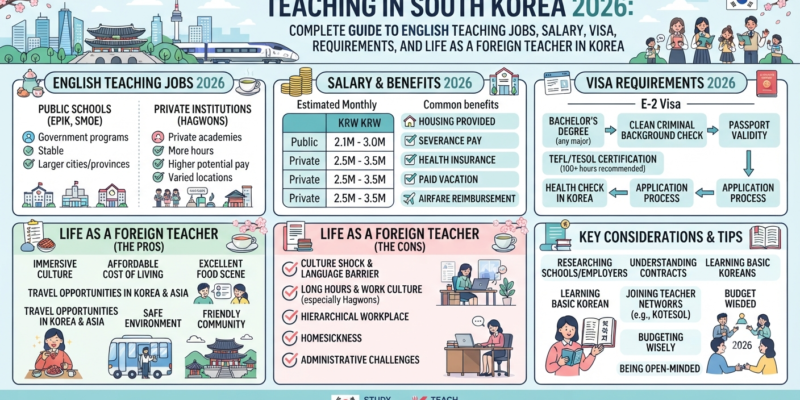
Teaching in South Korea has long been one of the most popular career paths for English-speaking graduates from around the world. South Korea’s strong emphasis on English education, competitive teacher salaries, affordable living costs, and the cultural richness of Korean life have made it a top destination for those seeking international teaching careers. Whether you are a fresh graduate looking for your first job abroad, an experienced teacher seeking better opportunities, or an Indian professional exploring work options in East Asia, this guide covers everything you need to know about teaching in South Korea in 2026.
Why South Korea Is One of the Best Countries for English Teaching
South Korea’s demand for English language education is deeply embedded in its culture and economy. English proficiency is viewed as a critical skill for professional advancement, university admission, and participation in the global economy. This cultural priority translates into consistent, well-funded demand for native and proficient English speaking teachers at every level from kindergarten to university.
The country offers teachers a combination of financial security and quality of life that is difficult to match. Salaries are competitive by Asian standards, free accommodation is typically included in contract packages, flight reimbursements are standard, and the cost of daily life in Korea is lower than in equivalent Western cities. This combination allows teachers to live comfortably, save money, travel, and experience one of the world’s most technologically advanced and culturally vibrant societies.
For Indian professionals interested in jobs in Korea for Indians, teaching represents one of the most accessible pathways into the Korean job market, particularly for those who hold recognized bachelor’s degrees and meet the English proficiency standards required by Korean immigration.
Types of Teaching Jobs in South Korea
Understanding the different categories of teaching positions in South Korea is essential before beginning an application. Each type of position has its own advantages, working conditions, salary ranges, and requirements.
EPIK: English Program in Korea
The English Program in Korea, commonly known as EPIK, is the South Korean government’s official program for placing foreign English teachers in public schools. Run by the Ministry of Education, EPIK places teachers in elementary, middle, and high schools across the country, including in both urban centers and rural regions.
EPIK is widely regarded as one of the most stable and well-supported teaching programs in Asia. Teachers receive consistent salaries, comprehensive benefits packages, professional training, and the security of government employment. EPIK teachers typically co-teach with Korean English teachers, which provides a collaborative and supportive classroom environment.
The program recruits in two main rounds each year: one for the fall semester beginning in August or September, and one for the spring semester beginning in February or March. Application processes open several months before the placement date.
Hagwon: Private English Academies
Hagwons are privately run after-school tutoring academies that form one of the largest sectors of English education in South Korea. They operate outside regular school hours, typically from mid-afternoon to late evening, catering to students who supplement their daytime school education with additional private instruction.
Hagwon teaching positions are the most numerous teaching jobs in South Korea and can be found in every city and town across the country. They offer higher starting salaries in some cases compared to EPIK, but working conditions and management quality vary significantly between individual schools.
The reputation of a specific hagwon before signing a contract is critically important. Prospective teachers should research the school thoroughly, speak with former or current teachers, and verify the school’s business registration and payment history before committing.
International Schools
International schools in South Korea primarily serve the children of expatriate families and Korean families seeking an internationally recognized curriculum. These schools typically follow American, British, Canadian, or International Baccalaureate (IB) curricula and require teachers with recognized teaching certifications from their home countries.
Salaries at international schools are generally higher than at EPIK or hagwons, and many schools offer comprehensive benefit packages including housing allowances, health insurance, professional development funding, and retirement contributions. However, the hiring requirements are more stringent, typically requiring a state or nationally recognized teaching license in addition to a bachelor’s degree.
University Teaching Positions
University-level English teaching positions are available at South Korean universities and are generally the most prestigious and academically oriented English teaching jobs in the country. These positions may involve teaching English conversation, academic writing, or subject-specific courses in English.
University positions typically require a master’s degree at minimum, and many prefer candidates with doctoral qualifications and prior higher education teaching experience. Benefits often include lower contact hours, academic freedom, research opportunities, and longer vacation periods compared to school-level positions.
Private Tutoring
Private one-on-one tutoring is a significant component of English education in South Korea, though it operates in a somewhat grey area legally depending on the teacher’s visa status. Teachers on E-2 visas are technically restricted from undertaking tutoring work outside their registered employer. However, private tutoring is widespread in practice and many teachers engage in it informally.
Teaching in South Korea Salary Guide 2026
Salary is one of the primary motivators for teachers considering South Korea, and compensation packages across all sectors are generally competitive by international standards.
EPIK Salary Range
EPIK salaries in 2026 range from approximately 1.8 million Korean Won to 2.6 million Korean Won per month, depending on the teacher’s qualifications and years of teaching experience. Entry-level teachers with a bachelor’s degree typically start at 1.8 to 2.0 million Won monthly. Teachers with a master’s degree or significant prior teaching experience receive higher placement within the salary band.
In addition to the base salary, EPIK provides free furnished housing or a housing allowance, a settlement allowance upon arrival, round-trip airfare reimbursement, 18 to 20 days of paid vacation, and a completion bonus equivalent to one month’s salary upon successful contract completion.
Hagwon Salary Range
Hagwon salaries vary more widely than EPIK salaries due to the private and unregulated nature of the sector. Most hagwon contracts offer salaries between 2.0 million and 2.8 million Won monthly, with some premium hagwons in Seoul or Busan offering up to 3.2 million Won for experienced teachers.
Similar to EPIK, hagwons typically provide free housing, airfare reimbursement, health insurance, and a severance payment equivalent to one month’s salary for each year of service.
International School Salary Range
International school salaries in South Korea range considerably depending on the school’s caliber and the teacher’s experience. Entry-level positions typically offer between 2.5 million and 3.5 million Won monthly, while experienced teachers with management responsibilities may earn 4 million Won or more. Top-tier international schools like Seoul Foreign School or Korea International School offer comprehensive packages that can be equivalent to or exceed salaries offered in some Western countries when factoring in free housing and benefits.
University Position Salary Range
University English teaching positions typically offer salaries between 2.2 million and 3.5 million Won monthly, with the variation reflecting the institution’s prestige, the teacher’s qualifications, and the specific role. The lower contact hours and longer vacation periods are often valued as much as the salary itself by teachers who prefer an academic lifestyle.
Qualifications Required to Teach in South Korea
The requirements for obtaining an E-2 teaching visa in South Korea are set by the Korean government and apply uniformly across all teaching positions.
Nationality Requirements
The E-2 visa for English teaching is currently restricted to citizens of seven countries: the United States of America, the United Kingdom, Canada, Australia, New Zealand, Ireland, and South Africa. This requirement is based on English being a recognized official or native language in these countries.
Citizens of other countries, including India, are not eligible for the standard E-2 English teaching visa, though they may be eligible for other work visa categories or teaching positions that do not fall under the E-2 classification.
Educational Requirement
All E-2 visa applicants must hold a minimum of a bachelor’s degree from an accredited university. The field of study does not need to be in education or English, though degrees in linguistics, English literature, education, or TESOL are advantageous.
Background Check Requirement
A criminal background check from the applicant’s home country is mandatory for all E-2 visa applications. The check must confirm a clean record with no criminal convictions. Any criminal history will typically result in visa denial.
Health and Medical Requirements
Applicants must undergo a medical examination either in their home country before arrival or at a designated medical facility in South Korea after arrival. This examination tests for communicable diseases and confirms general fitness to work.
TEFL, TESOL, or CELTA Certification
While not always legally required for the E-2 visa, a recognized English teaching certification such as TEFL (Teaching English as a Foreign Language), TESOL (Teaching English to Speakers of Other Languages), or CELTA (Certificate in English Language Teaching to Adults) is strongly recommended. Many employers, particularly quality hagwons and EPIK itself, prefer or require such certification. Having a recognized certificate significantly improves job placement prospects and salary negotiation outcomes.
Can Indian Nationals Teach English in South Korea
This is a question that many Indian professionals and graduates ask, and the answer requires nuance.
Indian citizens are not eligible for the E-2 English teaching visa because India is not on the list of English-native countries recognized by South Korean immigration policy. However, this does not mean Indian nationals cannot work as teachers in South Korea.
Indians with relevant qualifications can apply for other teaching-related visa categories. If teaching subjects other than English such as mathematics, science, computer science, or social sciences at international schools or universities, an E-7 specialist employment visa may be applicable. Indian professionals with master’s or doctoral degrees in education or specific subject areas should explore E-7 visa eligibility with the support of a Korean immigration attorney or through the Korean Embassy in their home country.
Additionally, Indian students who complete their degrees at universities in South Korea and then pursue postgraduate education may find expanded work opportunities, including teaching assistant roles at Korean universities, that open pathways into the academic job market.
For Indian nationals who want to explore all available jobs in South Korea, teaching is one pathway among many, and understanding visa eligibility early in the planning process saves significant time and effort.
The E-2 Visa Application Process for Foreign English Teachers
The E-2 visa application process is well-documented and, when followed correctly, is reasonably straightforward. The process typically begins with securing a job offer and then applying for the visa through the Korean Embassy or Consulate in the teacher’s home country.
Required documents for the E-2 visa application include an original copy of the bachelor’s degree certificate, official university transcripts, a criminal background check apostilled by the relevant government authority, a completed visa application form with passport photos, the signed employment contract from the Korean employer, and the employer’s business registration certificate.
Processing times vary by country and by Korean consulate, but the E-2 visa typically takes between four and eight weeks from complete document submission to approval. Teachers should not make irreversible plans such as ending rental agreements or booking one-way flights until visa approval has been confirmed.
Life as a Foreign English Teacher in South Korea
Understanding what daily life looks like as a foreign teacher in South Korea helps prospective teachers set realistic expectations and prepare more effectively.
Typical Working Hours and Schedule
EPIK teachers typically work regular school hours from around 8:30 AM to 4:30 PM Monday through Friday, with additional time for lesson planning and administrative tasks. Hagwon teachers often work afternoon to evening schedules, typically from 1 PM or 2 PM until 9 PM or 10 PM, Monday through Friday, with some hagwons also operating on Saturdays.
University teachers typically have far fewer contact hours, often 12 to 15 teaching hours per week, with the remainder of their contracted time available for research, office hours, and course preparation.
Housing Provided to Teachers
Most teaching contracts in South Korea include free furnished housing as a core benefit. For EPIK teachers, accommodation is provided by the school or education office. For hagwon teachers, the school typically provides an officetel (a studio apartment unit) close to the workplace.
The quality of provided housing varies. Most accommodations are small studio-style apartments that are functional and sufficient for a single person. Teachers who want more space or prefer to choose their own accommodation can often negotiate a housing allowance in lieu of school-provided housing, which allows them to rent independently.
Healthcare for Foreign Teachers
Foreign teachers employed in South Korea are enrolled in the Korean National Health Insurance Service (NHIS) as part of their employment. Both the employer and employee contribute to this insurance, which covers a wide range of medical services at a subsidized rate.
South Korea’s healthcare infrastructure is among the best in Asia, and accessing quality medical care is easy, affordable, and generally a positive experience for foreign residents. The life in South Korea guide provides a comprehensive overview of healthcare, transport, social life, and day-to-day logistics for those relocating to Korea.
Professional Development and Career Growth for Teachers in South Korea
Teaching in South Korea is not merely a gap year experience for many who choose it. A significant number of teachers remain in the country for multiple contract cycles and build substantial professional careers in Korean education.
EPIK provides mandatory orientation training for all new teachers and offers professional development workshops throughout the academic year. Teachers who remain with the program for multiple contracts develop expertise in Korean classroom culture, bilingual co-teaching methods, and curriculum design that is highly valued in international education circles.
Experienced teachers who transition from hagwon or EPIK positions to international school or university roles find that their Korean teaching experience is viewed positively by employers who value candidates who can adapt to diverse educational cultures.
Some teachers use their time in Korea to pursue further academic qualifications, taking online master’s degrees or DELTA certifications while working. The relatively low cost of living and included housing make it financially feasible to study part-time while employed full-time.
Cultural Adaptation for Foreign Teachers
Adapting to Korean workplace culture is one of the most significant adjustments foreign teachers experience. Korean professional culture places high value on hierarchy, seniority, group harmony, and indirect communication. Understanding these cultural dynamics helps teachers build positive relationships with Korean colleagues and management.
Seniority is respected in Korean workplaces, and teachers who show deference to senior colleagues while maintaining their professional expertise tend to integrate most successfully. Being punctual, well-prepared for lessons, and willing to participate in school social events such as staff dinners (hoesik) demonstrates commitment and cultural awareness.
Korean students are generally well-disciplined and academically motivated, particularly in public schools. However, student enthusiasm for English speaking practice can vary widely, and the most successful foreign teachers find creative, engaging methods to build student confidence in spoken English.
Learning basic Korean language phrases is strongly encouraged. While many Koreans in major cities speak some English, making an effort to communicate in Korean demonstrates respect and significantly improves daily life interactions outside the classroom. Even a few hundred Korean words and the ability to read Hangul (the Korean alphabet) opens up a vastly richer experience of living in Korea.
Financial Planning for Teachers: Saving Money in South Korea
One of the most frequently cited advantages of teaching in South Korea is the ability to save a significant portion of income. With housing provided, healthcare subsidized, and daily expenses relatively low compared to Western countries, a disciplined teacher can save between 800,000 and 1.5 million Korean Won per month after covering all living expenses.
Setting up a Korean bank account is the first financial task upon arrival. Most employers require a Korean bank account for salary payment. Major Korean banks including Kookmin (KB), Shinhan, Woori, and KEB Hana all have English-language support for foreign customers and offer international wire transfer services for sending money home.
Understanding the Korean Won to Indian Rupee exchange rate is relevant for Indian nationals working in Korea who want to remit earnings to family in India. Wire transfers from Korean banks to Indian accounts are straightforward and typically processed within one to three business days.
Teaching in South Korea vs Teaching in Other Asian Countries
South Korea is frequently compared to Japan, China, Taiwan, and Thailand as English teaching destinations. Each country has distinct advantages and disadvantages, and the right choice depends on individual priorities.
Korea generally offers higher salaries than most Southeast Asian teaching destinations and comparable or better benefits than Japan, where the JET Programme is the main government teaching initiative. Korea’s urban infrastructure, internet connectivity, and healthcare quality are superior to most other Asian teaching destinations.
The primary advantage Japan has over Korea for some teachers is language and cultural familiarity. For others, the fact that Korea has a smaller foreign teacher community can feel more immersive and authentic.
China offers high salaries at premium international schools but the quality of experience varies enormously by school and city, and the regulatory environment has become more complex for foreign teachers in recent years. South Korea’s stable legal and employment environment is a consistent advantage in comparison.
How to Find and Apply for Teaching Jobs in South Korea
The most reliable resources for finding English teaching positions in South Korea include official government portals, reputable online job boards, and recruitment agencies that specialize in Korean teaching placements.
Official EPIK applications are submitted through the EPIK website directly. The application process involves submitting a resume, a cover letter, a self-introduction video, copies of credentials, and reference letters. Shortlisted candidates are then interviewed before receiving placement offers.
For hagwon and private school positions, websites including Dave’s ESL Cafe, Teach Away, EPIK application portal, and the KOTESOL (Korea Teachers of English to Speakers of Other Languages) community forums are widely used. Working through a reputable recruiter can simplify the process but teachers should verify that any recruiter they use does not charge a fee to the teacher, as legitimate recruiters are compensated by the hiring school.
For those already in South Korea on student visas completing postgraduate studies, the student life resources at Korean universities often include career counseling services that can assist with identifying appropriate teaching or education-sector employment opportunities upon graduation.
Conclusion
Teaching in South Korea represents one of the most rewarding and financially viable pathways for qualified English-speaking graduates to build an international career. The combination of strong salaries, generous benefits, rich cultural immersion, and a stable professional environment makes Korea stand out among English teaching destinations worldwide.
For eligible candidates from English-speaking countries, the path is well-defined and well-supported. For Indian nationals and others from non-E-2 eligible countries, the route requires more research and creative application of alternative visa categories, but meaningful opportunities do exist for those with the right qualifications and determination.
Whatever your background or career stage, South Korea offers a teaching environment that combines professional growth with personal enrichment in ways that few other destinations can match.
For complete information on studying, working, and building a career in South Korea, visit Study in South Korea your comprehensive resource for navigating every aspect of Korean academic and professional life.