


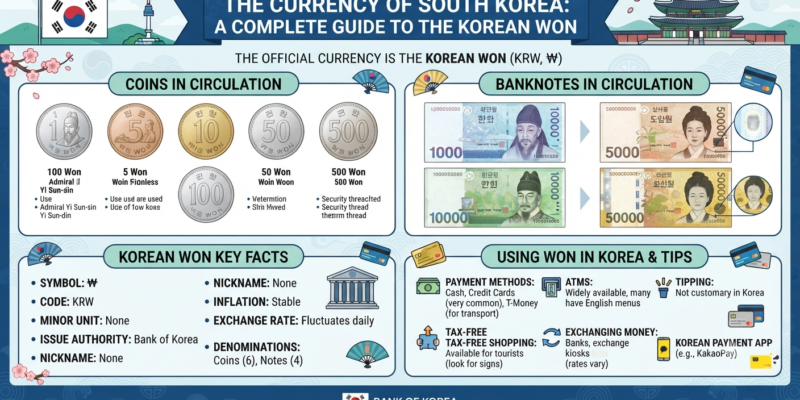
South Korea is one of the most visited and studied destinations for Indians today, and understanding its money system is one of the first things every traveler, student, or working professional should know before landing in the country. The currency of South Korea is called the Korean Won, and it plays a central role in how prices, salaries, tuition fees, and daily expenses work across the nation.
This guide breaks down everything about the Korean Won, from its history and symbol to how it compares with the Indian Rupee, so you can plan your trip, studies, or work life in Korea with full confidence.
What Is the Currency of South Korea Called
The official currency of South Korea is the Korean Won, abbreviated as KRW. It is issued and regulated by the Bank of Korea, the country’s central bank located in Seoul. The Won has been the official currency of the Republic of Korea since 1962, replacing the older Hwan currency that was used after the Korean War.
Unlike currencies such as the US Dollar or the Euro, the Korean Won does not use decimal subunits in everyday transactions. While technically the Won is divided into smaller units called jeon, these are rarely used in modern commerce and appear mostly in banking and foreign exchange calculations. If you want to understand the finer details of the currency code, symbol, and structure, this detailed explainer on the Korean Won symbol and currency code covers everything from denominations to design.
The Symbol and Notation of the Korean Won
The Korean Won is represented by the symbol ₩, and its ISO 4217 currency code is KRW. When you see prices written in Korea, they are usually shown with the symbol before the number, such as ₩10,000. Because the Won does not use decimals in daily use, prices are almost always shown as whole numbers, which can look unusually large compared to Rupee or Dollar figures.
This is an important detail for first time visitors, since seeing a price tag like ₩50,000 for a meal can initially feel alarming until you realize the actual value converts to a much smaller amount in Indian Rupees.
History of the Korean Currency
Korea’s currency system has evolved through several stages over the last century. Before the modern Won, Korea used various forms of currency during the Japanese colonial period and the years following liberation. The current Won was introduced in 1962 as part of South Korea’s broader economic reform efforts, and it has remained the national currency ever since.
Over the following decades, as South Korea transformed from a war affected economy into one of the world’s leading industrial and technology powers, the Won also grew into one of Asia’s most actively traded currencies. Today, it is used not only within the country but is also actively traded in global foreign exchange markets due to Korea’s strong trade relationships with countries around the world.
Korean Won Banknotes and Coins
The Bank of Korea issues both banknotes and coins for daily circulation. The commonly used banknotes include denominations of 1,000, 5,000, 10,000, and 50,000 Won, each featuring important historical figures and cultural symbols of Korea. The coins are issued in smaller denominations such as 10, 50, 100, and 500 Won, and are mainly used for smaller purchases like transportation fares, vending machines, and convenience store items.
Each note carries images that reflect Korea’s rich history, including scholars, scientists, and artists who shaped the nation’s cultural and intellectual heritage. These design choices make Korean currency not just a medium of exchange but also a small window into the country’s national identity.
Korean Won to Indian Rupee Exchange Rate
For Indian travelers, students, and working professionals, one of the most searched questions is how the Korean Won compares to the Indian Rupee. Exchange rates fluctuate daily based on global market conditions, but generally, 1 Indian Rupee equals a certain amount of Korean Won, and understanding this ratio helps in budgeting for daily expenses, tuition, and travel costs.
If you want an in depth breakdown of the current exchange rate along with historical trends and practical conversion tips, this resource on currency exchange between Korea and India provides updated figures and useful examples for everyday budgeting.
It is also worth checking how a single unit of Indian currency translates into Won, especially for students trying to estimate monthly living costs. This guide on converting Indian Rupees into Korean currency walks through practical scenarios that make the numbers easier to understand.
Why Understanding the Won Matters for Students and Travelers
If you are planning to study in Korea, work there, or simply visit as a tourist, understanding how the Won functions in daily life is essential. Prices for food, transportation, accommodation, and shopping are all quoted in Won, and misjudging the conversion can lead to overspending or budgeting mistakes.
For students specifically, tuition fees, hostel costs, and monthly living expenses are typically calculated in Won, so having a clear sense of the currency helps with financial planning well before departure. Many students preparing for their move also look into the broader cost of living in South Korea per month to understand how far their money will stretch once they arrive.
Similarly, professionals who are moving to Korea for employment should be aware of how salaries are structured in Won. This is closely tied to understanding the minimum wage and monthly income standards in South Korea, which gives a realistic picture of what to expect from a paycheck.
How to Exchange Currency Before and After Arriving in Korea
There are multiple ways to convert Indian Rupees into Korean Won, both before departure and after arrival. Indian travelers can exchange currency at authorized forex counters in India, at Incheon International Airport upon arrival, or at licensed money changers across major Korean cities like Seoul and Busan.
Banks in Korea also allow foreign visitors to open accounts and exchange currency, although the process can require documentation such as a passport, visa, and sometimes an Alien Registration Card for long term residents. Many students and workers eventually rely on Korean banking apps and cards once they are settled, since carrying large amounts of cash is not always practical or safe.
It is generally advisable to carry a modest amount of Won in cash for immediate needs upon arrival, such as transportation from the airport, while relying on cards or digital payment methods for larger expenses later.
Digital Payments and Cashless Culture in Korea
South Korea is widely known for its advanced digital infrastructure, and this extends strongly into its payment systems. Contactless cards, mobile payment apps, and QR code based transactions are extremely common, even for small purchases. Many stores, restaurants, and transportation systems in Korea are optimized for card and mobile payments, sometimes more than cash.
This is useful information for travelers and students to understand upfront, since relying entirely on cash may not always be the most convenient option once you are living in a country as digitally advanced as Korea.
Money Tips for Indian Students and Travelers
When planning your budget around the currency of South Korea, a few practical habits can help you manage your finances more efficiently. First, always track the daily exchange rate rather than relying on outdated figures, since currency values shift regularly due to global market movements.
Second, plan larger expenses such as tuition, accommodation deposits, or flight bookings using the most current conversion values available. If you are booking flights, understanding the plane ticket prices from India to Seoul in advance can help you factor travel costs into your overall currency planning.
Third, if you are relocating for a longer period, whether for study or work, it helps to understand the broader financial landscape of the country, including average salaries. This overview of median income and earning potential in South Korea gives useful context for anyone trying to understand how far their money will go, whether they are earning in Won or converting savings from India.
Common Mistakes Indians Make With Korean Currency
A frequent mistake among first time visitors is misreading large Won figures because the currency does not use decimals the way the Indian Rupee does. Seeing a bill of ₩30,000 can feel unusually large until you calculate the actual Rupee equivalent.
Another common issue is exchanging currency at unofficial or unlicensed counters, which often offer poor rates compared to banks or authorized exchange centers. It is always safer to use recognized banks, airport counters, or well reviewed money changers rather than informal exchange points.
Lastly, many travelers forget to plan for the transition from cash to digital payments, arriving with only physical currency in a country where cards and apps dominate daily transactions.
Final Thoughts on the Currency of South Korea
Understanding the currency of South Korea is one of the simplest yet most important steps in preparing for a trip, study program, or job placement in the country. The Korean Won, represented by the symbol ₩ and the code KRW, is central to how you will manage your daily life, from grocery shopping to tuition payments.
By keeping track of exchange rates, understanding denominations, and knowing where to safely convert currency, Indian travelers and students can avoid unnecessary stress and focus on enjoying their experience in Korea. Whether you are heading there for a short vacation, a semester of study, or a long term job, having a clear grasp of the Won will make your financial planning significantly smoother.
For more detailed and updated guides on money matters, exchange rates, and cost of living in Korea, explore the resources available at studyinsouthkorea.in, where you can find practical, up to date information tailored specifically for Indian students and travelers.