


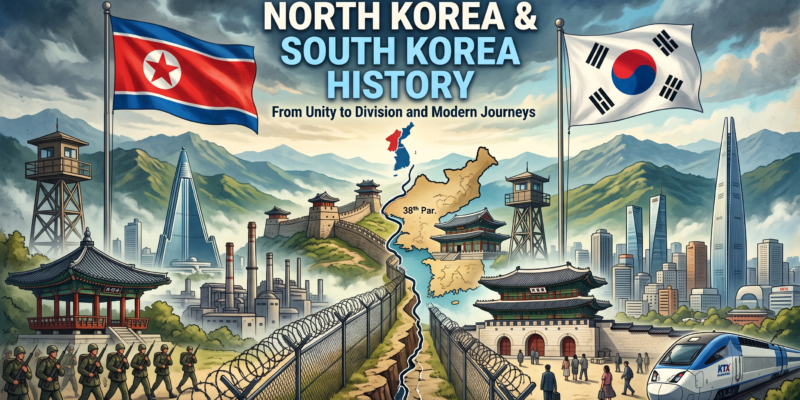
The story of north korea and south korea history begins as one nation and ends as two of the most different countries on earth. For Indian students exploring South Korea for study or travel, understanding how the Korean peninsula history unfolded, from a single kingdom to a divided land split along the 38th parallel, gives useful context for the modern Republic of Korea you will be living in. This guide walks through the full timeline, from early Korea to the division of Korea, the Korean war history, and where the two Koreas stand today.
A Shared Past Before the Division of Korea
Before 1945, Korea existed as a single nation with one language, one culture, and centuries of shared royal history under dynasties such as Joseon. This unified korean peninsula history matters because it explains why many families on both sides of the border still share surnames, dialects, and ancestral hometowns today.
Japan occupied Korea from 1910 to 1945, ruling the entire peninsula as a colony. When Japan surrendered at the end of the Second World War, the Korean peninsula was not handed back to Koreans as one country. Instead, the United States and the Soviet Union agreed to split administrative control, with the Soviets managing the north and the Americans managing the south. The dividing line chosen was the 38th parallel, a latitude line that cut the peninsula into two occupation zones with no regard for geography, economy, or population distribution. This single wartime decision is the true starting point of the division of Korea that still shapes the region.
For readers curious about how this border eventually became a permanent and heavily guarded line, see our guide on the north korea south korea border name and the DMZ.
Quick Timeline of the Division of Korea
| Year | Event |
|---|---|
| 1910 to 1945 | Japan rules the entire Korean peninsula as a colony |
| August 1945 | Japan surrenders, the US and Soviet Union split the peninsula at the 38th parallel |
| 1948 | Two separate governments form, the Republic of Korea in the south and the Democratic People’s Republic of Korea in the north |
| 1950 to 1953 | The Korean War is fought across the peninsula |
| 1953 | An armistice is signed, creating the Demilitarized Zone |
| 1960s to 1990s | South Korea industrializes and democratizes, North Korea remains centrally planned and isolated |
| 2000 and 2018 | Inter-Korean summits raise and then stall hopes of unification |
The Korean War: 1950 to 1953
By 1948, the temporary occupation zones hardened into two separate governments. The north became the Democratic People’s Republic of Korea under Soviet-backed leadership, while the south became the Republic of Korea under a US-backed government. Both sides claimed authority over the entire peninsula, and tensions escalated quickly.
On 25 June 1950, North Korean forces crossed the 38th parallel and invaded the south, starting the korean war 1950 to 1953. The conflict quickly became an international one. The United Nations, led largely by the United States, intervened to support South Korea, while China entered on the side of North Korea once UN forces pushed close to the Chinese border. The war dragged on for three brutal years, devastating cities, displacing millions, and separating countless families across the new front line.
The fighting ended in July 1953 with an armistice agreement, not a peace treaty. Technically, North Korea and South Korea remain in a state of war to this day, which is one of the most important facts students and travelers should know before visiting the region. This armistice created the Demilitarized Zone, a buffer strip roughly four kilometers wide that still separates the two nations.
The human cost of the korean war history is difficult to overstate. Estimates put total casualties, military and civilian combined, at well over two million people, with millions more displaced from their homes. Entire cities such as Seoul changed hands multiple times during the conflict and had to be rebuilt almost from scratch afterward. This devastation is one reason South Korea’s later economic rise is often described internationally as remarkable, since the country started its post-war recovery from near total ruin. It is also why many Korean families, on both sides of the border, still have relatives they have never been able to contact or visit, since the division cut through provinces and even individual villages.
Two Nations, Two Paths: Post-War Divergence
After the armistice, north korea and south korea history splits into two dramatically different stories.
North Korea, officially the Democratic People’s Republic of Korea, developed under a centrally planned economy and single-party rule. Kim Il Sung established a leadership structure that has since passed through three generations of the same family, a continuity often called the Kim dynasty. The state prioritized military strength and self-reliance, an approach that left the economy largely closed off from the rest of the world.
South Korea, officially the Republic of Korea, took a very different route. Early decades after the war were marked by poverty and political instability, but from the 1960s onward the country pursued rapid industrialization, export-driven growth, and gradual democratization. By the late twentieth century, South Korea had transformed into one of the world’s largest economies and a full democracy with regular elections. To understand how firmly democratic the country has become, read our dedicated piece on is south korea a democracy.
These north and south korea differences did not happen overnight. They are the direct result of nearly seven decades of separate governments, separate alliances, and separate economic models growing out of the same starting point in 1945.
South Korea’s transformation is often called the Miracle on the Han River, referring to the rapid growth of Seoul and the national economy from the 1960s through the 1990s under a series of five year development plans. Heavy investment went into steel, shipbuilding, electronics, and later semiconductors and automobiles, laying the foundation for companies that are now household names worldwide. Politically, the south moved through a period of military-backed governments before mass pro-democracy protests in 1987 led to direct presidential elections, a turning point that cemented the democratic system in place today.
North Korea, by contrast, pursued an ideology called Juche, or self-reliance, which discouraged dependence on foreign trade or aid. Collective farming and state-run industry were prioritized over consumer goods, and by the 1990s, the loss of Soviet subsidies after the collapse of the USSR contributed to a severe famine that killed hundreds of thousands of people. This divergence in economic philosophy, more than any single event, is why the per capita income gap between the two Koreas is now one of the widest between any two neighboring countries in the world.
How the Cold War Shaped Both Koreas
The broader Cold War in korea explains much of why the two countries chose such opposite paths. North Korea aligned with the Soviet Union and later China, absorbing communist economic and political models. South Korea aligned with the United States, receiving military protection, economic aid, and exposure to market-based growth strategies.
This Cold War alignment is also why the kim dynasty in the north has maintained tight control through propaganda and isolation, while the south built institutions, a free press, and competitive elections. Even national holidays trace back to this era. South Korea’s Liberation Day, for instance, commemorates freedom from Japanese rule in 1945, the very event that triggered the division. You can read more in our guide to south korea independence day and Gwangbokjeol.
The United States stationed troops in South Korea from the end of the Korean War onward, a military alliance that continues today and still shapes South Korea’s foreign policy and defense posture. North Korea, meanwhile, deepened ties with China throughout the Cold War and continues to rely heavily on Chinese trade to this day, since most other countries maintain strict economic sanctions against Pyongyang over its weapons programs. These opposing alliance systems, formed in the first decade after division, are a major reason the two Koreas never drifted back toward each other even after the broader Cold War ended elsewhere in the world during the early 1990s.
Daily Life and Culture: A Divided Identity
The cultural gap between the two Koreas today reflects decades of separate development as much as the political and economic ones do. South Korea has become a global cultural exporter through K-pop, Korean dramas, cinema, and cuisine, industries that depend on open internet access, private enterprise, and creative freedom. North Korea, by comparison, maintains tight state control over media, internet access, and artistic output, with foreign films, music, and even clothing styles heavily restricted.
Language itself has started to drift apart. While both Koreas speak dialects of the same language, decades of separation have produced different vocabulary, particularly around modern technology and loanwords, since South Korea absorbed many English terms while North Korea actively avoided them. Education systems also diverged sharply, with South Korea building a highly competitive, exam-driven system tied to university admission, while North Korea’s curriculum places heavy emphasis on the ruling ideology alongside standard academic subjects.
Where the Two Koreas Stand Today
Talk of korea unification has surfaced periodically since the 1950s, including high-profile summits between leaders of both nations in recent decades. However, the economic gap, political systems, and decades of separate development make any near-term unification unlikely. South Korea’s economy today is many times larger than North Korea’s, and its political structure, built on elected government bodies, is a world apart from the north’s single-party system. Readers wanting to understand how South Korea’s government actually functions can see our explainer on the national assembly of south korea.
The dmz north and south korea remains the most visible symbol of this unresolved history: a 250 kilometer long, heavily fortified strip that is paradoxically one of the most undeveloped and ecologically preserved areas on the peninsula, since almost no human activity has disturbed it since 1953.
For a side-by-side look at how the two nations compare across politics, economy, and daily life today, see our full rundown of the 10 differences between north and south korea.
Inter-Korean relations have seen several attempts at reconciliation over the decades, including family reunion events for those separated by the war, joint economic projects such as the now-closed Kaesong Industrial Complex, and summit meetings between leaders in 2000, 2007, and 2018. Each of these moments raised hopes of closer ties, yet each was eventually followed by renewed tension, often tied to North Korea’s missile and nuclear weapons testing. For students and travelers, the practical result is that South Korea remains fully safe and stable day to day, even though the broader diplomatic relationship with the north stays unresolved. Our guide on is south korea safe for indians covers this in more detail.
Frequently Asked Questions
When did Korea split into North Korea and South Korea?
Korea was divided in 1945 after Japan’s surrender ended World War Two, with the 38th parallel splitting the peninsula into Soviet and American occupation zones. This split became permanent in 1948 when two separate governments formed.
What caused the Korean War?
North Korea invaded South Korea on 25 June 1950 to try to reunify the peninsula under communist rule, drawing in the United Nations on the side of the south and China on the side of the north.
Are North Korea and South Korea still technically at war?
Yes. The Korean War ended with an armistice in 1953, not a peace treaty, so the two nations remain technically at war even though active fighting stopped.
Why are North Korea and South Korea so different today?
Nearly seven decades of separate governments, opposing Cold War alliances, and different economic models turned one shared culture into two very different societies, one closed and centrally controlled, one open and democratic.
Is Korean unification likely?
While both governments have discussed unification at various points, the wide economic gap and deep political differences make it unlikely in the near term.
Do North Korea and South Korea still speak the same language?
Both countries speak dialects of Korean, but decades of separation have led to noticeable differences in vocabulary, especially around technology and foreign loanwords.
Why is the Korean border called the 38th parallel if the DMZ does not run perfectly straight?
The 38th parallel was the original 1945 dividing line, but the front line shifted during the Korean War. The armistice fixed the current, slightly irregular Demilitarized Zone based on troop positions in 1953, not the original straight latitude line.
Is it safe to study or travel in South Korea given its history with North Korea?
Yes. South Korea is a stable, highly developed democracy, and daily life is unaffected by the technical state of war with the north, which has persisted without major incident for decades.