

South Korea Salary Per Month (2026): Complete Guide to Average Income, Minimum Wage and Pay by Industry
If you are researching jobs, higher education, or relocation, understanding the south korea salary per month picture for 2026 is the first step to planning your finances. This guide breaks down average monthly pay, the current minimum wage, salary ranges by industry and experience, regional differences, and what foreigners and Indian students can realistically expect to earn or budget for.
Average Salary in South Korea Per Month (2026 Overview)
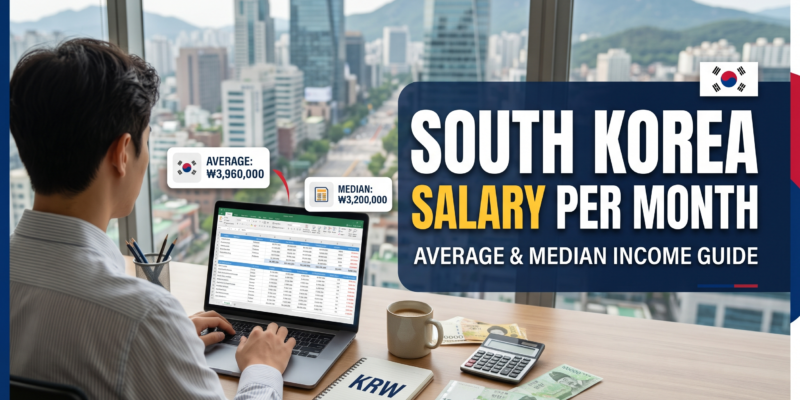
The average gross monthly salary in South Korea in 2026 sits at approximately KRW 3,960,000, close to USD 2,700. Annually, this converts to roughly KRW 47,520,000, or about USD 32,400. This figure, compiled from Ministry of Employment and Labor (MOEL) wage survey data via KOSIS, covers regular workers at establishments with one or more employees and includes base pay, overtime, and recurring allowances.
It is worth noting that the median monthly income is lower than the average, at around KRW 3,200,000 to KRW 3,360,000. The gap exists because high earners in finance, technology, and executive roles at major conglomerates (chaebols) pull the average upward. For a realistic sense of typical take-home pay, the median figure is usually the more useful benchmark.
| Salary Metric (2026) | Amount (KRW) | Approx. USD |
|---|---|---|
| Average gross monthly salary | 3,960,000 | ~2,700 |
| Average gross annual salary | 47,520,000 | ~32,400 |
| Median monthly income | 3,200,000 – 3,360,000 | ~2,180 – 2,290 |
| Minimum monthly wage (209 hrs) | 2,156,880 | ~1,470 |
| Average monthly salary in Seoul | 4,550,000 | ~3,100 |
For a wider breakdown of how this compares to historical trends and other income measures, see our median income guide for South Korea.
South Korea Minimum Wage Per Month (2026)
Effective January 1, 2026, South Korea’s nationwide statutory minimum wage is fixed at KRW 10,320 per hour, a 2.9 percent increase from KRW 10,030 in 2025. This was the first minimum wage figure set by employer-employee consensus since 2008.
On a standard 209-hour monthly calculation (40 weekly working hours plus mandatory paid weekly rest hours), the minimum wage works out to a legal floor of KRW 2,156,880 gross per month, close to USD 1,470. Unlike some countries, South Korea applies one minimum wage nationwide, with no regional variation between Seoul and smaller provinces.
For context on how this fits into the country’s broader pay structure and basic salary rules, check our South Korea minimum wage and monthly income guide.
South Korea Salary Per Month by Industry
Monthly pay in South Korea varies widely depending on sector. High-growth industries consistently pay above the national average.
| Industry | Average Monthly Salary (KRW) | Approx. USD |
|---|---|---|
| Healthcare and Medical | 5,800,000 | ~4,210 |
| Technology and IT | 5,550,000 | ~3,900 |
| Finance | 5,000,000+ | ~3,600+ |
| Manufacturing (incl. semiconductors) | 4,200,000 | ~2,900 |
| Education and Teaching | 3,300,000 – 4,500,000 | ~2,300 – 3,100 |
| Retail and Hospitality | 2,500,000 – 3,000,000 | ~1,700 – 2,050 |
Manufacturing figures hide a wide internal range, since semiconductor fabrication and precision engineering roles at major chaebol suppliers sit materially above the sector average. Finance and technology roles in Seoul also tend to push past these averages due to demand for specialised skills.
If you are specifically weighing a teaching career, our teaching in South Korea guide covers salary bands, visas, and contract terms in detail.
Salary by Seniority and Experience Level
Monthly pay in South Korea scales significantly with experience:
- Entry-level (0-2 years): roughly KRW 2,400,000 to 2,900,000 per month
- Mid-level (3-7 years): roughly KRW 3,500,000 to 4,800,000 per month
- Senior / managerial (8+ years): roughly KRW 5,500,000 to 8,000,000+ per month
Seniority-based pay progression is still common in Korean corporate culture, particularly at large conglomerates, though tech startups increasingly offer performance-based structures that can shift these numbers.
Salary in Seoul vs Other Cities and Provinces
Where you work in South Korea materially changes your monthly paycheck. Seoul leads regional pay at an average of around KRW 4,550,000 per month, followed by Gyeonggi Province, Ulsan (home to Hyundai’s manufacturing base), and Busan. Smaller provincial cities generally sit closer to or below the national average.
| City / Region | Average Monthly Salary (KRW) |
|---|---|
| Seoul | ~4,550,000 |
| Gyeonggi Province | ~4,000,000 |
| Ulsan | ~3,900,000 |
| Busan | ~3,700,000 |
| Other provinces | 3,000,000 – 3,500,000 |
Seoul’s higher pay comes with a higher cost of living, so the gap in disposable income between cities is usually smaller than the headline salary gap suggests. See our full cost of living breakdown for a side by side comparison.
Net Salary in South Korea After Tax (2026)
Gross pay is not what lands in your bank account. South Korea applies a progressive income tax system alongside mandatory social contributions, including National Pension, health insurance, employment insurance, and long-term care insurance.
On a median gross salary of roughly USD 4,000 per month, the effective deduction rate is approximately 24 percent, leaving around USD 3,050 net. On higher salaries, closer to USD 5,000 per month, the effective rate rises to around 27 percent.
Important for foreign workers: Foreign employees in South Korea can elect a flat 19 percent income tax rate instead of the standard progressive bands for a limited period, which can be advantageous for higher earners. National Pension contributions are also set to rise gradually from 9.5 percent toward 13 percent by 2033.
For currency-specific planning, our South Korea currency vs Indian currency guide explains how to convert and budget your monthly pay in rupees.
Is South Korea Salary Good for Indian Students and Workers?
For Indian students and professionals considering South Korea, the monthly salary picture needs to be read alongside visa rules, cost of living, and job sector.
- Part-time student jobs: typically pay close to the minimum wage, around KRW 2,100,000 to 2,400,000 per month if working close to legal limits.
- Graduate jobs (tech, engineering, research): often start at KRW 2,800,000 to 3,500,000 per month, rising quickly with experience.
- Skilled professional and specialist visas: can command salaries well above the national average, particularly in Seoul’s technology and finance sectors.
If you are weighing South Korea as a study and work destination, our guides on jobs in Korea for Indians and working in South Korea as a foreign professional go deeper into visa categories and hiring pathways. It is also worth reading how South Korea’s overall income level compares globally in our is South Korea a rich country guide.
Frequently Asked Questions
What is the average salary per month in South Korea in 2026?
The average gross salary is around KRW 3,960,000 per month, roughly USD 2,700, based on MOEL wage survey data compiled by KOSIS.
What is the minimum wage per month in South Korea?
From January 1, 2026, the minimum wage is KRW 10,320 per hour, which equals approximately KRW 2,156,880 per month on a standard 209-hour schedule.
What is a good monthly salary in Seoul?
Seoul salaries average around KRW 4,550,000 per month, above the national average, due to its concentration of corporate, finance, and technology employers.
How much tax is deducted from salary in South Korea?
Effective deductions, including income tax and social contributions, typically range from 24 to 27 percent of gross pay, depending on income level. Foreign workers can elect a flat 19 percent rate under certain conditions.
Which industries pay the highest monthly salary in South Korea?
Healthcare and medical roles average around KRW 5,800,000 per month, followed closely by technology and IT at around KRW 5,550,000 per month.