

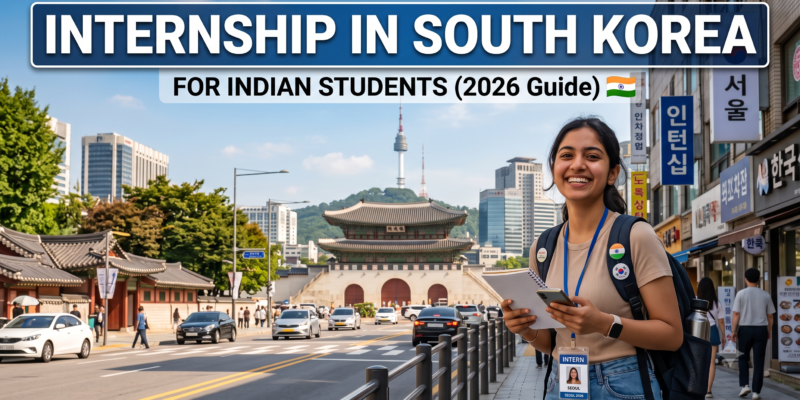
Internship in South Korea for Indian Students: Complete 2026 Guide
South Korea has quietly become one of the most sought-after internship destinations for Indian students, and it is easy to see why. Between Samsung, Hyundai, LG, Naver, and a fast-growing startup scene, the country offers hands-on experience with some of the world’s most recognisable brands, alongside a culture that Indian students already follow closely through K-dramas and K-pop.
But an internship in South Korea for Indian students is not the same as studying there. It comes with its own visa rules, its own application timeline, and a few traps that catch first-timers off guard, especially around which visa actually lets you work. This guide walks through all of it: the visa mechanics, the real stipend numbers, the best routes into an internship, and what day-to-day life looks like once you land.
If you are still deciding whether to study in South Korea after 12th, an internship is often the fastest way to test the waters before committing to a full degree.
Which Visa Lets You Actually Intern? D-2, D-4 and D-10 Explained
This is the part most guides skip, and it is the part that matters most. Not every South Korea student visa allows you to legally intern, and getting this wrong can mean a rejected application or, worse, a violation of your visa terms once you are already there.
Here is how the three visas that come up most often actually work for interns:
| Visa | Who it’s for | Can you intern? | Maximum duration |
|---|---|---|---|
| D-2 | Degree-seeking students (bachelor’s, master’s, PhD) | Only during official vacation periods, and only with prior approval from the immigration office | Tied to your academic programme |
| D-4 | Language trainees and non-degree short courses | No. Internship work is not permitted under this visa | Up to 2 years, but not for internships |
| D-10 | Job-seeking or internship-specific visa | Yes, this is the visa built for it | Up to 1 year of internship activity within a 2-year stay, capped at 6 months per company |
| E-7 | Specialist/skilled professional | Rare for interns, mostly used for post-internship conversion | Employment-linked |
A warning worth repeating: if you are in South Korea on a D-4 visa for a language course, you cannot legally take up an internship, paid or unpaid, without changing your visa status first. This single point trips up more Indian applicants than anything else in the process, because D-4 is often the easiest visa to get first, and students assume it covers internships too. It does not.
If you are still weighing which visa route fits your plans, our South Korea student visa guide for Indian students breaks down D-2 and D-4 in more depth, and our South Korea e-visa application guide walks through the online application itself.
Step-by-Step: How Indian Students Apply for an Internship in South Korea
Applying from India adds a few steps that most global internship guides do not mention, because they are written for students who are already in Korea on a degree programme. Here is the fuller picture:
- Choose your route. Decide whether you are going through a direct company application, a scholarship-linked programme, or a placement agency (more on each below). This decision shapes which visa you will eventually need.
- Secure your underlying student status, if applying via D-2. If your internship route depends on a Korean university enrolment, get your admission sorted first, since the internship approval is layered on top of that status.
- Build a Korea-ready resume and cover letter. Korean employers tend to expect a more formal, achievement-focused resume than what’s standard in India. Keep it factual, quantify results where you can, and mention any Korean language ability upfront.
- Apply through the company portal, agency, or your campus placement cell. Large companies like Samsung and LG run their own portals; agencies like AIP handle matching on your behalf; some Indian colleges also run placement drives directly with Korean employers.
- Get your internship confirmation or acceptance letter. This document is non-negotiable for the next step, and it needs to clearly state the internship duration, the host organisation, and whether it is paid.
- Apply for the correct visa at the Korean Embassy or a VFS Global centre in India. Bring your acceptance letter, passport, photographs, and financial proof. Processing typically takes a few weeks, so build in buffer time.
- Arrive and register for your Alien Registration Card (ARC) if you’re staying over 90 days. This has to be done within 90 days of arrival at your local immigration office, and you’ll need it for everything from opening a bank account to signing a lease.
For the visa application itself, our guide on how to get a South Korea visa from India covers the embassy paperwork in more detail.
Best Internship Routes for Indian Students
Not every internship route in South Korea works the same way, and picking the right one depends on what you are actually optimising for: career, scholarship value, cultural exchange, or social impact.
Government-Backed and Scholarship-Linked Internships
Some of the strongest opportunities come bundled with a scholarship. Programmes modelled on schemes like the Seoul Tech Scholarship combine a fee-waived master’s admission with a structured internship component, usually aimed at students from science and engineering backgrounds. These are competitive and deadline-driven, so if this route interests you, it is worth checking top universities in South Korea for international students early to see which institutions run scholarship-internship combinations.
Corporate and MNC Internships
This is the route most Indian engineering and business students picture when they think of interning in Korea. Samsung, LG, Hyundai, SK Group, Naver, Kakao, and POSCO all run structured internship programmes, mostly in engineering, IT, AI, business development, and marketing. For top-tier college students, these are often accessed through university placement cells that already have relationships with these companies, which tends to be a faster route than applying cold through a public portal.
Internship Placement Agencies
Agencies like AIP (Asia Internship Program), CRCC Asia, and Beyond Academy exist specifically to match international students, including Indians, with Korean companies. They typically handle housing support, visa guidance, and orientation, which makes them a good option if you want structure and hand-holding. The trade-off worth knowing upfront: most agency-placed internships are unpaid or stipend-only rather than salaried, since the value they offer is the placement and support, not the pay.
NGO and UN-Linked Internships
If your interest leans toward social impact rather than corporate experience, South Korea also hosts internship opportunities with organisations like UNOSD (UN Office for Sustainable Development) and various human rights NGOs working with vulnerable groups. These tend to be smaller in number but offer a genuinely different experience from the corporate or agency routes.
Eligibility Criteria for Indian Students
Requirements vary by programme, but most internship routes in South Korea share a similar baseline:
- You are typically expected to be in your third or fourth year of undergraduate study, or already enrolled in a postgraduate programme
- Most programmes place no restriction based on nationality, religion, gender, or age
- Graduate students are generally welcome to apply alongside undergraduates
- A clean, reasonably strong academic record is expected, though the bar varies widely by company
- Language requirements differ sharply by route: agency-placed and English-track corporate internships often need no Korean at all, while direct applications to Korean companies increasingly ask for conversational Korean or a TOPIK score
If Korean language ability is the gap in your application, it is worth looking into structured Korean language courses before you start applying, since even a basic TOPIK level can widen the pool of internships open to you.
Stipend, Salary and Cost of Living During Your Internship
This is the part most internship guides leave out entirely, and it is often the deciding factor for Indian families weighing the cost of the experience.
| Internship type | Typical monthly stipend (KRW) | Approx. in INR* |
|---|---|---|
| Unpaid (common with smaller agencies/NGOs) | None, sometimes housing support only | – |
| Partial stipend (most agency-placed roles) | 300,000 – 700,000 KRW | Roughly ₹18,000 – ₹43,000 |
| Fully paid (large corporate internships) | 1,500,000 – 2,500,000 KRW | Roughly ₹92,000 – ₹1,53,000 |
*Approximate conversion; check current exchange rates before budgeting.
On the cost side, a single intern living in Seoul should plan for higher expenses than a smaller city like Busan or Daejeon, largely driven by rent. Shared accommodation, basic meals, and local transport together tend to run noticeably lower than a solo studio apartment in central Seoul. For a fuller monthly breakdown, our guide to the cost of living in South Korea for international students covers rent, food, and transport in detail, and our page on the average salary in South Korea per month is useful context if you are trying to gauge how an internship stipend compares to a full-time entry salary.
The practical takeaway: budget for a partially or fully self-funded internship unless you have secured one of the paid corporate placements, and treat any stipend as a bonus rather than something to plan your finances around.
Life as an Intern in Korea: Workplace Culture and Student Life
Korean offices run on a noticeably more hierarchical structure than most Indian workplaces, and understanding it before your first day makes a real difference. Seniority shapes how you greet colleagues, how meetings are run, and even who speaks first in a group setting. Interns are generally expected to observe these norms closely, even in more relaxed startup environments.
Work hours for interns typically follow a standard weekday structure, sometimes with a hybrid arrangement depending on the company, and most large employers assign interns to specific projects with a supervisor rather than having them float across teams. Outside of work, settling in comes down to the same basics as studying there: finding housing, figuring out food (vegetarian options exist but require some searching outside major cities), and building a community, whether through your program, your workplace, or the wider Indian student network.
For a closer look at day-to-day norms, our page on Korean workplace manners and etiquette and our student life in South Korea guide both go deeper into what to expect once you are settled in.
From Internship to Full-Time Job in South Korea
For many Indian students, the internship is not the end goal, it is the audition. A strong internship can convert into a D-10 job-seeking visa, giving you time to interview for full-time roles, or in some cases lead directly to a job offer and an E-7 specialist visa if the company decides to sponsor you.
To maximise your chances of conversion, the last month of your internship matters more than most people realise. Ask directly about full-time openings, request feedback from your supervisor before you leave, and stay visible on the team’s radar even after the internship formally ends. Companies are far more likely to extend an offer to someone who asked clearly than someone who assumed it would happen on its own.
If you are already thinking ahead to the job hunt itself, our guide to jobs in South Korea for Indians and our page on how to work in South Korea as a foreign professional both cover what comes after the internship stage.
FAQs
Can I intern in South Korea on a D-4 visa? No. The D-4 visa is for language training and does not permit internship work. You would need to switch to a D-2, D-10, or another eligible visa before taking up an internship.
Is an internship in South Korea paid for Indian students? It depends on the route. Large corporate internships at companies like Samsung or LG are usually paid, while many agency-placed or NGO internships are unpaid or offer only a partial stipend.
Do I need to know Korean to intern in South Korea? Not always. Many agency-placed and English-track corporate internships do not require Korean. However, direct applications to Korean companies increasingly favour candidates with at least a basic TOPIK score.
How long can I intern in South Korea? On a D-10 visa, internship activity is capped at one year within a two-year stay, with a maximum of six months per company. D-2 visa holders can only intern during official vacation periods.
Which companies in South Korea hire Indian interns? Samsung, LG, Hyundai, SK Group, Naver, and Kakao are among the most active in hiring international interns, alongside smaller startups and NGOs that specifically welcome foreign talent.
Can an internship in South Korea lead to a full-time job? Yes, this is a common path. A strong internship performance can lead to a D-10 job-seeking visa or, in some cases, a direct offer and sponsorship for an E-7 work visa.
Start Your South Korea Internship Journey with StudyInSouthKorea
Finding the right internship route, and getting the visa paperwork right the first time, is where most applications from India actually go wrong. If you’d rather not navigate the D-2, D-4, and D-10 maze alone, talk to our study abroad team or explore our South Korea services for guidance built specifically around what Indian students need to get this right.