


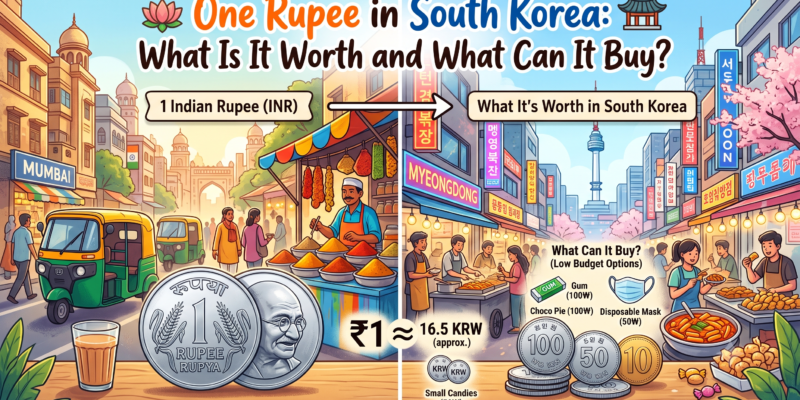
If you are planning to study, travel or work abroad, one of the first questions you will ask is simple: what is one rupee in South Korea worth? The short answer is that 1 Indian rupee (INR) converts to roughly 15 to 17 South Korean won (KRW) in recent years. The rate moves daily, so always check a live converter before transferring money.
But the exchange rate alone does not tell you much. The real question is how far one rupee, or ₹10,000, or ₹1 lakh, actually goes once you land in Seoul, Busan or any other Korean city. In this guide, we break down the value of one rupee in South Korea, explain how the INR to KRW conversion works, show what everyday items cost, and share practical tips for Indian students and travellers.
What Is One Rupee in South Korea? (INR to KRW Explained)
The official currency of South Korea is the South Korean won (₩, code KRW). When people search for “one rupee in South Korea,” they usually mean the Indian rupee to Korean won conversion.
In recent years, the rate has generally stayed in the range of ₩15 to ₩17 per ₹1. That means:
- ₹1 ≈ ₩15 to ₩17
- ₹100 ≈ ₩1,500 to ₩1,700
- ₹1,000 ≈ ₩15,000 to ₩17,000
- ₹1,00,000 ≈ ₩1.5 to ₩1.7 million
These are approximate figures and not live quotes. Exchange rates change with global markets, so verify the current rate on your bank’s website, Google or the Reserve Bank of India reference rate before you convert.
If you want a deeper look at the won itself, read our complete guide to the currency of South Korea and the explainer on the South Korea currency code KRW, its meaning and symbol.
Why One Rupee Looks Small in Korea
At first glance, ₹1 turning into ₩15 to ₩17 sounds like a bargain. It feels like you are getting many more units. But the won is a high-denomination currency. Prices in Korea are written in thousands and tens of thousands.
A bottle of water might cost ₩1,000. A bowl of kimchi stew might cost ₩9,000. A monthly rent deposit might run into millions of won. So the larger number of units does not mean cheaper living. It simply reflects how the currency is scaled.
The better way to think about it: ₩1,000 is roughly ₹60 to ₹65. Use that as your mental shortcut for converting prices on the street.
What Can One Rupee Buy in South Korea?
Practically nothing on its own. The smallest Korean coin in regular circulation is the ₩10 coin, and even ₩15 to ₩17 will not buy a single item in a shop. But the thought experiment is useful, so let us scale it up with realistic amounts.
₹100 (about ₩1,500 to ₩1,700)
- One triangle kimbap or a small snack at a convenience store (prices vary, often around ₩1,200 to ₩2,000)
- A single subway ride in some cases, since base fares in Seoul are in the ₩1,400 to ₩1,800 range
₹500 (about ₩7,500 to ₩8,500)
- A basic street food meal such as tteokbokki or gimbap
- A coffee at a budget cafe
₹1,000 (about ₩15,000 to ₩17,000)
- A solid restaurant meal such as bibimbap, kimchi jjigae or a set menu, with a drink
- Several days of local bus rides if you use a transit card
₹10,000 (about ₩150,000 to ₩170,000)
- A few nights in a budget guesthouse or hostel
- A week of cheap eating if you cook some meals yourself
These numbers help you plan, but remember that prices differ by city and season. Seoul is more expensive than Daegu, Gwangju or Jeonju. Our guide to hotel rates in South Korea shows what accommodation costs look like in different cities.
INR to KRW: How the Exchange Rate Works
The rupee and the won are not traded directly in huge volumes. Most conversions go through the US dollar. That means the rupee to won rate depends on two moving pieces: INR against USD and KRW against USD.
Things that move the rate include:
- Interest rate decisions by the Reserve Bank of India and the Bank of Korea
- Oil prices, since both countries import energy
- Export performance, because Korea is a major exporter of semiconductors, cars and electronics
- Global risk sentiment, which can strengthen or weaken emerging market currencies
For a full breakdown with conversion tables, see our Indian rupee to South Korea currency exchange guide and the comparison of South Korea currency vs Indian currency.
Cost of Living: Putting the Rupee in Context
Knowing the 1 INR to KRW rate is only step one. The next step is understanding monthly expenses. A typical international student in Korea spends money on:
- Accommodation: a dorm, goshiwon or one-room studio
- Food: campus cafeterias, convenience stores and local restaurants
- Transport: subway, bus and a rechargeable T-money card
- Phone and internet: prepaid or monthly plans
- Health insurance: mandatory for international students after a set period
- Study materials and social life
Students who cook at home and use campus meals can keep costs surprisingly low, while those who eat out daily in Seoul will spend far more. We have prepared a detailed breakdown of the cost of living in South Korea per month that you should read next if you are building a budget.
How Much Do People Earn in Korea?
The rupee value looks different when you compare it with local incomes. South Korea is a high-income economy, and wages are far higher than in India in absolute terms. Part-time work for students is allowed under certain visa conditions, with limits on weekly hours.
If you are curious about salaries, minimum wage and earning potential, check our average salary in South Korea per month guide and the overview of South Korea’s basic salary and minimum wage. This helps you see how a student income covers daily expenses even when the sticker prices look high.
Best Ways to Convert Rupees to Won
Do not simply walk into any exchange counter. The way you convert money can cost you a few percent of your total.
- Use a forex card or multi-currency card. Many Indian banks and fintech providers offer cards with better rates than airport counters.
- Compare the mid-market rate. Check the real rate on a currency converter, then compare it with what the provider offers. The gap is their margin.
- Avoid airport exchange desks. They usually have the worst margins.
- Use a Korean bank account for long stays. Students on a D-2 visa often open a local account after arrival. Wire transfers from family in India are common, so compare transfer fees and exchange spreads.
- Carry a small amount of cash. Korea is largely cashless, but small markets and some transport machines still use cash or T-money cards.
- Watch out for dynamic currency conversion. If a card terminal asks whether you want to pay in INR or KRW, always choose KRW.
Planning the Money for Your Trip or Studies
Before you go, estimate the big costs in rupees and then convert them to won, not the other way around. Start with:
- Flights: compare fares from Delhi, Mumbai, Chennai, Bengaluru and Hyderabad. Our India to South Korea ticket price guide will help you plan.
- Visa fees and documents: see the South Korea visa for Indian passport holders guide and the South Korea student visa guide for Indian students.
- Tuition and living costs: read how to study in South Korea as an Indian student for a full roadmap.
Add a 10 to 15 percent buffer for exchange rate swings and unexpected expenses. If the rupee weakens against the won, your costs in INR rise even if prices in Korea stay the same.
Everyday Price Shortcuts for Indians in Korea
Use these quick conversions while shopping:
- ₩1,000 ≈ ₹60 to ₹65
- ₩5,000 ≈ ₹300 to ₹330
- ₩10,000 ≈ ₹600 to ₹660
- ₩50,000 ≈ ₹3,000 to ₹3,300
- ₩100,000 ≈ ₹6,000 to ₹6,600
Divide the won price by about 16 to get the rupee value quickly. It is not exact, but it works for fast decisions in a store or restaurant.
If you want to explore student life beyond money, visit our student life in South Korea hub and the Korean courses page for language learning resources.
Common Mistakes Indians Make with INR to KRW
- Assuming more won means cheaper living. The number of units is bigger, but prices are scaled up too.
- Exchanging all money at once. Convert in stages to reduce rate risk.
- Ignoring card fees. Foreign transaction fees can add up over a semester.
- Forgetting about deposits. Housing in Korea can involve a refundable deposit that is large compared with monthly rent.
- Not tracking the rate. A small move of ₩0.5 per rupee changes the cost of a ₹10 lakh budget by over ₩500,000.
Frequently Asked Questions
What is one rupee in South Korea in won?
One Indian rupee is generally worth around ₩15 to ₩17. The exact value changes daily, so check a live source before exchanging money.
Is the Korean won stronger than the Indian rupee?
No. One won is worth only a fraction of a rupee, roughly ₹0.06. A single rupee equals many won, but that is because the won is issued in large denominations, not because it is weaker in purchasing power.
Can I use Indian rupees in South Korea?
No. You must exchange rupees for Korean won. Indian rupees are not accepted in shops, transport or restaurants.
What is the best way to carry money to Korea?
A combination works best: a forex card for daily spending, a debit or credit card with low foreign fees, and a small amount of cash for emergencies.
How much money do Indian students need per month in Korea?
It depends on the city, housing and lifestyle. Seoul is the most expensive. Read our cost of living guide for a realistic monthly budget.
Final Thoughts
One rupee in South Korea is worth roughly ₩15 to ₩17, but the number only matters when you connect it to real prices. Think in terms of ₩1,000 equalling about ₹60 to ₹65, use a forex card, and always budget with a buffer. With careful planning, your rupees can stretch a long way in Korea.
Ready to start your journey? Explore our study in South Korea resources or contact our team for personal guidance.
Disclaimer: Exchange rates and prices in this article are approximate and change frequently. Always verify live rates and current costs before making financial decisions. This article is informational and not financial advice.