

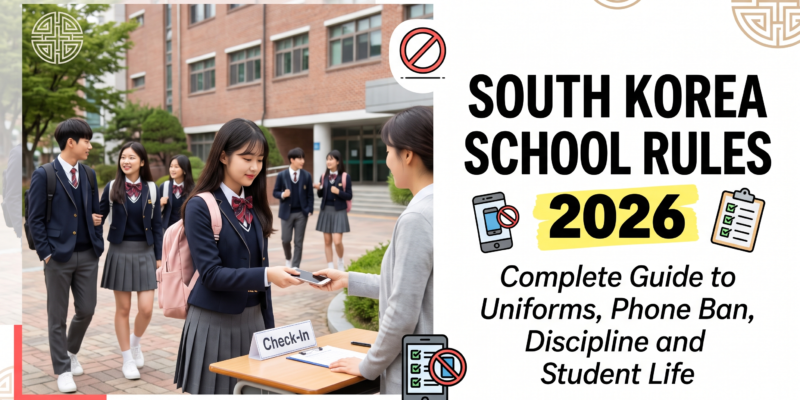
South Korea school rules shape almost every part of a student’s day, from the shoes worn in the corridor to the phone that stays in a locker during lessons. Whether you are an Indian parent planning a move to Seoul, a student preparing for a Korean university, or simply curious about Korean school life, this guide explains the rules in plain language. You will learn how the Korean school system works, what the dress code looks like, how the 2026 classroom phone law applies, how discipline is handled, and how foreign students fit in.
One honest note before we begin. South Korea has no single national rulebook that covers every detail. The Ministry of Education sets the legal framework, regional offices of education add their own guidance, and each school writes its own student life regulations. That is why hair rules, uniform details and evening study expectations differ from one school to the next. Always confirm the specifics with the exact school you are applying to.
South Korea School Rules at a Glance: Quick Summary Table
| Rule area | What to expect in South Korea | Who decides |
|---|---|---|
| School year | Starts in March, two semesters | Ministry of Education and regional offices |
| School uniform | Common in middle and high school, rare in elementary | Each school |
| Mobile phones | Restricted during class hours from 1 March 2026, with exceptions | National law |
| Corporal punishment | Banned | National law |
| Hair, makeup, accessories | Varies by school, loosened in many regions | School and regional office |
| Indoor shoes | Required in most schools | School |
| Cleaning duty | Students clean classrooms and corridors in most schools | School |
| Evening self-study | Offered at many high schools, often optional | School |
South Korea School System Explained: Grades, Academic Year and School Hours
Before the rules make sense, it helps to understand the structure they sit inside. The Korean school system follows a 6-3-3-4 pattern: six years of elementary school, three years of middle school, three years of high school, and then four years of university for most degrees. Elementary and middle school are compulsory. If you are comparing this with what you know from India, our guide on how Indian students can study in South Korea maps the full pathway from school to degree.
South Korea School Year and Semester Dates for 2026
The Korean school year begins in early March, which is a major difference from the June or April starts many Indian families are used to. The first semester typically runs from March to mid or late July, followed by a summer break of about four weeks. The second semester runs from late August to December, and a winter break follows until the new year begins. Schools are expected to provide roughly 190 instructional days a year, and exact dates are set by each school within regional guidelines.
The March start has a pleasant side effect. New students arrive just as the weather turns mild, and our guide to spring in South Korea explains why that season feels like a fresh start for everyone. Breaks line up with seasonal weather too, so reading about the Korean winter season helps you pack for the winter holiday. Schools also close on official days off, which you can check in our list of public holidays in South Korea.
School Hours in South Korea and After-School Study
Korean school days are long compared with many countries. Elementary students usually finish in the early afternoon, while middle and high school students often stay until around 4 to 5 pm. Many high school students then continue with supervised evening self-study at school, known as yaja, or attend private academies called hagwons. Several regions limit how late hagwons can operate for school-age students, commonly around 10 pm, although the exact curfew depends on the city or province.
South Korea School Uniform Rules: Dress Code, Shoes and Appearance
No national law forces every school to use a uniform. In practice, most middle and high schools do, while most elementary schools do not. Each school decides through its own regulations, and families often buy the uniform through a school-organised group purchase.
Korean School Uniform Rules for Boys and Girls
A typical high school uniform includes a blazer, shirt, tie or ribbon, and trousers or a skirt in the school colours. Many schools also set a gym uniform and a separate winter jacket. Skirt length, sock colour and the use of cardigans or hoodies are the details that most often appear in school regulations. Because rules differ, ask the school for its written student life regulations rather than relying on stories you have seen online or in dramas.
Hair, Makeup and Accessory Rules in South Korean Schools
Appearance rules have changed a lot over the past decade. Strict limits on hair length, dyeing and perming were once common. Education offices in Seoul and several other regions moved to loosen them, and in 2021 the National Human Rights Commission of Korea said that excessive appearance restrictions can violate students’ fundamental rights. Dozens of Seoul schools also dropped controversial underwear colour rules in 2022 after public criticism.
Today the picture is mixed. Some schools allow dyed hair and light makeup, some still restrict visible makeup or jewellery, and many sit somewhere in between. Rules about school-provided items such as name tags, and about whether students may wear sunscreen with a tint, are usually set locally. The safest approach for a new student is to follow the written rules during the first month and then observe what classmates actually do.
Indoor Shoes Rule in Korean Schools
Most Korean schools ask students to change into clean indoor shoes at the entrance, much like removing outdoor shoes at home. Students keep their outdoor shoes in a shoe locker and wear slippers or indoor sneakers in classrooms and corridors. Pack a spare pair of indoor shoes in your first week so you are never caught without them.
South Korea School Phone Ban 2026: What the New Classroom Law Means
The biggest change in South Korea school rules this decade is the national classroom phone law. The revision to the Elementary and Secondary Education Act took effect on 1 March 2026, restricting the use of mobile phones and other smart devices during class hours in elementary, middle and high schools.
Here is what students and parents should know:
- The ban applies to class time, and schools can set stricter rules for breaks, lunch and the rest of the school day.
- Exceptions exist when a device is used for an educational purpose with a teacher’s approval, in an emergency, or for a student who needs it because of a disability.
- Teachers have the authority to hold or restrict devices when the rules are broken, in line with the Ministry’s earlier life guidance notice from 2023.
- Many schools collect phones in a pouch, box or locker at the start of the day and return them at dismissal.
The law passed with support across party lines, driven by concern about smartphone dependence among teenagers. Some teachers’ groups and student advocates raised concerns about student rights, so expect schools to explain their own procedures clearly. If you are moving with a child, discuss the rule at home before the first day so it does not feel like a surprise.
South Korea School Discipline Rules: Behaviour, Penalties and Corporal Punishment Ban
Discipline in Korean schools has shifted from strict, punishment-heavy methods toward written procedures and student rights. Understanding the current approach helps parents know what is and is not acceptable.
Corporal Punishment Is Banned in South Korean Schools
Physical punishment by teachers is prohibited by law, and the ban is reinforced by student human rights ordinances in many regions. Schools instead use counselling, written reflection, community service on campus, parent meetings and, in serious cases, formal disciplinary measures. If a student or parent believes a rule has been applied unfairly, they can raise it with the school, the regional office of education or the Human Rights Commission.
Demerit Points and Student Life Regulations
Some schools still use a merit and demerit point system for lateness, uniform violations or classroom disruption. Several regions have discouraged point systems for minor appearance issues, so practice varies. Under the Ministry’s 2023 guidance, schools were also encouraged to write clearer rules on how teachers can separate disruptive students and store banned items, with the aim of protecting both the right to teach and the right to learn.
School Violence Rules in South Korea
South Korea has a dedicated legal framework on school violence. Cases are reviewed by a school violence committee, and the measures range from a written apology and community service to class changes, transfer and, for older students, more serious actions that can be recorded in the student file. Bullying, including online bullying, is taken seriously, and reporting channels exist for students and parents.
Smoking, Drinking and Vaping Rules for Students
Smoking, vaping and drinking are prohibited for minors, and schools treat them as disciplinary issues. Schools can include searching belongings in their regulations only under defined procedures that respect student privacy. For foreign students this matters because rules that feel relaxed at home may carry real consequences in Korea.
Daily Classroom Rules in Korean Schools: Seating, Cleaning Duty, Lunch and Respect
A lot of what makes South Korea school rules feel distinct is everyday routine rather than formal discipline.
- Homeroom structure: students usually stay in one classroom with the same classmates while subject teachers move between rooms.
- Seating: seats are commonly assigned and rotated, often monthly, rather than chosen freely.
- Cleaning duty: students take turns cleaning the classroom, corridor or special rooms. This teaches shared responsibility and is a normal part of the day.
- School lunch: most schools provide a set lunch served in the cafeteria or classroom, and students are encouraged to finish their food.
- Respect for teachers: students bow or greet teachers, speak politely and address them with honorific titles. Our guide to Korean etiquette and manners explains the cultural thinking behind this.
- Class roles: a class president and other student leaders help teachers with attendance, announcements and activities.
Attendance, Homework and Exam Rules in South Korean Schools
Attendance is recorded daily, and absences generally need a written explanation from a parent or a medical note, depending on the length. Repeated lateness may affect a student’s conduct record. Homework loads vary by grade and school, and many students also manage hagwon assignments on top of school work.
Exams are a central part of school life, especially in high school, where midterms and finals feed into internal grades used for university admission. Cheating policies are strict, and phones, smartwatches and notes are not allowed during tests. For students dreaming of a Korean degree, understanding this academic culture early is useful, and our guide on studying in South Korea after 12th shows what comes next.
Dating, Social Media and Friendship Rules in Korean Schools
Many middle and high schools discourage couples from showing affection on campus, and some include dating-related conduct in their regulations. Enforcement varies widely and has softened over time. Schools also address social media conduct, especially cyberbullying, sharing photos without consent and recording classmates. As a rule, treat classmates and teachers with the same courtesy online as in person, and avoid filming in school without permission.
South Korea School Rules for Foreign and Indian Students: Public, International and University
Foreign students meet Korean school rules in three main settings.
Public School Enrolment for Foreign Children in South Korea
Foreign children living in Korea can generally enrol in public schools through the local education office, usually with residence documents and previous school records. Language support, such as Korean-as-a-second-language classes, is offered in many areas. Public schools follow the national calendar and the full set of rules described above. If you are weighing neighbourhoods, our overview of schools in Seoul compares public, international and higher education options.
International School Rules in South Korea
International schools set their own policies on uniforms, phones, attendance and discipline, often closer to the rules of the curriculum they follow. Fees, admission tests and calendars differ, so read each school’s handbook carefully. Our detailed guide to international schools in South Korea lists what families should compare before applying. Budgeting also matters, so check the monthly cost of living in South Korea before you finalise a school.
University and Language Institute Rules for International Students
University students are adults, so rules focus on attendance, academic integrity, dormitory conduct and visa compliance rather than uniforms. Visa conditions can limit part-time work, and missing classes can affect your status, so read the South Korea student visa requirements before arrival. You can also compare universities in South Korea for international students to see how each campus handles housing and support. For a sense of daily routine outside class, visit our student life in South Korea hub.
South Korea School Rules vs Indian School Rules: Key Differences
| Topic | South Korea | India (typical) |
|---|---|---|
| Academic year start | March | April or June, depending on board and state |
| Uniform | Common in middle and high school, details set by school | Very common from nursery onward |
| Phones | Restricted in class by national law from March 2026 | Set by school, rules vary by state and board |
| Cleaning duty | Students clean classrooms in most schools | Rare in many private schools, more common elsewhere |
| Evening study | Hagwons and school self-study widespread | Coaching classes and tuition widespread |
| Corporal punishment | Banned | Prohibited by law, but enforcement varies |
| Seating | Often assigned and rotated | Usually set by class teacher |
The two systems share more than people expect, especially the weight placed on exams and the culture of private tutoring. The biggest adjustments for Indian families are the March calendar, shared cleaning duty and the formal phone rule.
Student Rights in South Korea: Human Rights Ordinances and Rule Reform
Several cities and provinces introduced student human rights ordinances that address corporal punishment, appearance rules, compulsory evening study and freedom of expression. Their details differ by region and have been the subject of political debate, so the legal picture can change. The practical takeaway is that school rules are written with student input in many schools, and families can usually ask how regulations were decided.
Tips to Follow South Korea School Rules Without Stress
- Request the school’s written student life regulations before the first day and read them together at home.
- Buy the correct uniform and indoor shoes early, and label every item.
- Agree a phone plan with your child, including where the phone is stored at school.
- Learn basic Korean classroom phrases and greetings, which makes the first weeks much easier.
- Ask the homeroom teacher about cleaning duty, lunch and seating so nothing feels unexpected.
- Keep communication respectful and prompt when you need to explain an absence.
- Learn more about daily life in South Korea and whether South Korea is safe for Indians so the whole family feels prepared.
If you are an adult hoping to work in a Korean classroom instead, read our guide to teaching in South Korea, which covers contracts, visas and classroom expectations.
FAQs About South Korea School Rules
Do South Korean schools have uniforms?
Most middle and high schools do, while most elementary schools do not. There is no national requirement, so each school decides its own uniform and the details of how it must be worn.
Are phones banned in South Korean schools?
Phone and smart device use is restricted during class hours in elementary, middle and high schools under a national law that took effect on 1 March 2026. Exceptions apply for educational use, emergencies and students with disabilities, and schools may add stricter rules.
Do students clean their own school in South Korea?
In most schools, yes. Students take turns cleaning their classroom and sometimes corridors or other areas as part of a shared responsibility routine.
Is dyeing hair allowed in Korean schools?
It depends on the school and region. Many regions have loosened hair rules, but some schools still have limits, so check the written regulations.
How long is the school day in South Korea?
Elementary students usually finish in the early afternoon, while middle and high school students often stay until about 4 to 5 pm. Many high school students continue with evening self-study or hagwon classes.
Is corporal punishment allowed in South Korean schools?
No. Physical punishment by teachers is banned, and schools use counselling and formal disciplinary procedures instead.
Can foreign students attend public schools in South Korea?
Foreign children living in Korea can generally enrol in public schools through the local education office, subject to documents and local procedures. International schools are another option with their own rules.
Conclusion: Understanding South Korea School Rules Before You Go
South Korea school rules combine tradition with steady reform. Uniforms, indoor shoes, cleaning duty and respect for teachers remain part of daily life, while appearance rules are loosening and the 2026 classroom phone law is setting a new national standard. For Indian students and families, the key is to read each school’s written regulations, prepare for the March calendar and understand the culture behind the rules. If you have questions about schools, universities or moving to Korea, feel free to contact the Study in South Korea team or explore more Korean traditions in our Korean culture section. For visits and consular support from India, see our guide to the South Korea consulate in India.