Blog Details

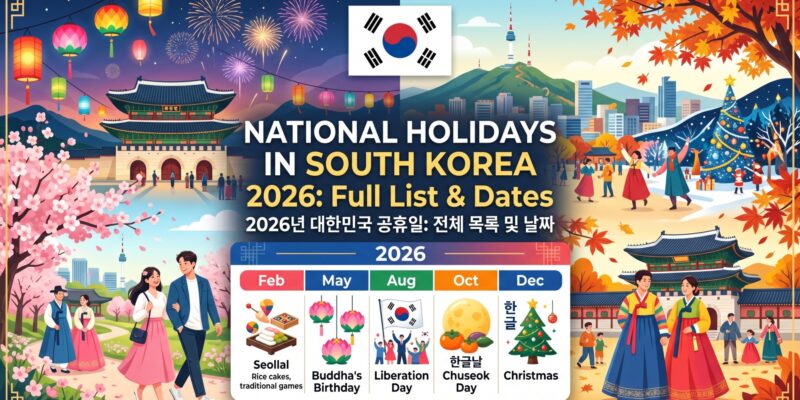
National Holidays in South Korea 2026: Full List, Dates & Travel Tips

28 Sep 2026 - Uncategorized
shape
shape
shape
National Holidays in South Korea 2026: Full List, Dates & Travel Tips If you are planning to study, work, or travel in Korea, knowing the national holidays in South Korea is one of the most practical things you can do before you book a ticket or sign a lease. Offices, banks, government counters, and many restaurants close on these days. Trains sell out weeks in advance. Whole cities empty out, then refill within 48 hours. This guide covers every South Korea public holiday, the exact 2026 dates, the rules for substitute holidays, and the practical tips that Indian students and travelers actually need. It also explains what each Korean holiday means, so you understand the culture behind the day off and not only the date on the calendar. Quick answer: In 2026, the national holidays in South Korea are New Year's Day, Seollal (Lunar New Year), Independence Movement Day, Labor Day, Children's Day, Buddha's Birthday, Memorial Day, Constitution Day, Liberation Day, Chuseok, National Foundation Day, Hangeul Day, and Christmas. Several fall on weekends, so the government adds substitute days off. Table of Contents South Korea Public Holidays 2026 at a Glance What Is New in the South Korea Holiday Calendar for 2026 Complete List of National Holidays in South Korea Explained How Substitute Holidays Work in South Korea Seollal and Chuseok: The Two Biggest Korean Holidays Korean Holidays vs Indian Holidays: Key Differences Travel Tips for Visiting South Korea During National Holidays Holiday Guide for Indian Students in South Korea Working in South Korea: Holidays and Paid Leave Best Time to Visit South Korea Around the Holiday Calendar Frequently Asked Questions About South Korea National Holidays Final Thoughts South Korea Public Holidays 2026 at a Glance The table below is your quick South Korea holiday calendar for 2026. Lunar holidays such as Seollal, Buddha's Birthday, and Chuseok move every year, while solar holidays stay on fixed dates. Holiday Korean Name 2026 Date Type New Year's Day 신정 (Sinjeong) Thursday, January 1 Solar Seollal (Lunar New Year) 설날 February 16 to 18 Lunar, 3 days Independence Movement Day 삼일절 (Samiljeol) Sunday, March 1 (substitute: Monday, March 2) Solar Labor Day 노동절 Friday, May 1 Solar, new public holiday in 2026 Children's Day 어린이날 Tuesday, May 5 Solar Buddha's Birthday 부처님 오신 날 Sunday, May 24 (substitute: Monday, May 25) Lunar Local Election Day (one-off) 지방선거일 Wednesday, June 3 One-time Memorial Day 현충일 (Hyeonchung-il) Saturday, June 6 Solar Constitution Day 제헌절 (Jeheonjeol) Friday, July 17 Solar, reinstated in 2026 Liberation Day 광복절 (Gwangbokjeol) Saturday, August 15 (substitute: Monday, August 17) Solar Chuseok (Korean Thanksgiving) 추석 September 24 to 26 Lunar, 3 days National Foundation Day 개천절 (Gaecheonjeol) Saturday, October 3 (substitute: Monday, October 5) Solar Hangeul Day 한글날 Friday, October 9 Solar Christmas Day 성탄절 Friday, December 25 Solar Holiday rules can be updated by the Korean government. Always confirm final dates with official sources before booking time-sensitive travel. What Is New in the South Korea Holiday Calendar for 2026 2026 is an unusual year for Korean public holidays, and older blog posts and printed calendars are already out of date. Two changes matter most. Labor Day (May 1) is now a public holiday for everyone. Before 2026, May 1 was a paid day off mainly for employees covered by the Labor Standards Act. Civil servants and teachers, who fall outside that law, usually worked. From 2026, the day off applies much more broadly. Constitution Day (July 17) returned as a public holiday. It was removed from the official day-off list in 2008 when the five-day work week was introduced, and it stayed only as a commemorative day for 18 years. In 2026 it came back, which means all five of Korea's major national days (Independence Movement Day, Constitution Day, Liberation Day, National Foundation Day, and Hangeul Day) are now public holidays. The 2026 calendar also includes a one-off holiday on June 3 for the nationwide local elections. Complete List of National Holidays in South Korea Explained Here is what each holiday means, how Koreans observe it, and what it changes for you on the ground. New Year's Day (January 1) New Year's Day is the quiet cousin of Seollal. Koreans mark the solar new year with sunrise trips to the east coast, mostly to Jeongdongjin and Homigot, and many people eat tteokguk (rice cake soup) even though that dish traditionally belongs to Seollal. It is a single-day holiday, and it is one of only two holidays that do not receive a substitute day when they land on a weekend. Seollal: Korean Lunar New Year (February 16 to 18, 2026) Seollal is the biggest family holiday of the year. Families gather, perform ancestral rites (charye), wear hanbok, play games like yutnori, and children bow to elders to receive pocket money called sebaetdon. The holiday runs for three days, covering the day before, the day itself, and the day after. Seollal lands in the coldest part of winter, so if you are planning a trip around it, read our guide to the South Korea winter season for clothing, weather, and festival advice. In 2027, Seollal falls from February 6 to 9, including a substitute day. Independence Movement Day (March 1) Known as Samiljeol, this holiday commemorates the nationwide, peaceful protest against Japanese colonial rule that began on March 1, 1919. Ceremonies are held in Seoul, and the national flag (Taegukgi) is displayed from homes and public buildings. In 2026 the date fell on a Sunday, so Monday, March 2 became the substitute holiday. March also marks the start of the Korean academic year, so this holiday often lands in the first week of class for new students. If you are arriving in spring, our spring in South Korea guide explains the weather, cherry blossom timing, and what campus life looks like. Labor Day (May 1) Labor Day is the newest addition to the universal public holiday list. Before 2026 many public-sector employees worked through it. Now banks, schools, and government offices are far more likely to close. If you are planning to work in South Korea, this is a useful change to know about, since it adds a guaranteed day off to your yearly schedule. Children's Day (May 5) Children's Day, or Eorininal, began in 1922 when a group led by Bang Jeong-hwan declared a day to honor children's dignity and happiness. It became a public holiday in 1975. Parents take their kids to amusement parks, zoos, museums, and outdoor festivals, so popular attractions get very crowded. If you want to avoid the rush but still explore, browse our list of must-visit places in South Korea and pick lesser-known spots for that day. Buddha's Birthday (8th Day of the 4th Lunar Month) Buddha's Birthday, called Bucheonnim Osinnal, falls on May 24 in 2026 and May 13 in 2027. Temples across the country hang colorful lanterns, and Seoul hosts the Lotus Lantern Festival with a large evening parade. Many temples serve free vegetarian meals and offer temple experiences for visitors. To understand how Buddhism and other traditions shape daily life, explore our overview of K-culture. Memorial Day (June 6) Memorial Day, or Hyeonchung-il, honors soldiers and independence fighters who gave their lives for the country. At 10 a.m. a siren sounds nationwide, and people observe one minute of silence. The flag is flown at half-mast, and the main ceremony is held at the Seoul National Cemetery. It is a solemn day, not a festive one, so keep your behavior respectful in public spaces. For the history, customs, and etiquette in detail, read our full guide to Memorial Day in South Korea. Memorial Day is one of the two holidays that do not get a substitute day. In 2026 it fell on a Saturday, so no extra weekday off was added. Constitution Day (July 17) Constitution Day, or Jeheonjeol, marks the promulgation of the Republic of Korea's constitution on July 17, 1948. It was a public holiday from 1949, was dropped from the day-off list in 2008, and returned in 2026. The main ceremony is normally held in Seoul, close to the legislature. To learn how that institution works, see our guide to the National Assembly of South Korea, and for the wider picture of how the country is governed, read whether South Korea is a democracy. Liberation Day (August 15) Liberation Day, or Gwangbokjeol, celebrates the end of Japanese colonial rule in 1945 and the founding of the Korean government on the same date in 1948. The word Gwangbok means "restoration of light." The president delivers a speech, the flag is displayed everywhere, and the date is also a strong reminder that India and Korea share an independence day on August 15. If that connection interests you, read about the shared freedom history of South Korea and India, or explore the Gwangbokjeol guide for the ceremonies and history behind the day. In 2026 August 15 fell on a Saturday, so Monday, August 17 became the substitute holiday. Chuseok: Korean Thanksgiving (September 24 to 26, 2026) Chuseok, on the 15th day of the 8th lunar month, is the harvest festival and the second major family holiday. Families visit ancestral hometowns, honor ancestors, and share songpyeon (half-moon rice cakes), jeon (savory pancakes), and fresh fruit. The main day of Chuseok in 2026 was September 25, with the day before and after also off. In 2027 it runs from September 21 to 23. If you are planning a Chuseok trip in a future year, book travel early. Our guide to India to South Korea ticket prices covers how fares change around peak periods. If a Korean friend invites you home for the holiday, read up on K-manners first, especially gift-giving and table etiquette. National Foundation Day (October 3) National Foundation Day, or Gaecheonjeol, means "the day the heavens opened." It celebrates the legendary founding of the first Korean kingdom, Gojoseon, by Dangun, traditionally dated to 2333 BCE. Ceremonies take place at Mount Manisan on Ganghwa Island and in Seoul. In 2026 October 3 fell on a Saturday, so Monday, October 5 became the substitute holiday. To understand the modern political and cultural gap on the peninsula that grew from this shared history, see our guide to differences between South Korea and North Korea. Hangeul Day (October 9) Hangeul Day celebrates the promulgation of Hangeul, the Korean alphabet, by King Sejong the Great in 1446. Koreans take great pride in it because it was designed to be simple enough for anyone to learn. Museums, cultural centers, and universities run calligraphy workshops and exhibitions. For international students, it is also a good reminder to start learning the language, and our K-Courses page is a good place to begin. Christmas Day (December 25) Christmas is a public holiday in South Korea, and it feels more like a couples' and friends' day than a family one. Cities light up, cafes decorate heavily, and restaurants fill with reservations. If you spend December in Seoul, use our Seoul travel guide to plan neighborhoods, sights, and winter activities. How Substitute Holidays Work in South Korea A substitute holiday (daechae gonghyuil) gives you a weekday off when a public holiday lands on a weekend or overlaps another holiday. The rule applies to Seollal, Chuseok, Children's Day, Buddha's Birthday, Independence Movement Day, Liberation Day, National Foundation Day, Hangeul Day, and Christmas. New Year's Day and Memorial Day are excluded. In 2026 the substitute days were: Monday, March 2, replacing Independence Movement Day (Sunday, March 1) Monday, May 25, replacing Buddha's Birthday (Sunday, May 24) Monday, August 17, replacing Liberation Day (Saturday, August 15) Monday, October 5, replacing National Foundation Day (Saturday, October 3) For Seollal and Chuseok, a substitute day is granted mainly when the holiday overlaps a Sunday or another holiday. That is why Chuseok 2026, which ran Thursday to Saturday, did not receive an extra Monday. Substitute days create three-day weekends, and those weekends are the most popular times for domestic tourism. Expect full expressways and sold-out KTX seats. Seollal and Chuseok: The Two Biggest Korean Holidays These two holidays behave differently from every other day on the calendar, so they deserve a separate look. Transport is the main challenge. Millions of people travel to their hometowns at once. Intercity trains, express buses, and domestic flights can sell out within minutes of opening. Reserve four to six weeks ahead if you must travel. Cities go quiet. Seoul feels emptier than usual. Some small shops, traditional markets, and family restaurants close for one to three days. Convenience stores, large restaurants, department stores, and major tourist sites usually stay open, but check hours before you go. Expect a warm cultural moment. Hanbok appear on the streets, cultural performances are held at palaces and folk villages, and special food stalls appear. For visitors, this is one of the best times to experience Korean culture, as long as you plan transport and meals in advance. Prices move. Domestic flights, hotels in tourist areas like Jeju, and rental cars all rise in price. Hotels in Seoul itself can sometimes get cheaper, since many domestic visitors leave the city. Korean Holidays vs Indian Holidays: Key Differences Indian students and travelers often ask how the Korean calendar compares with what they know at home. Festivals of lights and colors are not public holidays. Diwali, Holi, and Eid are not national holidays in Korea. Indian communities in cities like Seoul and Busan often hold their own celebrations, but offices and classes run as normal. The lunar calendar is important in both countries. Like many Indian festivals, Seollal, Buddha's Birthday, and Chuseok move each year because they follow the lunar calendar. Independence Day shares a date. Both India and Korea celebrate national independence on August 15, although the historical stories are different. Korean holidays are family-centered and travel-heavy. Seollal and Chuseok involve a mass movement of people, similar in scale to travel before Diwali or Eid in India. Substitute days are a formal legal system. India has no equivalent rule that shifts a weekend holiday to a Monday, so this can surprise new arrivals. If you are still adjusting to the wider rhythm of daily life, our guide to life in South Korea for Indians and students covers food, transport, housing, and cultural habits. Travel Tips for Visiting South Korea During National Holidays A holiday can improve a trip or complicate it. These steps help you get the good version. Sort your paperwork first. Embassies, consulates, and immigration offices close on public holidays, so apply early. Read our guide to the South Korea visa for Indian passport holders so you do not run into a closure at the wrong moment. Book flights early. Peak holiday dates push fares up. Compare routes and timing before you buy. Book accommodation early too. Hotels near major sights and on Jeju fill quickly. Our South Korea hotel booking guide explains what to look for, and budget travelers can check our South Korea guest house guide. Carry cash and a card. Traditional markets and small shops sometimes prefer cash. Learn the basics of the currency of South Korea before you land. Build a flexible itinerary. Use our 7-day South Korea itinerary as a base, then swap in indoor stops if a holiday crowd is too heavy at an outdoor site. Check opening hours. Museums, palaces, and small restaurants may change their schedules on holidays. Use convenience stores as a backup. They stay open almost everywhere and sell hot meals, drinks, and basic supplies. Holiday Guide for Indian Students in South Korea If you study in Korea, the holiday calendar affects more than your free time. Classes and exams. Universities plan their calendars around national holidays. Seollal falls during winter break at most schools, while Chuseok usually lands in the middle of the autumn semester, often with a longer break around it. Check your academic calendar every semester. Dormitories and cafeterias. Some dorms limit services and campus cafeterias close during Seollal and Chuseok. Stock up on food and basic supplies a few days early. Administrative deadlines. Visa extensions, alien registration, banking tasks, and health insurance matters all depend on government and bank offices, which close on public holidays. Never leave these to the last day before a long weekend. Make the most of the breaks. Long weekends are a good opportunity to travel domestically, join university cultural programs, or take a Korean language class. Many international student groups arrange trips together during Chuseok. Start with the basics. If you are still deciding where and how to study, read our guide on how to study in South Korea as an Indian student, and explore our student life section for housing, budgeting, and campus advice. Working in South Korea: Holidays and Paid Leave If you plan to work in Korea, national holidays are part of your total time off. Public holidays are separate from annual paid leave, and rules can differ between workplaces, so read your contract carefully. Employees in shift-based jobs, delivery, and some service sectors may still work on certain public holidays and receive premium pay or a substitute rest day according to their agreement. The 2026 changes to Labor Day and Constitution Day broadened the set of people who receive days off. For a wider view of careers, contracts, and visas, see our guide to working in South Korea. Best Time to Visit South Korea Around the Holiday Calendar Whether you want quiet streets or a festival atmosphere, the holiday calendar can guide your travel dates. For culture and festivals: Visit during Buddha's Birthday for lantern displays, Hangeul Day for language events, or Seollal and Chuseok for traditional performances. For low crowds and lower prices: Avoid Children's Day weekend, Chuseok travel days, and the three-day weekends created by substitute holidays. For seasonal scenery: Spring brings cherry blossoms near March 1 and Children's Day, while autumn brings foliage around Chuseok, Foundation Day, and Hangeul Day. Frequently Asked Questions About South Korea National Holidays How many national holidays does South Korea have? South Korea has more than a dozen recurring public holidays each year, including the multi-day Seollal and Chuseok periods. The exact number of days off changes annually because substitute holidays and one-off days, such as election days, are added depending on the calendar. In 2026, Labor Day and Constitution Day joined the public holiday list. What are the biggest holidays in South Korea? Seollal (Lunar New Year) and Chuseok (Korean Thanksgiving) are the biggest. Both last three days, involve family gatherings and ancestral rites, and cause the largest travel rush of the year. When is Chuseok in 2026 and 2027? Chuseok 2026 ran from September 24 to 26, with the main day on September 25. In 2027 it runs from September 21 to 23. When is Seollal in 2026 and 2027? Seollal 2026 was February 16 to 18. In 2027 it runs from February 6 to 9, including a substitute holiday. Is Labor Day a public holiday in South Korea? Yes. From 2026, Labor Day on May 1 is a public holiday for everyone, including civil servants and teachers who did not always receive the day off before. Is Constitution Day a public holiday in South Korea? Yes. Constitution Day on July 17 was reinstated as a public holiday in 2026 after being removed from the day-off list in 2008. Which Korean holidays get substitute days? Seollal, Chuseok, Children's Day, Buddha's Birthday, Independence Movement Day, Liberation Day, National Foundation Day, Hangeul Day, and Christmas. New Year's Day and Memorial Day do not. Are shops and restaurants open on Korean public holidays? Most convenience stores, department stores, large restaurants, and tourist attractions stay open. On Seollal and Chuseok, many small shops, traditional markets, and family-run restaurants close for one to three days, so plan meals ahead. Is Diwali a public holiday in South Korea? No. Diwali, Holi, and Eid are not national holidays in Korea. Indian communities often celebrate privately or in community events. Should I travel to South Korea during Chuseok or Seollal? You can, but book flights, trains, and hotels well ahead, expect some closures, and treat it as a cultural experience instead of a normal sightseeing week. If you prefer quiet, efficient travel, avoid the three days around each holiday. Do government offices and immigration offices close on national holidays? Yes. Government offices, banks, and visa-related counters generally close on public holidays, so schedule visa, residence card, and bank tasks on regular working days. Final Thoughts The national holidays in South Korea are more than days off. They are a window into the country's history, family values, and seasons. Knowing the dates helps you avoid closures, get better fares, and join celebrations you would otherwise miss. With Labor Day and Constitution Day now added to the calendar and substitute days creating several long weekends, 2026 is a good year to build the calendar into your plans early. Whether you are applying for a student visa, planning your first trip, or preparing to move for work, start with the fundamentals and build outward. Explore the Study in South Korea homepage for more guides, or contact our team if you want personal help planning your move.

National Holidays in South Korea 2026: Full List, Dates & Travel Tips

If you are planning to study, work, or travel in Korea, knowing the national holidays in South Korea is one of the most practical things you can do before you book a ticket or sign a lease. Offices, banks, government counters, and many restaurants close on these days. Trains sell out weeks in advance. Whole cities empty out, then refill within 48 hours.

This guide covers every South Korea public holiday, the exact 2026 dates, the rules for substitute holidays, and the practical tips that Indian students and travelers actually need. It also explains what each Korean holiday means, so you understand the culture behind the day off and not only the date on the calendar.

Quick answer: In 2026, the national holidays in South Korea are New Year’s Day, Seollal (Lunar New Year), Independence Movement Day, Labor Day, Children’s Day, Buddha’s Birthday, Memorial Day, Constitution Day, Liberation Day, Chuseok, National Foundation Day, Hangeul Day, and Christmas. Several fall on weekends, so the government adds substitute days off.

South Korea Public Holidays 2026 at a Glance

The table below is your quick South Korea holiday calendar for 2026. Lunar holidays such as Seollal, Buddha’s Birthday, and Chuseok move every year, while solar holidays stay on fixed dates.

HolidayKorean Name2026 DateType
New Year’s Day신정 (Sinjeong)Thursday, January 1Solar
Seollal (Lunar New Year)설날February 16 to 18Lunar, 3 days
Independence Movement Day삼일절 (Samiljeol)Sunday, March 1 (substitute: Monday, March 2)Solar
Labor Day노동절Friday, May 1Solar, new public holiday in 2026
Children’s Day어린이날Tuesday, May 5Solar
Buddha’s Birthday부처님 오신 날Sunday, May 24 (substitute: Monday, May 25)Lunar
Local Election Day (one-off)지방선거일Wednesday, June 3One-time
Memorial Day현충일 (Hyeonchung-il)Saturday, June 6Solar
Constitution Day제헌절 (Jeheonjeol)Friday, July 17Solar, reinstated in 2026
Liberation Day광복절 (Gwangbokjeol)Saturday, August 15 (substitute: Monday, August 17)Solar
Chuseok (Korean Thanksgiving)추석September 24 to 26Lunar, 3 days
National Foundation Day개천절 (Gaecheonjeol)Saturday, October 3 (substitute: Monday, October 5)Solar
Hangeul Day한글날Friday, October 9Solar
Christmas Day성탄절Friday, December 25Solar

Holiday rules can be updated by the Korean government. Always confirm final dates with official sources before booking time-sensitive travel.

What Is New in the South Korea Holiday Calendar for 2026

2026 is an unusual year for Korean public holidays, and older blog posts and printed calendars are already out of date. Two changes matter most.

Labor Day (May 1) is now a public holiday for everyone. Before 2026, May 1 was a paid day off mainly for employees covered by the Labor Standards Act. Civil servants and teachers, who fall outside that law, usually worked. From 2026, the day off applies much more broadly.

Constitution Day (July 17) returned as a public holiday. It was removed from the official day-off list in 2008 when the five-day work week was introduced, and it stayed only as a commemorative day for 18 years. In 2026 it came back, which means all five of Korea’s major national days (Independence Movement Day, Constitution Day, Liberation Day, National Foundation Day, and Hangeul Day) are now public holidays.

The 2026 calendar also includes a one-off holiday on June 3 for the nationwide local elections.

Complete List of National Holidays in South Korea Explained

Here is what each holiday means, how Koreans observe it, and what it changes for you on the ground.

New Year’s Day (January 1)

New Year’s Day is the quiet cousin of Seollal. Koreans mark the solar new year with sunrise trips to the east coast, mostly to Jeongdongjin and Homigot, and many people eat tteokguk (rice cake soup) even though that dish traditionally belongs to Seollal. It is a single-day holiday, and it is one of only two holidays that do not receive a substitute day when they land on a weekend.

Seollal: Korean Lunar New Year (February 16 to 18, 2026)

Seollal is the biggest family holiday of the year. Families gather, perform ancestral rites (charye), wear hanbok, play games like yutnori, and children bow to elders to receive pocket money called sebaetdon. The holiday runs for three days, covering the day before, the day itself, and the day after.

Seollal lands in the coldest part of winter, so if you are planning a trip around it, read our guide to the South Korea winter season for clothing, weather, and festival advice. In 2027, Seollal falls from February 6 to 9, including a substitute day.

Independence Movement Day (March 1)

Known as Samiljeol, this holiday commemorates the nationwide, peaceful protest against Japanese colonial rule that began on March 1, 1919. Ceremonies are held in Seoul, and the national flag (Taegukgi) is displayed from homes and public buildings. In 2026 the date fell on a Sunday, so Monday, March 2 became the substitute holiday.

March also marks the start of the Korean academic year, so this holiday often lands in the first week of class for new students. If you are arriving in spring, our spring in South Korea guide explains the weather, cherry blossom timing, and what campus life looks like.

Labor Day (May 1)

Labor Day is the newest addition to the universal public holiday list. Before 2026 many public-sector employees worked through it. Now banks, schools, and government offices are far more likely to close. If you are planning to work in South Korea, this is a useful change to know about, since it adds a guaranteed day off to your yearly schedule.

Children’s Day (May 5)

Children’s Day, or Eorininal, began in 1922 when a group led by Bang Jeong-hwan declared a day to honor children’s dignity and happiness. It became a public holiday in 1975. Parents take their kids to amusement parks, zoos, museums, and outdoor festivals, so popular attractions get very crowded. If you want to avoid the rush but still explore, browse our list of must-visit places in South Korea and pick lesser-known spots for that day.

Buddha’s Birthday (8th Day of the 4th Lunar Month)

Buddha’s Birthday, called Bucheonnim Osinnal, falls on May 24 in 2026 and May 13 in 2027. Temples across the country hang colorful lanterns, and Seoul hosts the Lotus Lantern Festival with a large evening parade. Many temples serve free vegetarian meals and offer temple experiences for visitors. To understand how Buddhism and other traditions shape daily life, explore our overview of K-culture.

Memorial Day (June 6)

Memorial Day, or Hyeonchung-il, honors soldiers and independence fighters who gave their lives for the country. At 10 a.m. a siren sounds nationwide, and people observe one minute of silence. The flag is flown at half-mast, and the main ceremony is held at the Seoul National Cemetery. It is a solemn day, not a festive one, so keep your behavior respectful in public spaces. For the history, customs, and etiquette in detail, read our full guide to Memorial Day in South Korea.

Memorial Day is one of the two holidays that do not get a substitute day. In 2026 it fell on a Saturday, so no extra weekday off was added.

Constitution Day (July 17)

Constitution Day, or Jeheonjeol, marks the promulgation of the Republic of Korea’s constitution on July 17, 1948. It was a public holiday from 1949, was dropped from the day-off list in 2008, and returned in 2026. The main ceremony is normally held in Seoul, close to the legislature. To learn how that institution works, see our guide to the National Assembly of South Korea, and for the wider picture of how the country is governed, read whether South Korea is a democracy.

Liberation Day (August 15)

Liberation Day, or Gwangbokjeol, celebrates the end of Japanese colonial rule in 1945 and the founding of the Korean government on the same date in 1948. The word Gwangbok means “restoration of light.” The president delivers a speech, the flag is displayed everywhere, and the date is also a strong reminder that India and Korea share an independence day on August 15. If that connection interests you, read about the shared freedom history of South Korea and India, or explore the Gwangbokjeol guide for the ceremonies and history behind the day.

In 2026 August 15 fell on a Saturday, so Monday, August 17 became the substitute holiday.

Chuseok: Korean Thanksgiving (September 24 to 26, 2026)

Chuseok, on the 15th day of the 8th lunar month, is the harvest festival and the second major family holiday. Families visit ancestral hometowns, honor ancestors, and share songpyeon (half-moon rice cakes), jeon (savory pancakes), and fresh fruit. The main day of Chuseok in 2026 was September 25, with the day before and after also off. In 2027 it runs from September 21 to 23.

If you are planning a Chuseok trip in a future year, book travel early. Our guide to India to South Korea ticket prices covers how fares change around peak periods. If a Korean friend invites you home for the holiday, read up on K-manners first, especially gift-giving and table etiquette.

National Foundation Day (October 3)

National Foundation Day, or Gaecheonjeol, means “the day the heavens opened.” It celebrates the legendary founding of the first Korean kingdom, Gojoseon, by Dangun, traditionally dated to 2333 BCE. Ceremonies take place at Mount Manisan on Ganghwa Island and in Seoul. In 2026 October 3 fell on a Saturday, so Monday, October 5 became the substitute holiday. To understand the modern political and cultural gap on the peninsula that grew from this shared history, see our guide to differences between South Korea and North Korea.

Hangeul Day (October 9)

Hangeul Day celebrates the promulgation of Hangeul, the Korean alphabet, by King Sejong the Great in 1446. Koreans take great pride in it because it was designed to be simple enough for anyone to learn. Museums, cultural centers, and universities run calligraphy workshops and exhibitions. For international students, it is also a good reminder to start learning the language, and our K-Courses page is a good place to begin.

Christmas Day (December 25)

Christmas is a public holiday in South Korea, and it feels more like a couples’ and friends’ day than a family one. Cities light up, cafes decorate heavily, and restaurants fill with reservations. If you spend December in Seoul, use our Seoul travel guide to plan neighborhoods, sights, and winter activities.

How Substitute Holidays Work in South Korea

A substitute holiday (daechae gonghyuil) gives you a weekday off when a public holiday lands on a weekend or overlaps another holiday. The rule applies to Seollal, Chuseok, Children’s Day, Buddha’s Birthday, Independence Movement Day, Liberation Day, National Foundation Day, Hangeul Day, and Christmas. New Year’s Day and Memorial Day are excluded.

In 2026 the substitute days were:

  • Monday, March 2, replacing Independence Movement Day (Sunday, March 1)
  • Monday, May 25, replacing Buddha’s Birthday (Sunday, May 24)
  • Monday, August 17, replacing Liberation Day (Saturday, August 15)
  • Monday, October 5, replacing National Foundation Day (Saturday, October 3)

For Seollal and Chuseok, a substitute day is granted mainly when the holiday overlaps a Sunday or another holiday. That is why Chuseok 2026, which ran Thursday to Saturday, did not receive an extra Monday.

Substitute days create three-day weekends, and those weekends are the most popular times for domestic tourism. Expect full expressways and sold-out KTX seats.

Seollal and Chuseok: The Two Biggest Korean Holidays

These two holidays behave differently from every other day on the calendar, so they deserve a separate look.

Transport is the main challenge. Millions of people travel to their hometowns at once. Intercity trains, express buses, and domestic flights can sell out within minutes of opening. Reserve four to six weeks ahead if you must travel.

Cities go quiet. Seoul feels emptier than usual. Some small shops, traditional markets, and family restaurants close for one to three days. Convenience stores, large restaurants, department stores, and major tourist sites usually stay open, but check hours before you go.

Expect a warm cultural moment. Hanbok appear on the streets, cultural performances are held at palaces and folk villages, and special food stalls appear. For visitors, this is one of the best times to experience Korean culture, as long as you plan transport and meals in advance.

Prices move. Domestic flights, hotels in tourist areas like Jeju, and rental cars all rise in price. Hotels in Seoul itself can sometimes get cheaper, since many domestic visitors leave the city.

Korean Holidays vs Indian Holidays: Key Differences

Indian students and travelers often ask how the Korean calendar compares with what they know at home.

  • Festivals of lights and colors are not public holidays. Diwali, Holi, and Eid are not national holidays in Korea. Indian communities in cities like Seoul and Busan often hold their own celebrations, but offices and classes run as normal.
  • The lunar calendar is important in both countries. Like many Indian festivals, Seollal, Buddha’s Birthday, and Chuseok move each year because they follow the lunar calendar.
  • Independence Day shares a date. Both India and Korea celebrate national independence on August 15, although the historical stories are different.
  • Korean holidays are family-centered and travel-heavy. Seollal and Chuseok involve a mass movement of people, similar in scale to travel before Diwali or Eid in India.
  • Substitute days are a formal legal system. India has no equivalent rule that shifts a weekend holiday to a Monday, so this can surprise new arrivals.

If you are still adjusting to the wider rhythm of daily life, our guide to life in South Korea for Indians and students covers food, transport, housing, and cultural habits.

Travel Tips for Visiting South Korea During National Holidays

A holiday can improve a trip or complicate it. These steps help you get the good version.

  1. Sort your paperwork first. Embassies, consulates, and immigration offices close on public holidays, so apply early. Read our guide to the South Korea visa for Indian passport holders so you do not run into a closure at the wrong moment.
  2. Book flights early. Peak holiday dates push fares up. Compare routes and timing before you buy.
  3. Book accommodation early too. Hotels near major sights and on Jeju fill quickly. Our South Korea hotel booking guide explains what to look for, and budget travelers can check our South Korea guest house guide.
  4. Carry cash and a card. Traditional markets and small shops sometimes prefer cash. Learn the basics of the currency of South Korea before you land.
  5. Build a flexible itinerary. Use our 7-day South Korea itinerary as a base, then swap in indoor stops if a holiday crowd is too heavy at an outdoor site.
  6. Check opening hours. Museums, palaces, and small restaurants may change their schedules on holidays.
  7. Use convenience stores as a backup. They stay open almost everywhere and sell hot meals, drinks, and basic supplies.

Holiday Guide for Indian Students in South Korea

If you study in Korea, the holiday calendar affects more than your free time.

Classes and exams. Universities plan their calendars around national holidays. Seollal falls during winter break at most schools, while Chuseok usually lands in the middle of the autumn semester, often with a longer break around it. Check your academic calendar every semester.

Dormitories and cafeterias. Some dorms limit services and campus cafeterias close during Seollal and Chuseok. Stock up on food and basic supplies a few days early.

Administrative deadlines. Visa extensions, alien registration, banking tasks, and health insurance matters all depend on government and bank offices, which close on public holidays. Never leave these to the last day before a long weekend.

Make the most of the breaks. Long weekends are a good opportunity to travel domestically, join university cultural programs, or take a Korean language class. Many international student groups arrange trips together during Chuseok.

Start with the basics. If you are still deciding where and how to study, read our guide on how to study in South Korea as an Indian student, and explore our student life section for housing, budgeting, and campus advice.

Working in South Korea: Holidays and Paid Leave

If you plan to work in Korea, national holidays are part of your total time off. Public holidays are separate from annual paid leave, and rules can differ between workplaces, so read your contract carefully. Employees in shift-based jobs, delivery, and some service sectors may still work on certain public holidays and receive premium pay or a substitute rest day according to their agreement.

The 2026 changes to Labor Day and Constitution Day broadened the set of people who receive days off. For a wider view of careers, contracts, and visas, see our guide to working in South Korea.

Best Time to Visit South Korea Around the Holiday Calendar

Whether you want quiet streets or a festival atmosphere, the holiday calendar can guide your travel dates.

  • For culture and festivals: Visit during Buddha’s Birthday for lantern displays, Hangeul Day for language events, or Seollal and Chuseok for traditional performances.
  • For low crowds and lower prices: Avoid Children’s Day weekend, Chuseok travel days, and the three-day weekends created by substitute holidays.
  • For seasonal scenery: Spring brings cherry blossoms near March 1 and Children’s Day, while autumn brings foliage around Chuseok, Foundation Day, and Hangeul Day.

Frequently Asked Questions About South Korea National Holidays

How many national holidays does South Korea have?

South Korea has more than a dozen recurring public holidays each year, including the multi-day Seollal and Chuseok periods. The exact number of days off changes annually because substitute holidays and one-off days, such as election days, are added depending on the calendar. In 2026, Labor Day and Constitution Day joined the public holiday list.

What are the biggest holidays in South Korea?

Seollal (Lunar New Year) and Chuseok (Korean Thanksgiving) are the biggest. Both last three days, involve family gatherings and ancestral rites, and cause the largest travel rush of the year.

When is Chuseok in 2026 and 2027?

Chuseok 2026 ran from September 24 to 26, with the main day on September 25. In 2027 it runs from September 21 to 23.

When is Seollal in 2026 and 2027?

Seollal 2026 was February 16 to 18. In 2027 it runs from February 6 to 9, including a substitute holiday.

Is Labor Day a public holiday in South Korea?

Yes. From 2026, Labor Day on May 1 is a public holiday for everyone, including civil servants and teachers who did not always receive the day off before.

Is Constitution Day a public holiday in South Korea?

Yes. Constitution Day on July 17 was reinstated as a public holiday in 2026 after being removed from the day-off list in 2008.

Which Korean holidays get substitute days?

Seollal, Chuseok, Children’s Day, Buddha’s Birthday, Independence Movement Day, Liberation Day, National Foundation Day, Hangeul Day, and Christmas. New Year’s Day and Memorial Day do not.

Are shops and restaurants open on Korean public holidays?

Most convenience stores, department stores, large restaurants, and tourist attractions stay open. On Seollal and Chuseok, many small shops, traditional markets, and family-run restaurants close for one to three days, so plan meals ahead.

Is Diwali a public holiday in South Korea?

No. Diwali, Holi, and Eid are not national holidays in Korea. Indian communities often celebrate privately or in community events.

Should I travel to South Korea during Chuseok or Seollal?

You can, but book flights, trains, and hotels well ahead, expect some closures, and treat it as a cultural experience instead of a normal sightseeing week. If you prefer quiet, efficient travel, avoid the three days around each holiday.

Do government offices and immigration offices close on national holidays?

Yes. Government offices, banks, and visa-related counters generally close on public holidays, so schedule visa, residence card, and bank tasks on regular working days.

Final Thoughts

The national holidays in South Korea are more than days off. They are a window into the country’s history, family values, and seasons. Knowing the dates helps you avoid closures, get better fares, and join celebrations you would otherwise miss. With Labor Day and Constitution Day now added to the calendar and substitute days creating several long weekends, 2026 is a good year to build the calendar into your plans early.

Whether you are applying for a student visa, planning your first trip, or preparing to move for work, start with the fundamentals and build outward. Explore the Study in South Korea for more guides, or contact our team if you want personal help planning your move.

Comment