


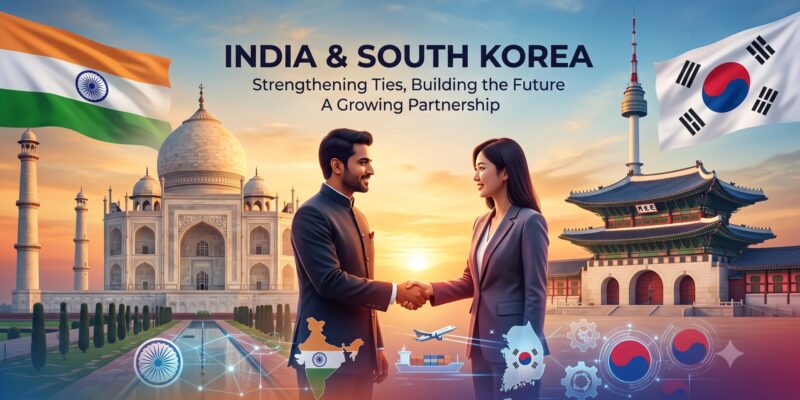
Relationship Between India and South Korea: History, Trade, Defence, Culture and the 2026 Roadmap
The relationship between India and South Korea has moved from a quiet, mostly commercial friendship into one of Asia’s most closely watched partnerships. In April 2026, the two governments adopted a Joint Strategic Vision for 2026-2030, restarted talks to upgrade their trade agreement and set a trade goal of 50 billion US dollars by 2030. For an Indian student, traveler or professional, this is not just diplomacy. It shapes visas, scholarships, jobs, flights, products and the Korean brands you already use every day.
This guide explains the India South Korea relationship in plain language: how it began, how trade and investment grew, why defence and shipbuilding are now central, how culture connects both societies, where the real friction lies and what it all means for you.
Quick answer: The relationship between India and South Korea is a Special Strategic Partnership built on the 2010 CEPA trade agreement, strong Korean investment in India (Hyundai, Samsung, Kia, LG, POSCO), growing defence and shipbuilding cooperation, and deep cultural exchange through Hallyu and Indian heritage links. Its biggest open issue is the trade imbalance, which the ongoing CEPA upgrade is meant to fix.
Table of Contents
- India South Korea Relations at a Glance
- History of India South Korea Diplomatic Relations
- From Strategic Partnership to Special Strategic Partnership
- The April 2026 Summit and the Joint Strategic Vision 2026-2030
- India South Korea Trade and the CEPA Upgrade
- Korean Companies in India
- India South Korea Defence and Shipbuilding Cooperation
- Technology, Semiconductors and Energy Cooperation
- India South Korea Cultural Ties and People-to-People Links
- Education: Indian Students in South Korea
- Challenges in the India South Korea Relationship
- What the Relationship Means for Indians
- Future Outlook
- Frequently Asked Questions
India South Korea Relations at a Glance
| Area | Where things stand |
|---|---|
| Formal status | Special Strategic Partnership |
| Diplomatic relations | Consular ties from 1962, full diplomatic relations from 1973 |
| Trade framework | India-Korea CEPA, signed August 2009, in force from 1 January 2010 |
| Trade ambition | 50 billion US dollars bilateral trade by 2030 |
| CEPA upgrade | Talks resumed in 2026, with a stated aim of early conclusion by the first half of 2027 |
| Key Korean investors in India | Hyundai, Kia, Samsung, LG, POSCO, Hanwha |
| Defence highlight | K9 Vajra self-propelled howitzer, built in India by L&T with Hanwha technology |
| Newest priority | Shipbuilding, shipping and maritime logistics framework |
| Cultural bridge | Hallyu in India, Indian films and yoga in Korea, shared heritage links |
Figures and dates above reflect public information available in October 2026. Trade numbers and negotiation timelines move quickly, so check the Embassy of India in Seoul and the Ministry of Commerce for the latest official updates before you quote them.
History of India South Korea Diplomatic Relations
Early links before modern diplomacy
The story of India and Korea starts well before modern states existed. Korean tradition, recorded in the medieval chronicle Samguk Yusa, tells of Queen Heo Hwang-ok, said to have travelled from the kingdom of Ayodhya to marry King Suro of Gaya. Many Koreans trace their ancestry to this story, and a memorial to her stands in Ayodhya today. Whatever its historical certainty, it remains a living symbol that both governments use when they speak about civilisational ties.
Buddhism is the other great bridge. Buddhist thought, art and texts travelled from the Indian subcontinent through China into the Korean peninsula, shaping temples, monastic life and philosophy that are still visible in Korea. In 1929 the Indian poet Rabindranath Tagore wrote a short poem calling Korea a “lamp of the East”, a line many Koreans still remember.
The Korean War and the Cold War years
India played a visible humanitarian and diplomatic role in the Korean War. It sent a field ambulance unit to treat the wounded and later led the Neutral Nations Repatriation Commission that handled the exchange of prisoners after the 1953 armistice. Even so, the two countries drifted apart during the Cold War. India followed non-alignment and kept ties with both Koreas, while South Korea aligned closely with the United States. Trade stayed small and political contact was thin.
Formal relations: 1962 and 1973
Consular relations were set up in 1962, and full diplomatic relations followed in December 1973. The 50th anniversary was marked in 2023, a useful reminder that for most of this period the partnership grew slowly. The real acceleration came after India’s economic reforms of the 1990s, when Korean manufacturers started to see India as a major market and production base.
Key milestones
| Year | Milestone |
|---|---|
| 1962 | Consular relations established |
| 1973 | Full diplomatic relations established |
| 1996 | Hyundai begins its India journey, later building a large plant near Chennai |
| 2006 | President A.P.J. Abdul Kalam makes a state visit to South Korea |
| 2009-2010 | India-Korea CEPA signed and brought into force |
| 2010 | Relationship raised to a Strategic Partnership |
| 2015 | Relationship raised to a Special Strategic Partnership |
| 2018 | Samsung opens its large mobile phone factory in Noida; Korean leader visits India |
| 2023 | 50 years of diplomatic relations |
| 2026 | State visit by President Lee Jae-myung, Joint Strategic Vision 2026-2030 adopted |
From Strategic Partnership to Special Strategic Partnership
The 2010 Strategic Partnership recognised that the two countries shared interests beyond trade: stable sea lanes, democratic values, supply chain resilience and a rules-based order in Asia. In May 2015, during a summit between Prime Minister Narendra Modi and then-President Park Geun-hye, the relationship was elevated to a Special Strategic Partnership, a label India reserves for only a handful of countries.
Two policy ideas helped. India’s Act East Policy aimed to deepen engagement with East and Southeast Asia, while South Korea’s New Southern Policy aimed to widen its ties beyond traditional partners. The two fit together neatly, and they explain why the countries now talk about Indo-Pacific cooperation as naturally as they talk about trade.
If you want a shorter, friendlier explainer on whether the two nations are really close, see our post is India and South Korea friends. This guide goes much deeper on trade, defence, culture and the 2026 roadmap.
The April 2026 Summit and the Joint Strategic Vision 2026-2030
President Lee Jae-myung made a three-day state visit to India in April 2026, the first visit by a South Korean head of state in about eight years. Meeting Prime Minister Modi in New Delhi, he helped produce around 25 outcomes, including a Joint Strategic Vision for 2026-2030, agreements on the Special Strategic Partnership, a framework on shipbuilding, shipping and maritime logistics, and a document on energy and resource security.
The headline commitments were:
- Trade target: raise bilateral trade to 50 billion US dollars by 2030.
- CEPA upgrade: resume and expedite negotiations, with a stated aim of finishing by the first half of 2027.
- Shipbuilding and maritime cooperation: attract Korean shipyard expertise to Indian coastal clusters.
- Technology: cooperate on semiconductors, artificial intelligence, critical minerals and nuclear technology.
- Industry: create a Korean Industrial Township to help Korean small and medium enterprises set up in India.
- People: expand education, culture and talent exchange.
Prime Minister Modi described the aim as turning a trusted partnership into a futuristic one, from chips to ships and from entertainment to energy. Analysts also point out that the partnership should be judged by delivery, not declarations, since earlier summits promised a lot and delivered unevenly. For a broader look at how Seoul supports New Delhi across trade and culture, read our guide on South Korea support for India.
India South Korea Trade and the CEPA Upgrade
What the CEPA did
The Comprehensive Economic Partnership Agreement, signed on 7 August 2009 and effective from 1 January 2010, cut or removed tariffs on a large share of goods traded between the two countries and covered services and investment as well. After it came into force, bilateral trade rose sharply, from a modest base to roughly 20 to 28 billion US dollars a year in recent years, with a record in 2022.
Why India wants an upgrade
The core complaint is simple. South Korea sells far more to India than India sells to South Korea, so India runs a persistent trade deficit. India also argues that non-tariff barriers and limited access for Indian services and agricultural products hold back its exports. Since 2015, negotiators have held a dozen formal rounds to amend the agreement, the latest in New Delhi in May 2026, and a Joint Declaration in April 2026 set the target of an early conclusion by the first half of 2027.
What a stronger CEPA could mean
- Better market access for Indian goods, IT and professional services.
- Fewer non-tariff barriers on both sides.
- More predictable rules for Korean investors and for Indian exporters.
- A clearer path to the 50 billion US dollar trade target.
To understand how this fits with Korea’s wider network of deals, see our overview of South Korea trade agreements. If you are curious why a country with this much trade power is considered advanced, our explainer on whether South Korea is a rich country covers GDP and income.
Korean Companies in India
More than 700 Korean companies operate in India, and several of their brands are household names.
- Hyundai Motor India: one of the country’s leading carmakers, with a large manufacturing base near Chennai.
- Kia India: a plant in Andhra Pradesh that supports an expanding product range.
- Samsung: a major mobile phone factory in Noida and a very strong consumer electronics presence.
- LG Electronics: appliances and electronics made and sold across India.
- POSCO: steel investment, including a planned large steel project in Odisha with an Indian partner.
- Hanwha and other heavy industry groups: defence, shipbuilding and energy.
These firms create jobs, support Indian suppliers and carry Korean work culture into Indian workplaces. If you hope to work for a Korean employer, our guides on jobs in Korea for Indians and the list of companies in South Korea are good places to start. If you want to know what Korean brands are worth buying or bringing back, see South Korea products.
India South Korea Defence and Shipbuilding Cooperation
Defence is now a pillar of the relationship. The best-known example is the K9 Vajra-T, a tracked self-propelled howitzer built in India by Larsen and Toubro using technology from Hanwha. India has also placed follow-on orders for additional systems, which shows real commitment rather than a one-time purchase. The two countries have also set up higher-level security and foreign-policy dialogues, including a vice-ministerial format, to coordinate on regional issues.
Shipbuilding is the newest big idea. South Korea has some of the world’s most advanced shipyards, and India wants to build commercial and naval capacity faster. The Comprehensive Framework for Partnership on Shipbuilding, Shipping and Maritime Logistics adopted in April 2026 points to joint investment, technology transfer and new shipbuilding clusters on India’s coasts. Both countries also share an interest in safe sea lanes across the Indo-Pacific, which gives this cooperation a strategic logic as well as a commercial one.
Technology, Semiconductors and Energy Cooperation
Beyond ships and tanks, the partnership increasingly covers frontier technology.
- Semiconductors: Korean firms are global leaders in memory chips, and India is building its own chip ecosystem. Cooperation could link Korean expertise with Indian talent and incentives.
- Artificial intelligence and digital: joint research, startups and talent flows.
- Critical minerals and energy security: both countries import energy and need dependable supplies, a concern sharpened by global supply disruptions.
- Nuclear technology: early discussions on small modular reactors.
A related thread is time and communication. Indian and Korean teams now work together daily, which makes basics like the India to South Korea time difference and how to call South Korea from India surprisingly practical knowledge.
India South Korea Cultural Ties and People-to-People Links
Hallyu in India
Korean dramas, K-pop, skincare and food have a huge following in India, especially among young people in cities and in the North East. Streaming platforms have made Korean series mainstream, and Korean cuisine and beauty routines are now easy to find in Indian stores. For a taste of the stars behind the trend, see our guide to top South Korean actors, and explore more on our K-culture page.
Indian culture in Korea
Yoga, Indian food, Bollywood films and Buddhist heritage all have followers in Korea. Indian restaurants operate in major Korean cities, and the Indian community, though small, is active and visible. You can read more about worship, festivals and community life in our guide to the Hindu population in South Korea.
Shared history of freedom
Both countries were once under colonial rule and both celebrate independence in mid-August, a coincidence that officials often highlight. Our explainer on South Korea and India Independence Day tells that shared story.
Democracy and institutions
India and South Korea are both vibrant democracies with independent legislatures and active civil societies. To see how the Korean system works, read is South Korea a democracy and our overview of the National Assembly of South Korea.
Education: Indian Students in South Korea
Education may be the most personal part of the India South Korea relationship. Korea is attractive for strong technology and engineering universities, government scholarships and a safe, modern living environment. India, with its large young population, is one of the most important sources of future international students for Korea.
If you are considering Korea, these resources help you plan step by step:
- How to study in South Korea for a full overview.
- Universities in South Korea for international students to compare options.
- South Korea student visa guide for documents and process.
- Study in South Korea after 12th for school leavers.
- MBBS in South Korea for Indian students if medicine is your goal.
- Internship in South Korea for practical experience.
You can also browse our student life and K-courses sections, or contact our team for guidance on choosing a path.
Challenges in the India South Korea Relationship
A fair look at the partnership must include its weak spots.
- Trade imbalance. The deficit with South Korea is a long-running irritant in India, and it is the main reason the CEPA needs to be reworked.
- Slow negotiations. Many rounds of CEPA upgrade talks have produced little visible progress, so the 2027 target will test political will on both sides.
- Implementation gaps. Past summits produced strong statements, but follow-through has been uneven. Investors want faster approvals and predictable rules.
- Non-tariff barriers. Both sides report regulatory hurdles that make market entry harder than tariffs alone suggest.
- Limited public awareness. Many Indians know Korea through K-drama and phones, while many Koreans know India mainly through tourism and technology services. Closing that gap takes sustained people-to-people effort.
The positive reading is that both governments now acknowledge these problems openly, and the 2026 roadmap sets dates and targets that can be tracked.
What the Relationship Means for Indians
For a student, a closer relationship usually means more scholarships, more university tie-ups and smoother visa handling. For a traveler, it means more flight options and better information. For a professional, it means more Korean employers in India and more openings in Korea.
Here are practical next steps:
- Check entry rules in our South Korea visa for Indian passport guide and the latest South Korea e-visa for Indians update.
- Plan your trip with how far South Korea is from India and the India to South Korea flight ticket guide.
- Budget using the Indian rupee to South Korea currency guide.
- Read about everyday life in life in South Korea for Indians and students.
- Check safety information in is South Korea safe for Indians.
Future Outlook
Over the next five years, three things will decide whether the relationship between India and South Korea lives up to its billing.
First, whether the CEPA upgrade concludes on time and actually narrows the trade gap. Second, whether big projects in shipbuilding, semiconductors and energy move from announcement to construction. Third, whether people-to-people links, especially education and tourism, grow fast enough to give the partnership a broad public base.
If all three go well, India and South Korea could become a model partnership between two Asian democracies that complement each other: Korea brings advanced manufacturing and technology, while India brings scale, talent and a fast-growing market.
Frequently Asked Questions
What is the relationship between India and South Korea?
India and South Korea have a Special Strategic Partnership covering trade, investment, defence, technology, education and culture. Diplomatic relations began in 1973, the CEPA trade agreement took effect in 2010, and a Joint Strategic Vision for 2026-2030 was adopted in April 2026.
When did India and South Korea establish diplomatic relations?
Consular relations began in 1962, and full diplomatic relations were established in December 1973. The two countries celebrated 50 years of diplomatic relations in 2023.
What is the India Korea CEPA?
The Comprehensive Economic Partnership Agreement is a trade pact signed in August 2009 and effective from January 2010. It reduced tariffs and covers goods, services and investment. Both sides are now negotiating an upgrade, with an early conclusion targeted for the first half of 2027.
What is the India South Korea trade target?
Leaders have set a goal of 50 billion US dollars in bilateral trade by 2030.
Which Korean companies are active in India?
Hyundai, Kia, Samsung, LG, POSCO and Hanwha are among more than 700 Korean companies operating in India.
Do India and South Korea cooperate on defence?
Yes. The K9 Vajra howitzer, built in India with Korean technology, is the best-known example, and the two countries hold regular security and foreign-policy dialogues.
Is South Korea good for Indian students?
Many Indian students choose Korea for its technology-focused universities, scholarship options and safe cities. See our guides on studying in South Korea and the student visa.
What is the biggest problem in India South Korea relations?
The trade imbalance, which favours South Korea, and the slow pace of CEPA upgrade talks are the biggest issues.
How does the India Korea relationship affect ordinary Indians?
It influences jobs at Korean companies, the availability of Korean products, education opportunities, flight and visa options and cultural exchange.
Conclusion
The relationship between India and South Korea has grown from a distant, trade-led friendship into a Special Strategic Partnership with a dated roadmap, a shared Indo-Pacific outlook and real industrial ties. Its success now depends on execution: a fairer CEPA, working shipyards and chip projects, and many more students, travelers and professionals crossing between the two countries.
If you are planning to study, work or travel, start with our study in South Korea guide or explore our services and contact us for personal help.